Choosing a web designer comes down to four things: can they show you relevant work that actually performs, can they explain their process without jargon, will they put scope and ownership in writing, and can they be found in a search themselves. Everything else is detail.
Here is the awkward part. Every web designer's own website looks good. That is literally their job. So the one signal you would naturally reach for, "does their site look nice", tells you almost nothing about whether they will build you something that brings in enquiries.
We are a web design agency. We have been building websites since 2014, over 150 of them, and we are writing this knowing full well that you might use it to interrogate us. Good. If a checklist like this makes an agency uncomfortable, that is the most useful thing you will learn about them all week.
This is a guide to the checks that separate a designer who will grow your business from one who will hand you a nice-looking brochure and disappear.
Key Takeaways
- Write a one-page brief before you contact anyone. Without it, every quote you receive will be for a different project and you will have no way to compare them.
- Judge portfolios on live websites, not screenshots. Open them on your phone, time how long it takes to work out what the business does, and run one through PageSpeed Insights.
- Get scope, revisions, support and ownership in writing before you pay a deposit. Ownership is the single most commonly skipped clause and the most expensive one to fix later.
- Check whether the designer can be found in search themselves. If they sell SEO but cannot rank their own website, that tells you something.
- The cheapest quote is usually the most expensive outcome. A £900 website you replace in eighteen months costs more than a £3,500 one you keep for five years.
Start With What You Actually Need
Before you contact a single designer, write a one-page brief. It takes twenty minutes and it changes every conversation that follows, because it turns "how much for a website" into a question that can actually be answered. It should also settle who writes the copy, because the words are what turn a finished design into enquiries.
Your brief needs six things:
- The goal. Enquiries, online sales, bookings, credibility with people who have already been referred to you, or recruitment. Pick the main one. A website built to generate enquiries looks different from one built to close a sale that has already been agreed.
- The audience. Who is visiting, and what do they need to do when they get there.
- The must-haves. Pages you definitely need, plus any real functionality: online booking, payments, a customer login, multiple languages, integration with software you already use.
- The platform. Either a preference, or an explicit "you tell me and explain why". Both are fine. Pretending to have an opinion you do not have is not.
- A budget range. Not a fixed number. A range lets a designer tell you honestly what is achievable inside it.
- Your launch date, and why. "Before the trade show in March" is a real deadline. "As soon as possible" is not.
Here is the tell to watch for once you send it out. A good designer will come back with questions about your business before they talk about colours, fonts or homepage sliders. If someone is quoting on layout before they understand how you make money, they are selling you decoration.
If you are looking for a web designer and you cannot yet answer the six questions above, you are not ready to shop. That is not a criticism. It is the cheapest twenty minutes you will spend on the whole project.
Agency, Freelancer or Studio: Which One Fits You
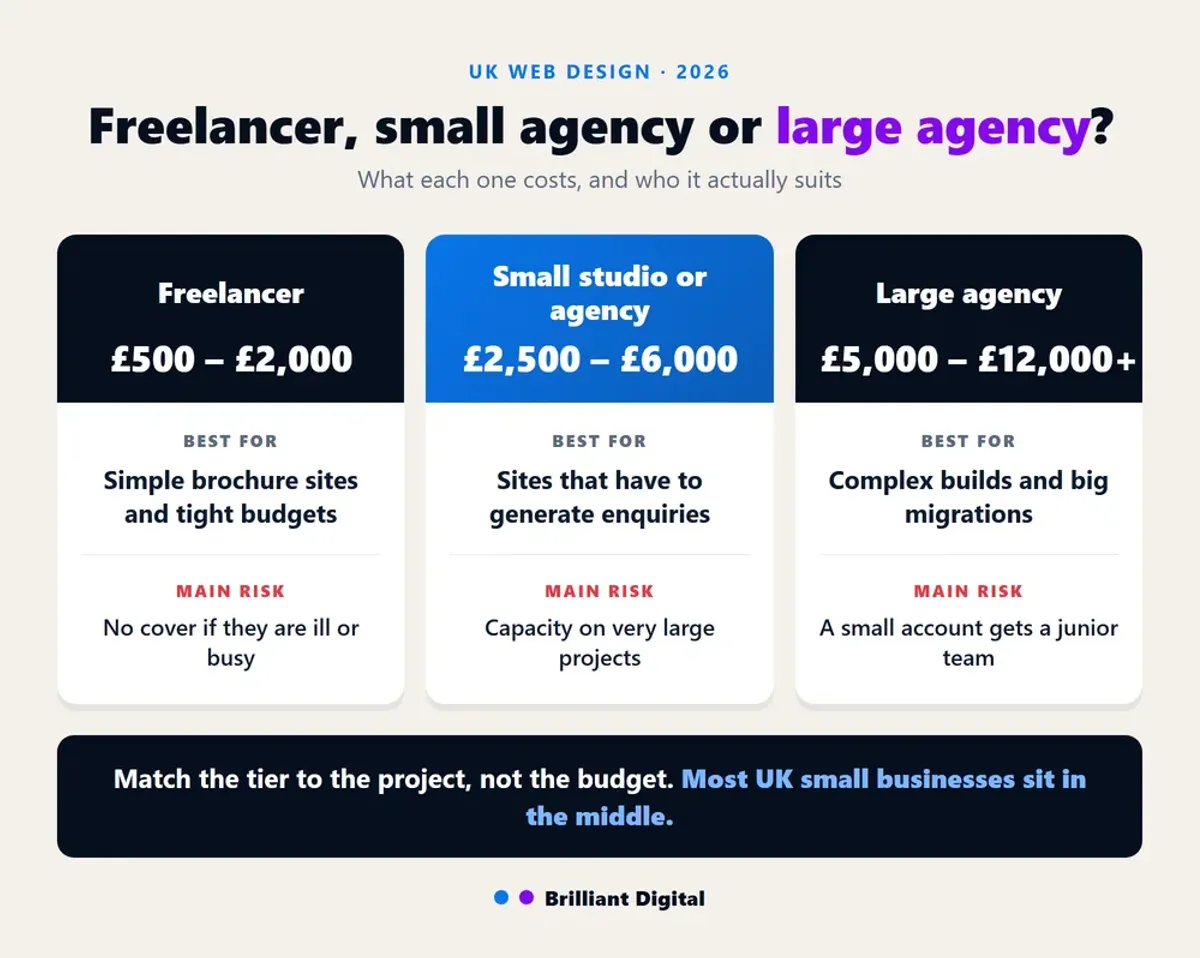
There are three types of web designer, and the right one depends entirely on the size and complexity of your project. A freelancer is the best choice for a genuinely simple website. A large agency is the right call when you have several decision-makers and complex integrations. Most UK small businesses sit in the middle.
- Freelancer, £500 to £2,000. One person and direct contact. Best for simple brochure sites, tight budgets and a clear brief. The risk is that there is no cover if they are ill, busy or move on.
- Small studio or agency, £2,500 to £6,000. A small team with design and marketing input and a defined process. Best for small businesses that need the website to actually generate enquiries. The limit is capacity on very large projects.
- Large agency, £5,000 to £12,000 or more. Full teams, specialists and structured project management. Best for complex builds, several departments and large content migrations. The risk is becoming a small account handed to a junior team.
We are the middle option, so treat what follows with appropriate suspicion.
A freelancer is genuinely the better choice if your brief is simple, your budget is under about £2,000, and you have the time to project-manage. Plenty of UK freelancers are excellent. The risk is not competence, it is continuity: if one person is your designer, developer, support desk and account manager, then a broken wrist is a stalled project. Ask what happens if they are unavailable for a month.
A large agency earns its fee when there is genuine complexity: several departments with opinions, a migration of thousands of pages, integrations with systems that will fight you. The trade-off is that you rarely speak to the people building your website, and a £6,000 project inside a £3m agency is not going to get the senior team.
The middle option exists because most small businesses need more than one person can reliably deliver and less than a large agency is set up to sell. Lower overheads, direct access to the person doing the work. At Brilliant Digital that means you talk to Alex, not an account manager.
How to Read a Portfolio Like a Buyer, Not a Critic
A portfolio tells you how a designer thinks, not just how they decorate. Do not scroll through screenshots on their website. Open the live client websites, on your phone, and use them like a customer would. That takes ten minutes and reveals more than any sales call.
Run these five checks on two or three of their recent projects:
- The five-second test. Open the homepage and count. Can you tell what the business does and who it is for within five seconds? If you cannot, neither can their customers.
- The one obvious next step. Is there a single clear action on every important page, or four competing buttons and a chat bubble?
- The phone test. Not "does it resize". Is it genuinely usable with a thumb? Are the forms bearable? Is the phone number tappable?
- The speed test. Run one of their sites through Google's PageSpeed Insights. You are not looking for a perfect score, you are looking for a disaster. A slow website costs conversions, and Core Web Vitals are a documented Google ranking factor (web.dev, Google).
- The template test. Do all their sites share the same skeleton with different colours and photos? Template work is not automatically bad, and for a small budget it is often the sensible answer. It should just be priced and described as what it is.
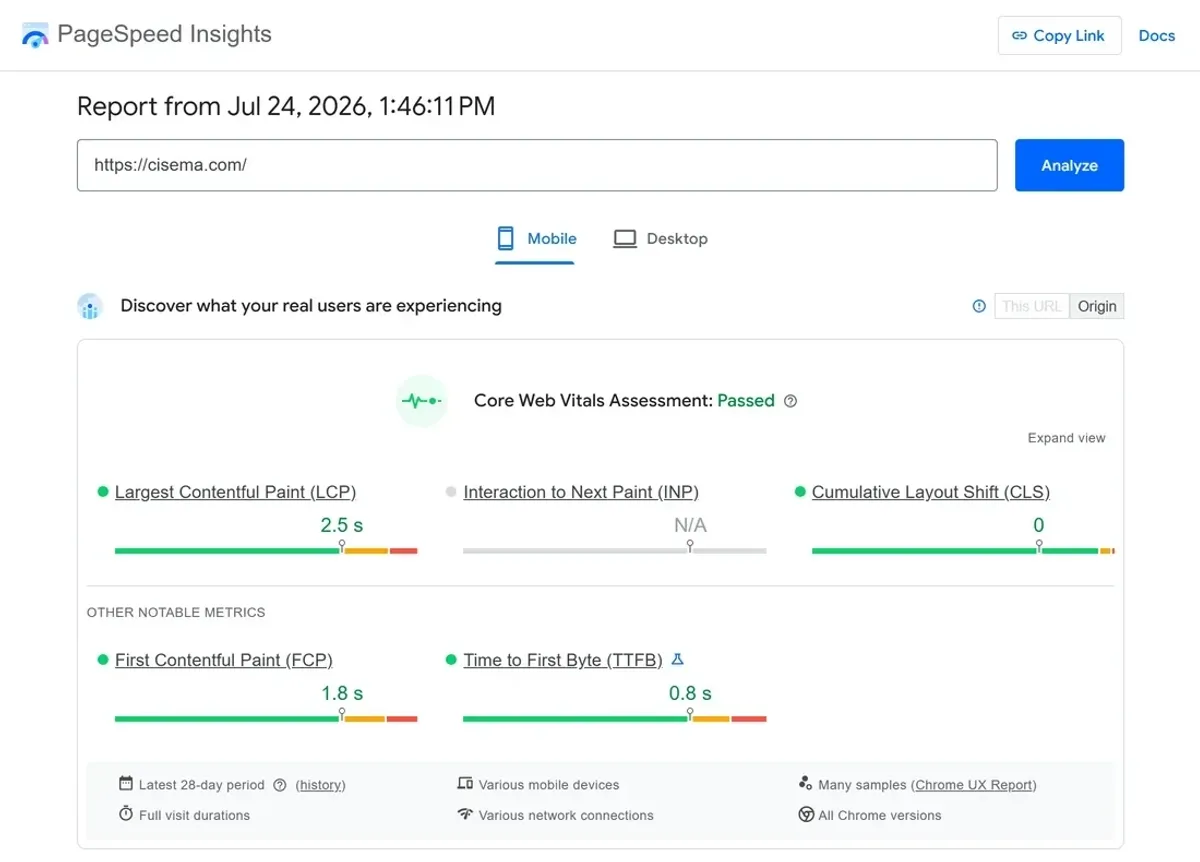
The speed test on a client site of ours. Green across the Core Web Vitals is what a well-built site looks like from the outside.
Then do the check almost nobody tells you to do. Take one of their client businesses, search for it in Google the way a customer would, using what the business does and where it is, rather than its name. If none of the websites in an agency's portfolio can be found for anything except their own brand name, then the agency builds websites that look finished but never get seen.
Ask for two or three case studies with a straight question attached: what was the client trying to achieve, what did you build, and what happened afterwards. Designers who work commercially will have an answer. Designers who work decoratively will talk about the design.
Treat testimonials on a designer's own website as a starting point, not evidence. They chose which ones to publish. Check independent sources too, Google reviews and Trustpilot, and then ask for a client reference you can actually ring. A designer with a few years of good work behind them will have someone happy to take the call.
For more on what you are actually assessing, our guide to what makes a good website breaks down the fourteen elements we check on every build.
The Questions to Ask Before You Hire
The questions below are the ones that change decisions. For each, we have included what a good answer sounds like and what should worry you, because the answer matters far more than the fact that you asked.
1. Who is actually doing the work?
Good: a named person or a small named team, with a clear answer on what is done in house and what is not. Bad: vagueness, or discovering after you sign that the build is subcontracted overseas with no overlap in working hours.
2. What is included, and what is extra?
Good: an itemised list covering design, build, content, images, testing, training and launch. Bad: a single line item and a total. Ask specifically who writes the copy. It is the most commonly assumed and most commonly missing deliverable.
3. How many rounds of revisions are included, and what counts as one?
Good: a specific number and a definition. Bad: "unlimited revisions", which is either untrue or the price of a project that never ends.
4. What do you need from me, and by when?
Good: a clear list with dates, usually content, images, logins and feedback. Bad: no answer. Most late websites are late because the client did not know what was needed. A designer who has run projects before will tell you upfront.
5. What happens if it overruns?
Good: an honest answer about the most common cause, usually content or feedback delays, and how they handle it. Bad: an assurance that it never happens. Knowing what a realistic build timeline looks like for your type of website makes it much easier to judge whether the answer you get is an honest one.
6. How do you handle mobile, speed and browser testing?
Good: specifics. Which devices, which tools, what target. Bad: "it will be responsive", which has been table stakes since about 2015.
7. What is your approach to accessibility?
Good: a reference to WCAG, the international accessibility standard, and practical examples like keyboard navigation, colour contrast and alt text. Bad: a blank look. Accessibility is a legal requirement for UK public sector websites (GOV.UK), and for private businesses the Equality Act 2010 (legislation.gov.uk) makes it a risk worth taking seriously.
8. Who will I talk to after launch, and how fast do you respond?
Good: a named contact and a stated response time. Bad: "just email the office".
9. Can I move the website elsewhere later?
Good: yes, with an explanation of what you would take with you. Bad: hesitation, or a proprietary platform you cannot leave. This one is worth asking even if you never intend to move.
10. Can I update the content myself?
Good: a live demo of the content management system, the CMS, ideally on a real client site rather than a sales video. Bad: "just send us changes and we will do them", which is a maintenance invoice wearing a helpful hat.
11. Can you show me a client of yours that ranks in Google?
Good: an example, with the search term. Bad: a portfolio of pretty sites and a change of subject.
12. What would you change about my current website first, and why?
Good: two or three specific observations that show they looked. Bad: a generic answer they could give anyone. This is the question that separates people who have thought about your business from people who have thought about your budget.
You do not need to fire all twelve at once. Questions 1, 2, 3, 9 and 12 will sort most shortlists on their own.
Not sure your current website is the problem? If you are getting traffic but no enquiries, the issue is usually the website. If you are getting neither, start with why your website might not be showing up on Google. Either way, tell us what is happening and we will give you a straight answer about which it is.
What It Should Cost in the UK, and How to Compare Quotes
A professional small business website in the UK typically costs between £2,500 and £6,000 from a small agency, £500 to £2,000 from a freelancer, and £5,000 to £12,000 or more from a mid-size agency. Hourly rates for experienced UK designers sit around £50 to £80. We have broken the full picture down in our UK web design cost guide, so this section is about the harder problem: comparing quotes.
The mistake is comparing headline prices. Two quotes at £4,000 can contain completely different projects, and you will not find out which until month three.
Make it comparable by sending every candidate the same written scope, then reading each proposal against these seven points rather than the total:
- Deliverables. How many pages, which features, what integrations, and whether content migration is included.
- Copywriting. Who writes the words. This alone can be a £1,000 swing.
- Images. Stock, supplied by you, or a photoshoot.
- Revisions. How many rounds, at what stages.
- Ownership. Covered in the next section, and it belongs on this list.
- Support after launch. Included for how long, then what.
- What triggers an extra charge. Ask directly. The answer tells you how the project will feel.
One more thing worth saying plainly. Below about £1,500, someone is either using a template with your logo dropped in, or they are undercharging and will run out of goodwill before your project finishes. Neither is dishonest, but you should know which you are buying.
Who Owns Your Website When It Is Finished
You should own everything: the domain, the website files, the content, and the admin access to every account involved. This is the most commonly skipped clause in web design contracts and the most expensive one to discover late. Get it in writing before you pay a deposit.
Here is what to check, specifically:
- The domain must be registered to you or your company, not to the agency, with you as the registrant. If your designer registered it on your behalf, ask for the registrant details in writing. This is the single most common way businesses get held hostage.
- You need admin access to hosting, not just a promise that it is handled.
- You need owner access to Google Analytics and Google Search Console, in an account you control. If these live inside the agency's account, your entire history disappears the day you leave.
- You should own the website files and any bespoke code produced for you. Third-party software the agency licenses is a fair exception, but they should name it.
- You need to know what happens if you stop paying. If the site goes offline when a monthly fee stops, that is a rental, not a purchase. Rentals are a legitimate model. Just be sure you know you are in one.
The sentence to get into the agreement is short: on final payment, the client owns the website files, all content, and the domain, and will be given administrative access to all hosting and analytics accounts.
If a designer will not agree to that, you have learned something important, and you have learned it for free.

Can They Actually Be Found? SEO and AI Search
A website that cannot be found is an expensive brochure. There are two checks worth running here, and they take about five minutes between them. One covers traditional search, the other covers the AI answers that increasingly sit above it.
The search check. Look up the designer's own website for a term they sell, not their business name. Then ask them to show you a client that ranks, and for which search. Neither result is disqualifying on its own, because plenty of good designers are too busy with client work to market themselves. But if someone is selling SEO as part of the package and cannot demonstrate it anywhere, in their own work or a client's, the SEO is a line item rather than a service.
The follow-up question matters more: at what point does SEO enter your process? If the answer is after the design is signed off, it is decoration.
Structure, page hierarchy, headings and content planning are all search decisions, and they get made during design. Google's own SEO starter guide puts site structure in the build, not the touch-up.
The AI search check. This is the one nobody is telling buyers to ask about yet. A growing share of people now get an answer from Google's AI Overviews, ChatGPT or Perplexity without ever clicking a result. That changes what a website has to do: it has to be structured so a machine can extract a clear answer from it and cite you.
Ask your designer whether they build for AI search, and what that means in practice. A real answer sounds like structured content, clear headings, direct answers to real questions, and clean technical markup. A vague answer is not a reason to walk away, but it is a gap you should know about, because the businesses filling it now will be the ones quoted in AI answers in two years.
What Happens After Launch
Launch is the middle of the project, not the end. Websites need security updates, backups, plugin maintenance if you are on WordPress, and someone to call when a form stops sending. Agree all of this before you sign, because it is the part that quietly costs the most.
Six things to pin down:
- Who fixes it when it breaks, and how you contact them.
- The response time. Same day, next working day, or best effort.
- Whether maintenance is included or is a separate retainer. UK retainers typically run £50 to £150 a month for a small business site.
- Who handles security updates and backups, and how often backups run.
- Whether you can edit content yourself, and on which content management system.
- What a small change costs once the included period ends.
This is where the platform decision comes home to roost. A WordPress site needs ongoing plugin and core updates, and the running cost is real: we broke the numbers down in the real cost of WordPress.
Modern static setups like the Astro and Cloudflare stack we moved to have close to zero hosting cost and far less to maintain. That is why we stopped using WordPress after seven years of using it.
A website you cannot update is a website that dies quietly. Not with a crash, just with an "opening hours" section that has been wrong since last Christmas.
Red Flags: When to Walk Away
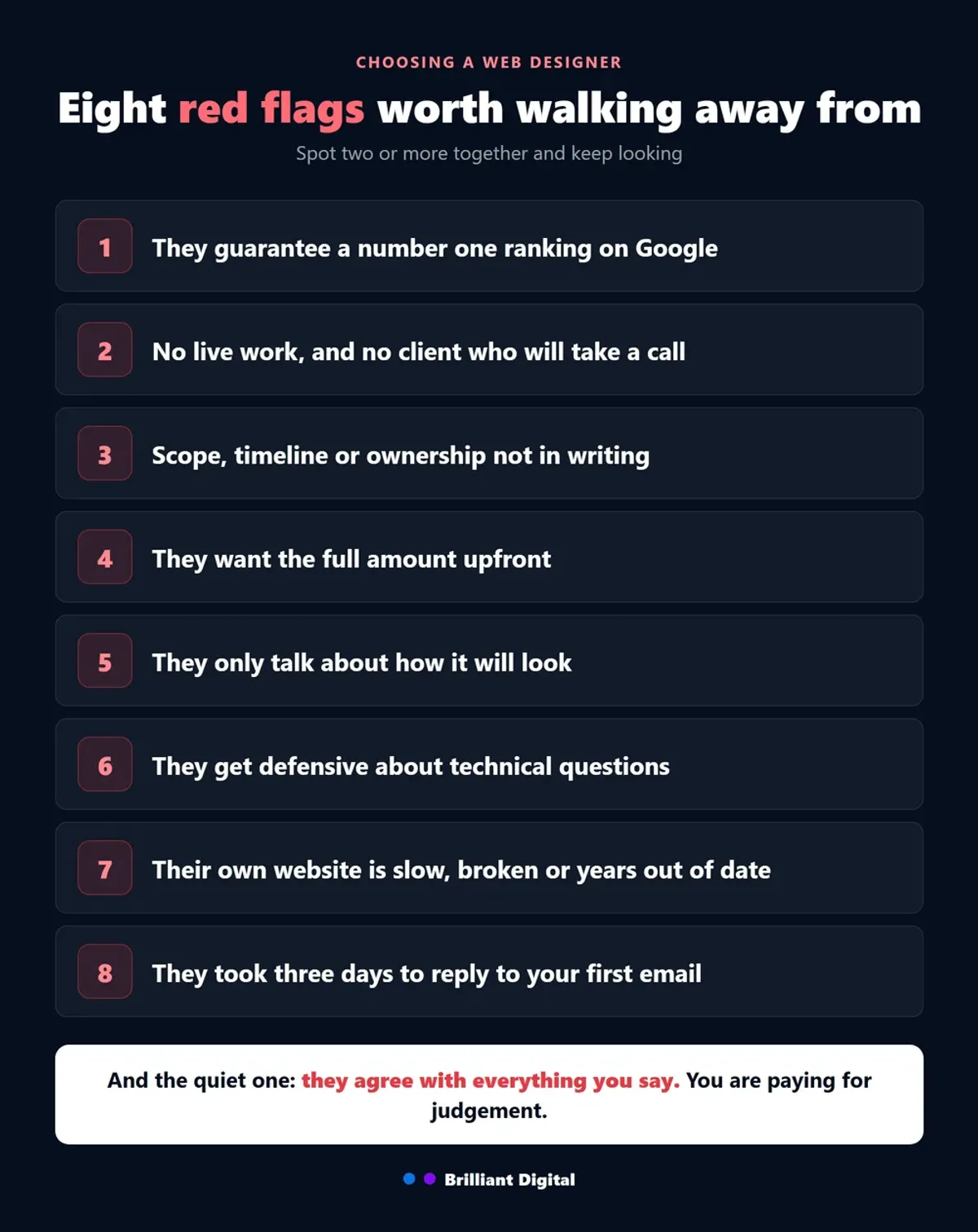
Some warning signs are worth a conversation. The eight below are worth ending one. Each of them predicts how the project will actually run, because they show you how a designer behaves while they still want your money. If you spot two or more together, keep looking.
- They guarantee a number one ranking on Google. Nobody can. Google does not sell positions and no agency controls the algorithm. This claim is the clearest possible signal that you are being sold to rather than advised.
- They will not show live work or connect you with a past client. Screenshots are not a portfolio. Three years of good work produces at least one client who will take a phone call.
- They will not put scope, timeline or ownership in writing. A verbal agreement is not a project. It is a disagreement waiting for a date.
- They want the full amount before meaningful work is delivered. Staged payments protect both sides. A deposit, a design approval payment and a launch payment is normal. One hundred per cent upfront is not.
- They only talk about how it will look. If nobody has asked what the website is for, nobody is building it for that.
- They get defensive when you ask a technical question. How they answer you now is the best available preview of how they will answer you when something goes wrong at 5pm on a Friday.
- Their own website is slow, broken or three years out of date. Cobbler's children get some grace. A broken contact form does not.
- They took three days to reply to your first email. That is their best behaviour, while they still want the work.
One more, quieter than the rest: they agree with everything you say. You are paying for judgement. A designer who never pushes back on a bad idea is not being easy to work with, they are being paid to stop caring.
When You Do Not Need a Web Designer at All
Sometimes the honest answer is that you should not hire one. If you need four pages and a contact form, your budget is a few hundred pounds, and you genuinely will not touch the site again, a website builder like Squarespace, Wix or Shopify will do the job for £12 to £45 a month. And if you run an online shop, several of the things that actually move sales are configuration and copy rather than design work.
That is a real recommendation, not a rhetorical one. A tidy £200 website that exists beats a £4,000 website you keep postponing.
Here is where the maths flips and a designer starts earning their fee:
- You need the website to bring in enquiries or sales, rather than confirm you exist.
- You need real functionality: bookings, payments, quotes, customer accounts.
- You need to rank for something competitive, where structure and speed decide the outcome.
- Your site is more than about ten pages, or will grow.
- You have tried a builder and the result does not look like a business anyone would trust with money.
The trigger is rarely the number of pages. It is the moment the website stops being an online business card and starts being a channel that has to pay for itself. Our own view on when the rebuild is justified is in when to rebrand your website.
Frequently Asked Questions
How do I find a good website designer?
Start with referrals from businesses like yours, then check portfolios by opening the live websites rather than screenshots. Shortlist three to five, send them all the same written brief, and compare their questions as closely as their quotes. The designer who asks the most about your business is usually the right one.
How much should I pay a web designer in the UK?
Expect £500 to £2,000 from a freelancer, £2,500 to £6,000 from a small agency, and £5,000 to £12,000 or more from a mid-size agency for a small business website. Hourly rates for experienced UK designers sit between £50 and £80. Anything under £1,500 is usually a template build.
Are web designers worth it?
If your website needs to generate enquiries, rank in search, or handle bookings and payments, yes. A designer earns their fee through structure, speed and conversion, not decoration. If you need four static pages and nothing more, a website builder is the more sensible spend.
What makes a good web designer?
A good web designer asks about your business before your colour preferences, can explain why they made a layout decision, builds for speed and search from the start, and puts scope, revisions and ownership in writing. Technical skill matters. Commercial judgement is what separates them.
What is the difference between a web designer and a web developer?
A web designer handles how the website looks and how people move through it: layout, branding, user experience. A web developer writes the code that makes it work, including functionality, integrations and databases. Many small agencies and freelancers do both, so ask directly which part they handle in house.
What to Do Next
You now have the checklist. Use it on us.
Open our portfolio, pick a couple of the websites, and run the five-second test, the phone test and the speed test on them. Search for one of those businesses without using its name and see what comes up. Then ask us anything from the twelve questions above, including the awkward ones about ownership and who does the work.
If you would rather just talk it through, get in touch and tell us what your business does and what you need the website to achieve. We will come back honestly about what is realistic for your budget, even if the honest answer is that you do not need us yet.
No hard sell. Just a straight conversation about what is possible. You can see how we build websites if you want the detail first.
If you are based near us, we have also written a local version of this guide for choosing a web designer in Peterborough.