On average, a small business website in the UK takes around four to eight weeks to build. A simple one-page site can be ready in a couple of weeks. A larger ecommerce or membership site can take three to five months.
That spread is not a dodge. It is the honest answer, because the type of website you need changes the number more than anything else does.
Most web designers answer this question with "it depends" and stop there. The useful version is explaining what it actually depends on, so you can work out roughly where your own project is likely to sit.
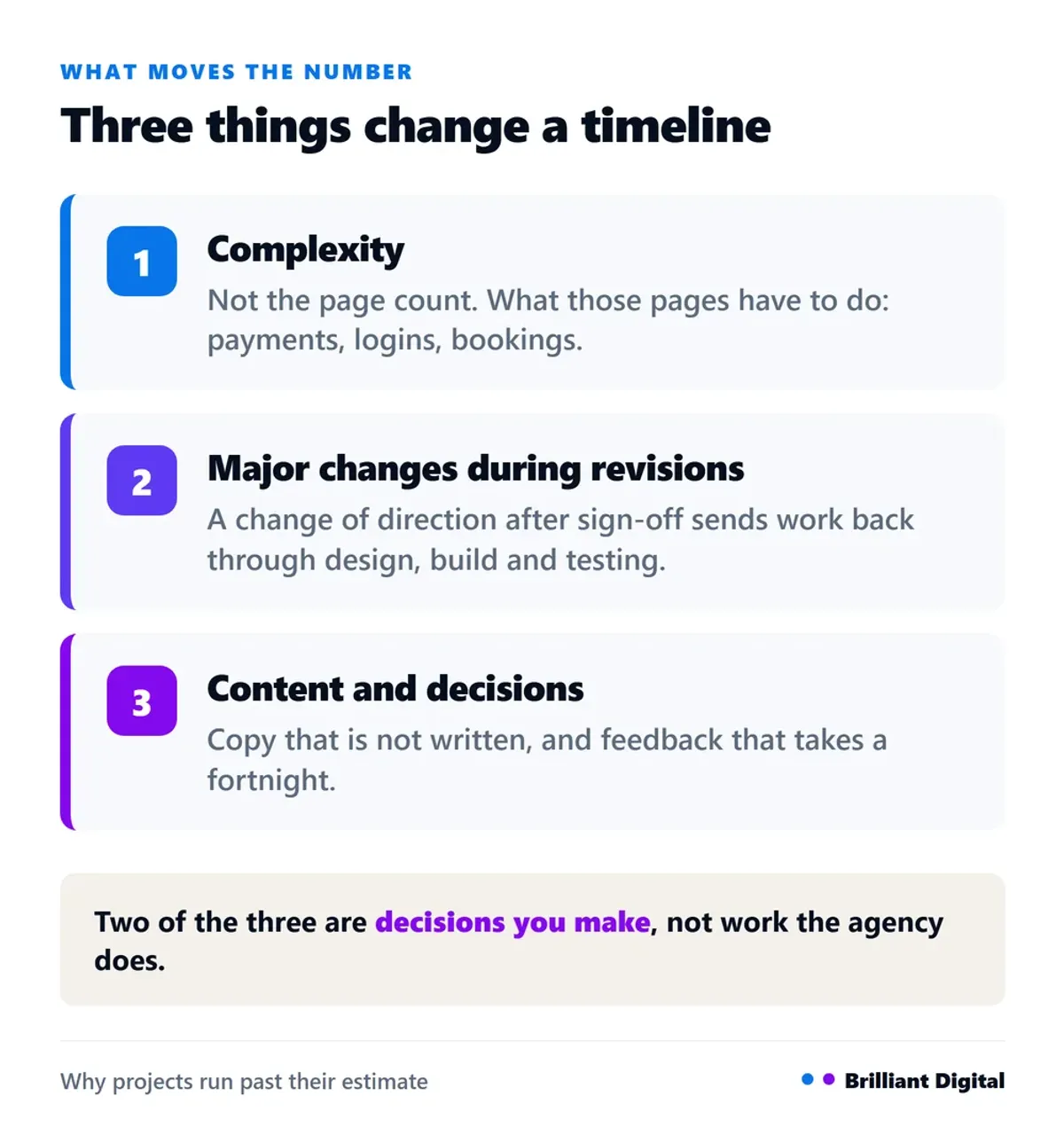
Three things move the number more than everything else: how complex the website is, how much changes once you see the designs, and how quickly content and decisions come back.
After 150+ website projects since 2014, the pattern is consistent. The build itself is reasonably predictable. What stretches a timeline is almost always something that was not agreed at the start.
Key Takeaways
- On average, a small business website takes around 4 to 8 weeks. Simple sites are quicker. Ecommerce and membership sites take considerably longer.
- The type of website matters most. A brochure site and an online shop are not the same job, and they do not run on the same clock.
- Major changes asked for during revisions are the most common reason a project runs past its estimate.
- Anything that was not planned at the start costs more time later than it would have at the beginning.
- Allow a little extra time for the UK compliance items most quotes leave out: cookie consent, privacy policy and accessibility.
How Long Does a Website Take to Build? Average Timelines by Type
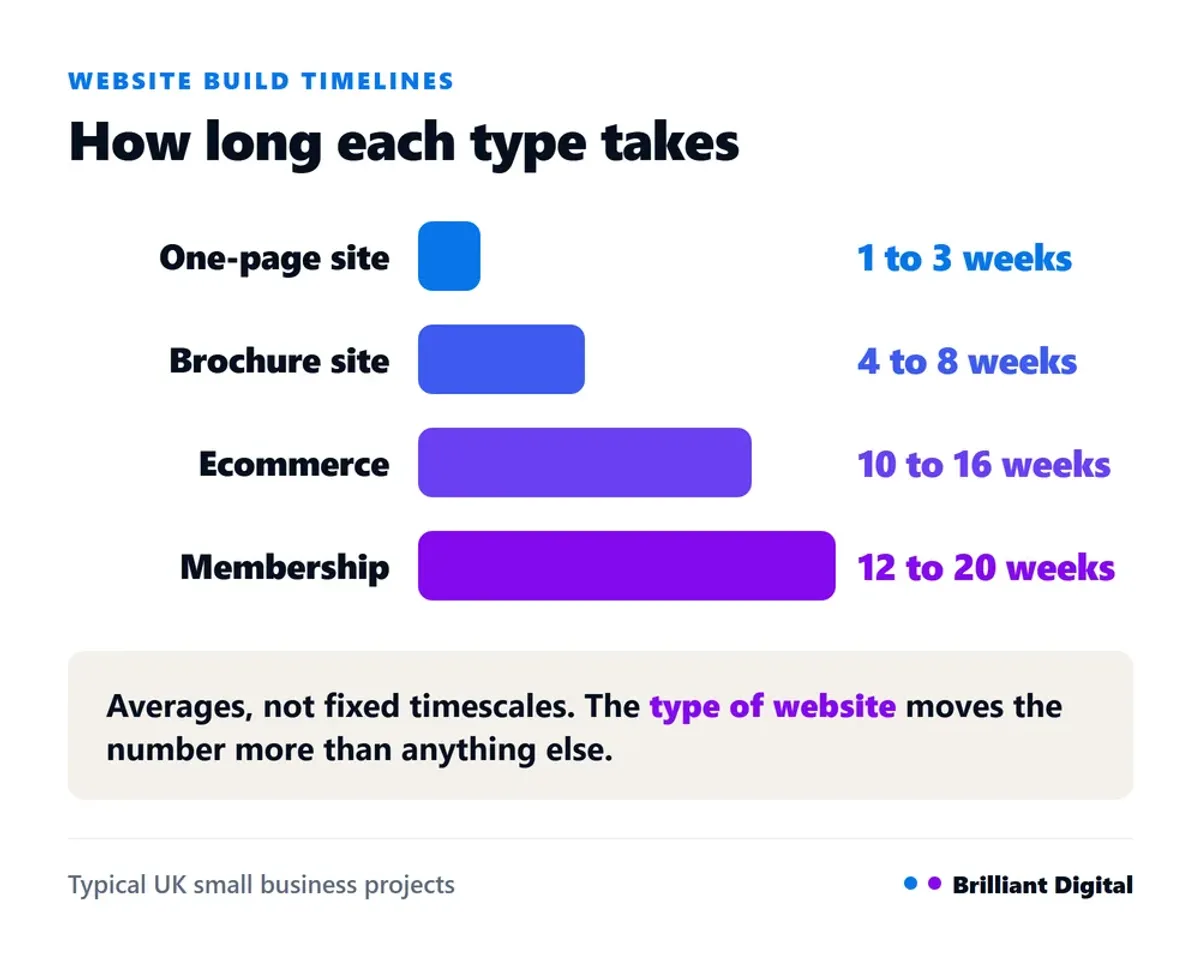
As a rough guide, a one-page site takes around 1 to 3 weeks, a brochure website of five to fifteen pages around 4 to 8 weeks, an ecommerce site around 10 to 16 weeks, and a membership or booking site around 12 to 20 weeks. These are averages rather than fixed timescales.
A brochure website is a site that presents your business, your services and your contact details, without selling anything directly online. It is what most small businesses actually need, and it is the bracket most enquiries fall into.
Here is what pushes each type towards the slow end of its range:
- One-page site: how many design rounds you want, and whether the copy is already written.
- Brochure site: the page count, and how much of the content you are writing from scratch.
- Ecommerce site: the size of your product catalogue, and payment testing.
- Membership or booking site: logins, gated content, and recurring billing.
Ecommerce and membership builds sit at the slow end for a reason worth understanding, because it is the part of a timeline that cannot be compressed. Payments and user accounts are not features you switch on. They have to be tested properly, with real transactions and real edge cases, before anyone trusts them with a card number.
What a Website Build Actually Involves
Most builds move through the same stages, and those stages overlap rather than running one after another. That is why a six-week project is not six separate weeks in sequence.
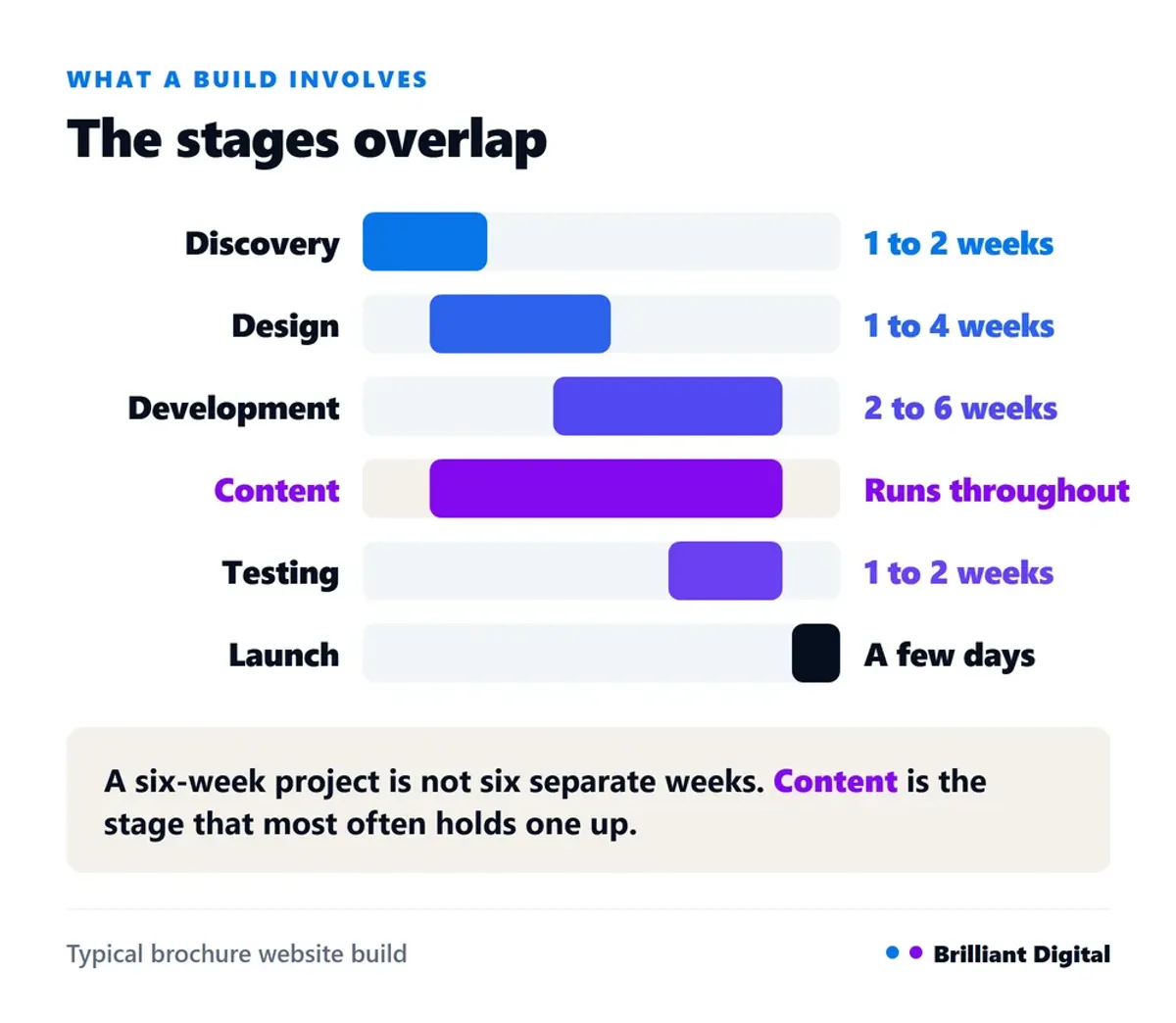
- Discovery and planning (around 1 to 2 weeks). Agreeing what the website needs to do, which pages it needs, and what it connects to. Nothing visible gets made, which is why it gets rushed, and rushing it is what produces expensive changes later on.
- Design (around 1 to 4 weeks). Rough layouts first, then full-colour designs of the real thing. The range is this wide because of revisions, not because of the design work itself.
- Development (around 2 to 6 weeks). Turning the approved designs into a working website.
- Content (runs alongside everything else). Copy, photography, product descriptions. This is the stage that most often holds a project up.
- Testing (around 1 to 2 weeks). Every page on phones, tablets and desktops. Every form actually submitted. Every link checked.
- Launch (a few days). Moving the site to your live domain, final checks, submitting your sitemap to Google (Google Search Central documents how that works), and confirming your analytics are recording.
One note on development, because it affects you long after launch rather than during the build. At Brilliant Digital we build on Astro and Sanity rather than WordPress. The difference is not really the build week. It is what happens in year two, when you want to change a page and find out whether that needs a developer.
What Changes the Timeline Most
Three things account for most of the difference between a project that lands on time and one that runs over: how complex the website is, what changes once the designs are in front of you, and how quickly content and decisions come back.
Complexity
The number of pages matters less than what those pages have to do. Ten straightforward pages are quicker than three pages with a booking system behind them.
Payments, logins, bookings and anything that connects to other software all add build time, and they add more testing time than people expect. A brochure site that goes live with a typo is embarrassing. A checkout that goes live with a bug costs you money and customers.
Major changes during revisions
Revisions are a normal part of every project and small adjustments are expected. What moves a timeline is a significant change of direction once the designs are done.
Asking for a different homepage layout in week four is not a tweak. Neither is adding a page type or a feature that was not discussed at the start. Each one sends part of the work back through design, build and testing again.
None of that means you cannot change your mind. It means changes cost more the later they arrive, which is worth knowing when you are weighing up whether something is worth changing.
Things that were not planned at the start
The other common one is work that appears mid-project. A booking system nobody mentioned. A second language. Products that need importing from an old site.
These are rarely difficult in isolation. The problem is that they arrive after the plan is set, so they either extend the timeline or push something else out.
Get everything on the table at the start, including the "we might want this eventually" items. Something planned for and not built costs nothing. Something built and then reworked costs weeks.
Content and decisions
The least glamorous one, and the most reliable. Content that is not ready, and feedback that takes a fortnight, will hold up a project that is otherwise running perfectly well.
The design can be finished and the build can be finished, and the site still sits waiting for an About page nobody has written.
Two things help more than anything else: gather your feedback into one response rather than sending it in pieces, and have one person who can give final approval.
It is also worth asking any agency you are considering how they handle changes once design has started. How they answer tells you how they actually run projects, and it is one of the more revealing questions when you are choosing a web designer.
Planning a website and want a straight answer on what yours would involve? Tell us about your business and we will come back to you honestly, including a realistic timeframe.
The UK Bits Nobody Budgets For
UK websites carry a handful of requirements that rarely appear on a quote: a privacy policy, cookie consent, accessibility, and correct company details. Together they usually add 1 to 3 days to a build, but only if someone remembers them before launch week. Discovered on the day you go live, they delay it.
One thing to be clear about first. We build websites. We are not solicitors, and none of this is legal advice. What follows is what we see take up time on a build and where the official guidance sits. If any of it applies to your business in a way you are not certain about, talk to someone qualified in this area. That is a cheap conversation compared with getting it wrong.
Cookie consent. If your website uses analytics or advertising cookies, the ICO's position is that consent is needed before those cookies are set. Their guidance on cookies and similar technologies is the source worth reading, and your own adviser is the person to confirm how it applies to you. For your timeline, the point is that a consent banner has to be chosen, installed, configured and tested. It is a task, not a tick box.
Accessibility. A website that works with a keyboard and a screen reader is worth building for any business, and there are specific accessibility regulations covering public sector bodies. The technical standard they reference is WCAG. Whether it applies to you as a legal obligation is a question for someone qualified. Building towards it anyway is a decision we would make either way, and it adds testing time.
Company details. A limited company is expected to show its registered name, company number, place of registration and registered office address on its website. The government guidance on signs, stationery and promotional material sets out what is needed. It is a footer job that takes twenty minutes, and it is the single most commonly missed item on a new business website.
The point for your timeline is straightforward: none of this is difficult, and all of it takes longer than nothing. Put it in the schedule in week one, rather than discovering it on the morning you planned to launch.
Does a Redesign Take as Long as a New Build?
A website redesign usually takes about as long as building from scratch, and occasionally longer. It still needs discovery, design, development and testing. What changes is the balance: less time producing content, more time handling everything that already exists and has to keep working.
What genuinely saves time is that your content already exists, and you have real evidence about what was not working. That makes discovery faster and design decisions easier.
What adds time, and catches people out, is everything attached to the old site:
- Mapping old URLs to new ones so your existing search rankings survive.
- Migrating content that has built up over years, some of which should not come across.
- Auditing what actually earns its place, rather than rebuilding every page because it exists.
Skip the URL mapping and you can lose rankings you spent years earning. It is the least visible part of a redesign and the most expensive to get wrong. When you reach that stage, our website launch checklist covers what to verify before going live.
Can You Go Faster? And What Would You Give Up
Yes, and the fastest honest route is a templated build with your content written before kickoff. That removes the two slowest variables in any project: design revisions and waiting for copy. A templated brochure site with content ready can realistically launch in two weeks.
What you give up is a structure designed around your business. Templates start from someone else's decisions about what matters on a page. Sometimes that is fine. Sometimes it means your best selling point ends up three scrolls down because the template put a photo gallery there.

Some things compress and some things do not:
- Compresses well: design rounds, page count, using a template instead of a bespoke structure.
- Does not compress: payment testing, user accounts, accessibility checks, proofreading.
Can a website be built in a day? Technically yes, with a builder and a template. But it will not have custom design, considered copy, or proper testing. For something representing a real business, two weeks is the honest floor.
The deeper question is usually not "how fast can this go" but "what is actually driving the number I have been quoted". That tells you whether there is genuine room to move, or whether you are being asked to cut something that matters. Our guide to how much web design costs in the UK breaks down the same trade-offs measured in pounds rather than weeks, and the two decisions are usually made together.
Frequently Asked Questions
How long does it take to build a small business website?
Most small business brochure websites take 4 to 8 weeks from kickoff to launch. The range depends on how many pages you need and how quickly your content and approvals arrive. With copy written in advance and one decision maker, the lower end is realistic.
Can a website be built in a day?
Technically yes, using a website builder and a template. It will not include custom design, properly written copy, or thorough testing. For a website that represents a real business and needs to generate enquiries, two weeks is a more honest minimum.
How much does it cost to build a website?
Cost and timeline move together: the things that add weeks usually add pounds. Prices in the UK range widely depending on page count, bespoke design and functionality. Our UK web design pricing guide breaks down what each bracket actually includes.
What usually delays a website project?
Major changes requested after the designs are approved, work that was not planned at the start, and content that is not ready. Those three account for most overruns, well ahead of anything technical. The later a change arrives, the more of the work it sends back through design, build and testing.
Does a website redesign take as long as building a new one?
Usually about the same, and sometimes longer. A redesign still needs discovery, design and testing, and it adds work a new build does not have: mapping old URLs to new ones so your search rankings survive, and migrating years of existing content that has to be audited rather than simply copied across.
How long does it take to build an ecommerce website?
An ecommerce website typically takes 10 to 16 weeks. The extra time over a brochure site goes into the product catalogue, payment integration and testing. Payment testing cannot be rushed, because a checkout bug found after launch costs sales and customer trust.
What to Do Next
If you are weighing up a new website, work out your timeline and your budget together. They are the same decision viewed from two angles, and the things that stretch one usually stretch the other.
Before you approach anyone, do the one thing that will save you the most time: write your content, or at least decide who is writing it and by when. That single step puts you ahead of most website projects.
It is also worth planning what happens after launch. A website does not generate enquiries because it exists, and the weeks straight after go-live are the ones that set the tone. Our guide to marketing a new website in its first 30 days covers what to line up before you go live, not after.
When you are ready to talk it through, tell us about your business and what you need the website to do. You can also look through our recent work to see the kind of websites we build, or read more about how we approach web design.
No lengthy proposals and no hard sell. Just a straight conversation about what is possible, and a realistic date.