In the UK, searches for "blogging for business" are down 87% on last year (DataForSEO, October 2026). Fewer people are asking the question than at any point in the last decade.
That is not the same thing as blogging stopping working. But the two get confused constantly, and the confusion is costing businesses money in both directions.
You were probably told years ago that your business needed a blog. Perhaps you wrote four posts. Perhaps nothing obvious happened, so you stopped. And now Google answers most questions at the top of the results page, ChatGPT answers them before Google gets a look in, and the whole thing feels like advice that quietly expired.
So this article does three things. It gives you the honest answer, explains what has genuinely changed, and hands you a way to test that answer against your own business. More use than another decade-old statistic.
Key Takeaways
- Interest in business blogging has collapsed, but the businesses still getting enquiries from posts written years ago have not noticed.
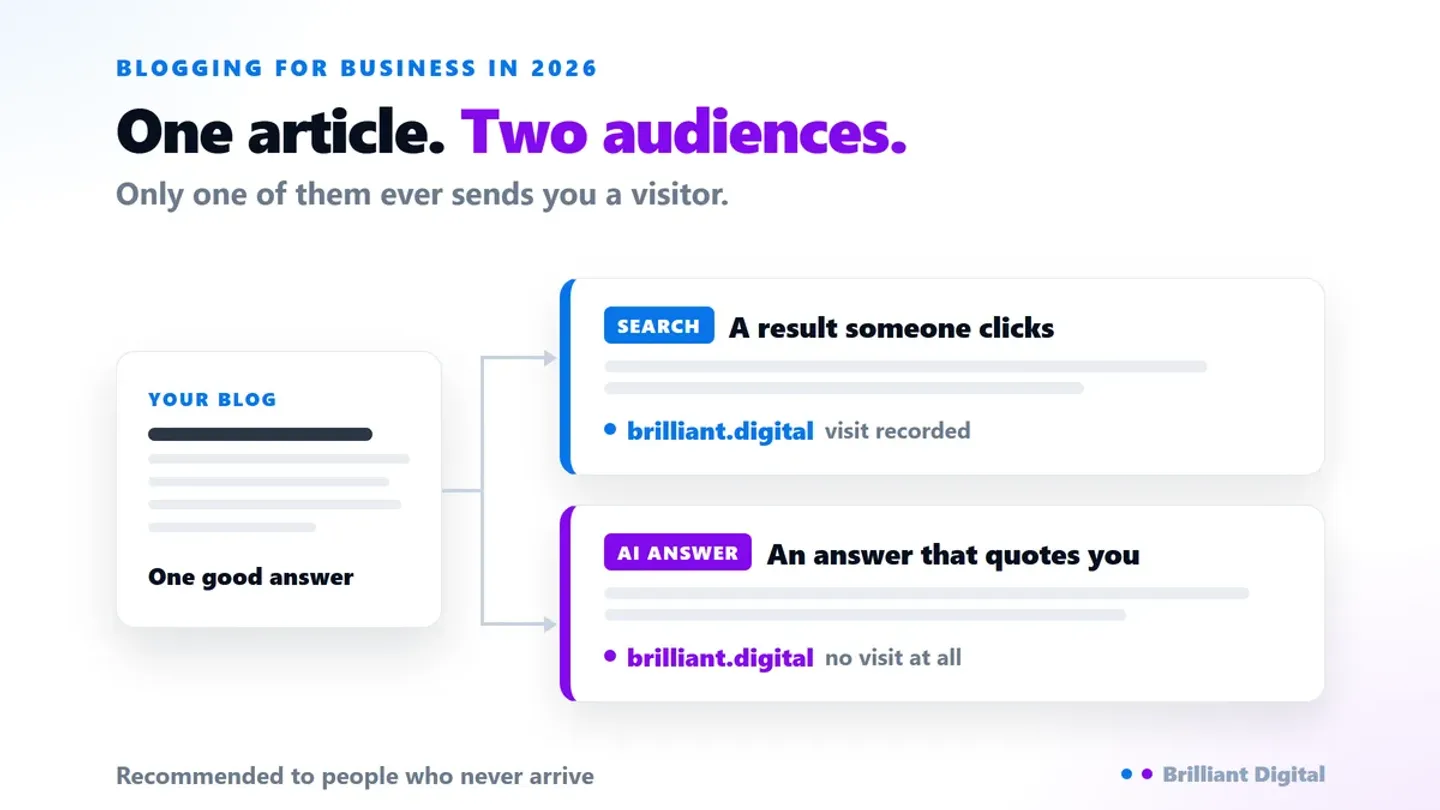
- A blog now has two audiences: Google's results, and the AI answers that sit above them. Being quoted matters as much as being clicked.
- The format that stopped working is the thin, generic benefits post. Not blogging itself.
- The most valuable article most businesses could write is the one they already write by email, over and over, several times a month.
- If you cannot publish consistently, do not start. Put the money into paid advertising and do that properly instead.
The short answer
Yes, for most small businesses blogging is still worth it, but not in the way it was sold in 2015. A business blog now earns its place by answering specific buyer questions well enough to be quoted by Google and AI assistants. It does not earn its place by publishing generic posts to fill a content calendar.
Business blogging is publishing articles on your own website that answer questions your potential customers are already asking. That definition has not changed. The standard has, sharply.
What has held up: specific, useful articles that answer a real question better than anything else available. Those still rank, still get quoted, and still bring in enquiries years later. What has not held up: posting for the sake of posting. Short, vague, me-too articles now compete with an AI answer sitting directly above them, and they lose.
The honest caveat is that the payoff is slower and far less visible than it used to be. You will see fewer clicks for the same amount of influence. The rest of this article is the evidence, including the parts that do not flatter us.
What actually changed about blogging for business
Two things changed, and only one of them gets talked about. Google now answers many questions directly on the results page, so fewer people click through. And the models behind ChatGPT, Gemini and Perplexity now read your articles and quote them in their answers, which means you can get the credit without ever getting the visit.
AI answers sit above the results. Search for almost any informational question now and you get an AI Overview before the first blue link. Google documents this behaviour directly in its guidance on AI features and your website. For a business publishing content, the practical consequence is permanent: a smaller share of searches will ever produce a click, no matter how well you rank.
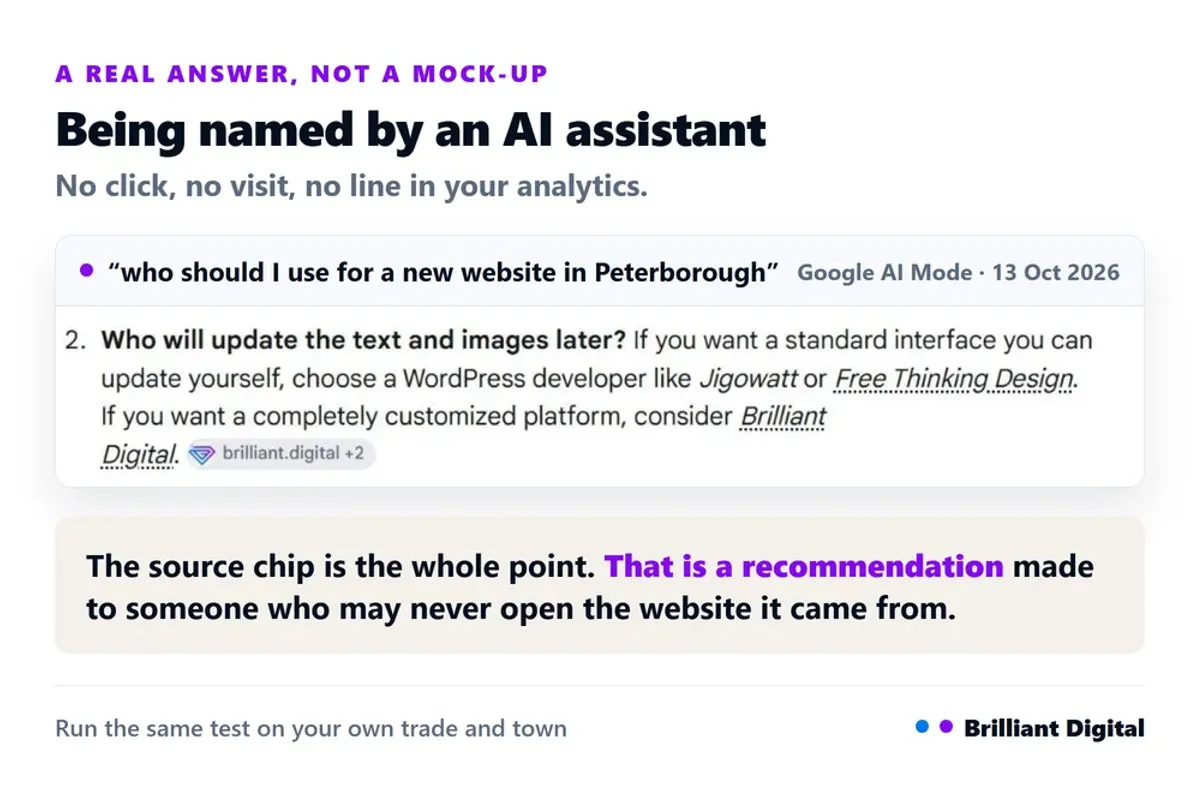
Your blog now has a second audience. An article is read by Google's crawler and by the systems that generate those AI answers. When one of them names you as the source, you have been recommended to someone who never visited your website. That is a real outcome and it is close to invisible in your analytics.
That second audience rewards a specific kind of writing: direct answers, clear structure, honest sourcing, and first-hand knowledge that could only come from someone who has actually done the work. It skips the rest.
Now the uncomfortable part.
The page you are reading replaced one of ours that failed. Until this rewrite, this URL held a 1,070-word article called "Blogging for Business? 7 Benefits You Need To Know". Seven headings, a few borrowed statistics, no first-hand evidence. It never ranked and it never brought us a single enquiry.
It was not badly written. It was generic, which is now the same thing as invisible. We rewrote it rather than quietly deleting it, because our own worst article is the most useful thing we can show you.
We have written elsewhere about why AI has not replaced web designers but has replaced the lazy ones. The same logic applies to writing. The floor came up. Average no longer clears it.
What a business blog actually does for you now
A business blog does four jobs: it gets you found for specific questions, it builds trust before anyone contacts you, it works as something you send to prospects, and it compounds in a way that paid advertising cannot. None of them are fast, and the fourth is the one that justifies the first three.
It gets you found for the specific things people ask
Not "web design". Nobody searches that with a decision in mind. The articles that work target the awkward, specific questions people genuinely type: why is my website not showing up on Google, what a redesign actually costs, how do I add my business to Google Maps.
Here is how to price that for your own business, which is more use to you than any figure of ours. Open Google's Keyword Planner, type in a question your customers actually ask you, and look at the suggested bid. That number is roughly what one click costs when you buy it. An article that ranks for the question brings the same clicks in for nothing, month after month, once written.
Do that sum before you judge a blog on traffic volume. Fifty visits a month sounds like a rounding error. Fifty clicks on a term worth a few pounds each is a line on your bank statement you would notice, and the better questions in trades like ours carry some of the most expensive clicks you can buy.
For the mechanics of finding those questions, our guides on why SEO matters for small businesses and how to increase website traffic cover the groundwork.
It does the trust work before the call
Someone who has read two of your articles arrives at the enquiry form already fairly convinced you know the job. You skip a stage of the sales conversation without doing anything.
We see this directly. Enquiries that open with a reference to something we have written are shorter, better informed, and usually competing against fewer alternatives.
It is a sales asset, not just a traffic play
This is the most underrated job a blog does, and the one that makes blogging worthwhile even for a business with almost no search audience.
A good article is something you send. A prospect asks mid-quote why your pricing is structured the way it is, and instead of writing 400 words in an email for the fifth time, you send the article. It answers the question properly, the same way every time, and it does so on your website rather than in a thread nobody keeps.
Measured purely on search traffic, an article like that can look like a failure. Measured on how many conversations it shortens, it can be the most valuable page you own.

It compounds
An article written in 2022 can still be bringing in enquiries in 2026. A Google Ad stops the day the card declines. That difference is not a matter of scale, it is a matter of kind, and it is the part most businesses abandon just before it starts working.
The catch is the timescale, and it is longer than anyone selling you content will admit. Our guide to how long SEO takes to work sets honest expectations.
Not sure whether your website is set up to publish properly, or whether blogging is even the right call for your business? [Tell us what you are trying to achieve](https://brilliant.digital/contact) and we will give you a straight answer, including if that answer is no.
When blogging is not worth it
Blogging is the wrong investment in four situations: you cannot commit to publishing, your customers genuinely do not search for what you do, you need enquiries this month, or you would be outsourcing it to someone who knows nothing about your trade. In any of those cases, paid advertising is usually the better buy.
We sell both website work and Google Ads management, so we have no reason to push the slower option.
You cannot commit to publishing. Four posts and then silence is worse than no blog at all. A blog whose most recent article is from 2023 tells every visitor that the business lost interest. If you cannot realistically produce something worth reading every month or two, skip it.

Your customers do not search for what you do. Some trades run almost entirely on referral, repeat work and Google Maps. If your enquiries come from a van livery and word of mouth, a blog is a slow answer to a problem you do not have. Local visibility is the better target.
You need enquiries this month. Blogging is a six to twelve month instrument at best. If the pipeline is empty now, content will not fix it in time. Paid advertising will. Start with our comparison of PPC versus SEO and our honest assessment of whether Google Ads are worth it for small businesses, and if you want it run properly, that is what our Google Ads management is for.
You would be outsourcing it to a stranger. Generic outsourced content, written by someone with no knowledge of your trade, is precisely the category AI has made worthless. It reads like it was assembled rather than known, because it was. If you will not supply the expertise, do not pay someone to fake it.
How much work is a business blog, really
One genuinely good article a month beats four thin ones, and a proper article takes most of a working day. Research is the bulk of that, not writing. If you already have a blog, updating an article that ranks will almost always outperform publishing a new one from scratch.
One correction first, because the article this page replaced got it wrong, and so does most advice on the subject.
Google does not reward you for updating things. The old version of this page, and the article we merged into it, both claimed that search engines favour websites that publish regularly. That is not how it works. Google's own guidance on creating helpful content is about whether content is useful to people, not how often you touch it. Changing a date and shuffling a paragraph achieves nothing.
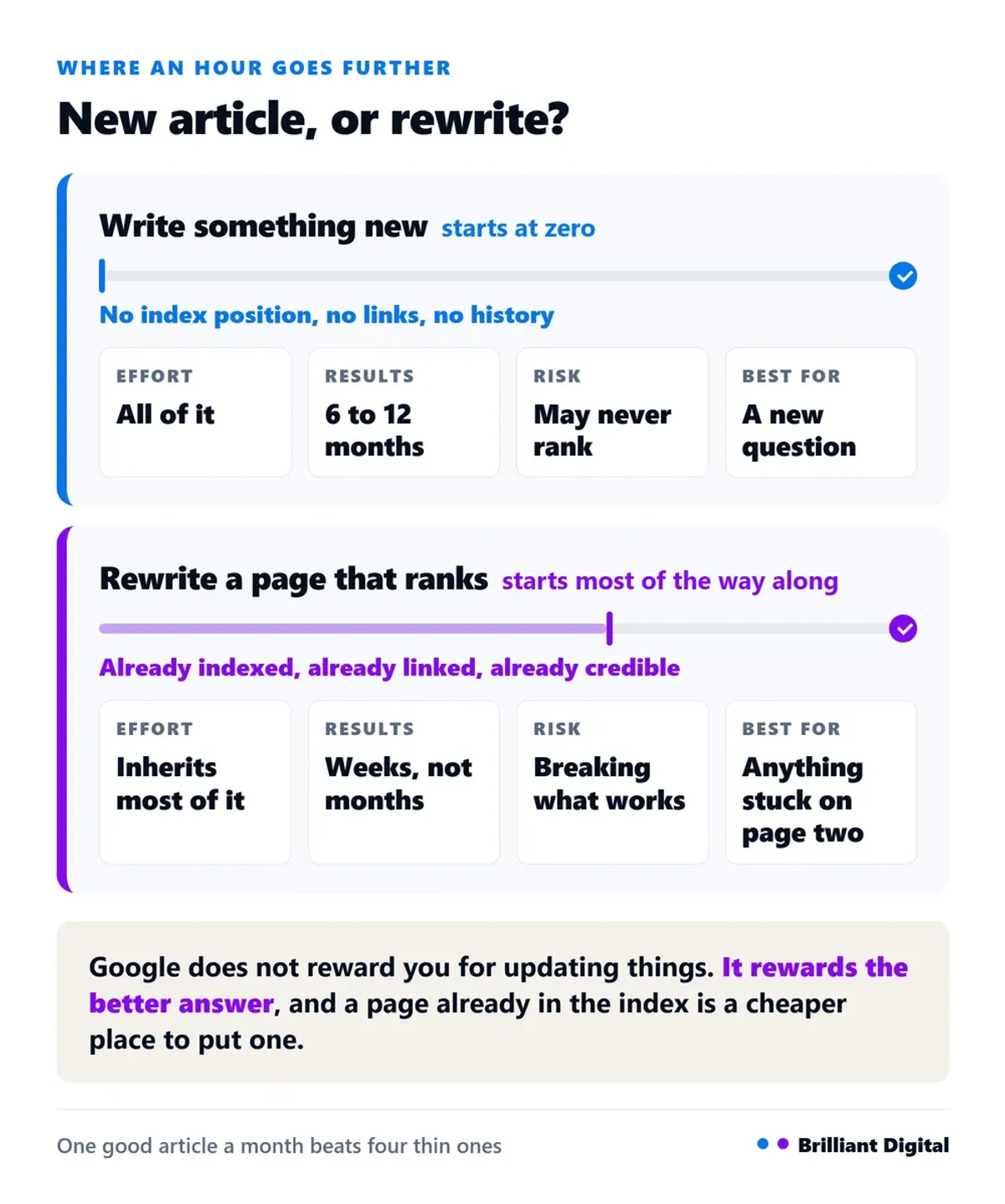
What is true is more useful: a page that already ranks is a far better place to invest an hour than a blank page. Not because of a freshness signal, but because it already holds an index position, already has whatever links it has earned, and already has some topical credibility. You are improving an asset rather than starting one.
The practical difference between the two:
- Effort. A new article means research, structure and writing from nothing. A rewrite inherits all three.
- Time to results. Six to twelve months for something new. Weeks, sometimes days, for a page already in the index.
- Main risk. A new article may never rank. A rewrite risks damaging what already works, so do not strip out whatever is earning the ranking.
- Best for. Write something new for a question you have never covered. Rewrite anything stuck on page two or three.
How to pick what to rewrite:
- Anything sitting on page two or three for a term you care about. It is close.
- Anything where the advice is now wrong. Accuracy is not optional.
- Anything you find yourself explaining to clients repeatedly. That is a sales asset you already half own.
If you want to see that difference in practice, you are reading it. The version of this page that answered no question at all sat here for two years doing nothing. Same site, same neglect, same people writing it. The only change is that this version answers something people actually type.
How to tell if your blog is working when the clicks go down
Stop judging it on traffic alone. Watch impressions and average position in Google Search Console, watch whether enquiries mention your articles, and watch whether AI assistants name your business when asked about your trade in your area. Impressions can rise while clicks fall, and that can still be a win.
Traffic was a reasonable single metric when a good ranking meant a click. If you track clicks only now, you will conclude your blog is dying at exactly the point it starts getting quoted.
Four things worth watching instead:
- Impressions and average position in Search Console. These tell you whether Google thinks you deserve to be seen, which is upstream of everything else.
- Branded searches. More people searching your business name directly is the clearest sign your content is doing its job.
- Enquiries that mention an article. Low-tech and the most reliable signal there is. Ask people how they found you and write the answer down.
- Whether AI assistants name you. This is the new one, and it is free to check.
Here is a two-minute test you can run today. Open ChatGPT, Gemini and Google's AI mode, and ask each one a question a real customer would ask about your trade in your town. Something like "who should I use for a new website in Peterborough".
See who gets named. If it is not you, you now know exactly what you are competing for, and it is not a blue link.
Then give it time. Most businesses abandon a blog at month four, which is roughly two months before anything was ever going to happen.
Frequently Asked Questions
Are blogs still worth it in 2026?
For most small businesses, yes, but only if you publish genuinely useful articles rather than generic ones. The volume of easy traffic has fallen because AI answers questions directly. The value of being the source those answers quote has gone up. Thin content is no longer worth writing.
Is blogging still effective for businesses?
It is effective at different things than it was five years ago: less as a pure traffic channel, more as a trust and sales asset. An article you can send to a prospect, that also gets quoted by AI tools, earns its keep even if its click numbers look unimpressive.
Does blogging help SEO?
Yes, but indirectly. Blogging helps because it creates pages that answer specific search queries your service pages cannot target. It does not help simply by existing or by being updated often. Google's guidance focuses on whether content genuinely helps people, not on publishing frequency or word count.
What is replacing blogging?
Nothing is replacing it, but the format has changed. Video, LinkedIn posts and newsletters all compete for the same attention. The advantage a blog article still holds is that you own it, it is permanently searchable, and it is the format AI assistants actually read and quote when answering questions.
How often should a small business blog?
Once a month is enough, provided each article is genuinely worth reading. Many businesses are better served publishing six strong articles a year and rewriting two existing ones than publishing twenty-four thin ones. Consistency matters more than volume, and quality matters more than both.
What is the 80/20 rule for blogging?
It usually means spending 20% of your effort writing and 80% promoting and improving what you have already written. For a small business the practical version is simpler: most of your results will come from a handful of your articles, so find those and make them better.
What to do next
Do not build a content calendar. Almost nobody follows one, and an abandoned calendar is how most business blogs die.
Do this instead. Write down the three questions customers ask you most often, the ones you answer by email over and over. Pick the one you are most tired of explaining, write it properly, and put it on your website.
That single article will teach you more than any amount of strategy. If it earns its keep, write the second one, and our guide to building a content marketing strategy for a small business covers the process from there.
If the real problem is that publishing on your current website is a fight, that is common and fixable. We have built over 150 websites since 2014, and we set them up so adding an article takes minutes rather than a support ticket. Have a look at what we do with websites, or just tell us what you are trying to achieve. No hard sell, and we will say so if blogging is the wrong answer for you.