Every week, a business owner comes to us having spent thousands on Google Ads with nothing to show for it. And every week, a different business owner tells us Google Ads transformed their enquiry pipeline.
Both are telling the truth.
The honest answer to "are Google Ads worth it?" is that it depends entirely on your situation. Not in the vague, unhelpful way that phrase usually gets used. There are specific factors that determine whether Google Ads will generate a strong return for your business, or drain your budget while your phone stays quiet.
We manage Google Ads for UK businesses across multiple sectors: tradespeople, professional services, healthcare, hospitality, and more. We have seen campaigns generate hundreds of qualified enquiries a month. We have also audited campaigns where every penny was being wasted. In this guide, we will give you the honest picture.
Are Google Ads worth it for most UK small businesses? Yes, provided there is genuine search demand for your services, your budget can sustain at least 60 to 90 days of learning, and your website is set up to convert visitors into enquiries. They are not worth it if your cost per click is too high relative to your margins, or if you have no way to convert the traffic you are paying for.
Key Takeaways
- Google Ads work best when there is clear, measurable demand for your services in your area. If people are not searching for what you offer, ads will not create that demand.
- UK cost per click ranges from under £1 for local tradespeople to £30 or more for solicitors and financial advisors. Budget needs to reflect this reality.
- The biggest reason campaigns fail is not Google Ads itself. It is poor keyword targeting, no negative keywords, and landing pages that do not convert.
- A minimum meaningful budget for most UK service businesses is £500 to £1,000 per month. Below that, you will rarely generate enough data to optimise the campaign.
- Google Ads and SEO serve different purposes. For most small businesses, running both together produces better results than either alone.
How Google Ads Actually Work
Google Ads runs on a pay-per-click model. You pay only when someone clicks your ad, not when it is shown.
You choose the keywords you want to appear for. When someone searches one of those terms, your ad enters an auction with every other advertiser targeting the same keyword. The winner is not simply the highest bidder. Google uses a Quality Score, which combines your bid, the relevance of your ad, and the quality of your landing page. A well-structured campaign from a smaller advertiser can outrank a larger competitor spending more carelessly.
Your ads appear at the top and bottom of the search results page, labelled as sponsored. You set a daily budget and a maximum cost per click (CPC). When that daily budget runs out, your ads stop showing until the next day.
This is pay-per-click advertising at its most direct: you target people actively searching for what you sell, you control exactly how much you spend, and you can track precisely which clicks turn into enquiries.
The model sounds straightforward. Running it well is not. The auction is competitive, keyword targeting is nuanced, and Google's automated bidding strategies require data to function properly. A campaign that is left to run without active management will almost always deteriorate over time. If you are new to the platform, our beginner's guide to Google Ads walks through account setup, campaign types and keyword match types step by step.
The Case For: What Google Ads Do Well
When Google Ads work, they work quickly. Unlike SEO, which typically takes three to six months to show meaningful results, a well-structured campaign can generate enquiries within days of going live.
The intent targeting is the core advantage. Someone who types "emergency boiler repair Manchester" is not browsing. They have a problem, they need it solved today, and they are ready to speak to someone. That search intent is genuinely valuable, and Google Ads puts your business directly in front of that person at exactly the right moment.
The other major advantage is measurability. Every click, every call, every form submission can be tracked back to the keyword that triggered it. You can see your cost per enquiry, your conversion rate, and which campaigns are driving results. That kind of visibility is extremely difficult to achieve through most other marketing channels.
Budget control is equally important for small businesses. You decide how much to spend per day. You can pause the campaign immediately. You can increase budget during your busy season and reduce it in quieter months. There is no contractual commitment to spending a minimum amount.
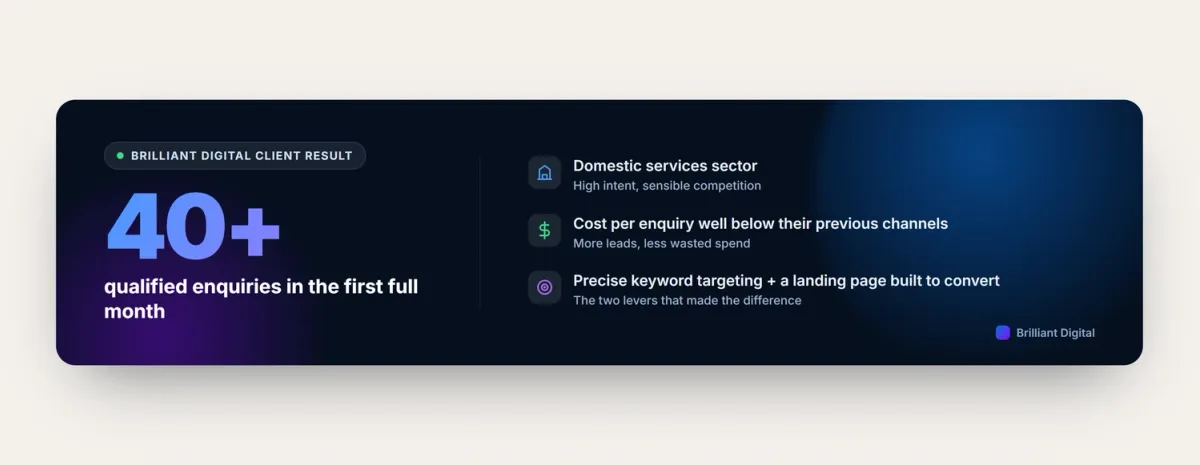
For clients we manage at Brilliant Digital, the strongest results consistently come from businesses in sectors with high intent and relatively low competition: specialist tradespeople, niche professional services, local health practitioners. One of our clients in the domestic services sector generated over 40 qualified enquiries in their first full month, at a cost per enquiry well below what they had been paying through other channels. The combination of precise keyword targeting and a well-optimised landing page made the difference.
The Case Against: When Google Ads Waste Budget
This is the section most Google Ads agencies will not write. But if you are going to make an informed decision, you need to understand when the model breaks down.
The most common failure mode is high cost per click in competitive industries. In sectors like financial services, personal injury law, and private healthcare, CPCs of £20 to £50 per click are not unusual. At £30 per click with a 5% conversion rate on your landing page, you are paying £600 for every enquiry. If your average client is worth £500, you are losing money on every lead.
The learning period is a real cost that most business owners underestimate. Google's automated bidding algorithms need data to function. A new campaign typically requires at least 30 to 60 days and a meaningful number of clicks before the system starts to optimise effectively. During that period, you are essentially paying for Google to learn your market. That is a legitimate cost of entry, but it means launching with a very small budget often means the campaign never gathers enough data to improve.
Landing pages are where the most money is silently wasted. We see this regularly when auditing new client accounts: the ads are set up reasonably well, the keywords are targeted correctly, but the landing page is the main business website with no clear call to action, slow load times, and content that is not specific to the service being advertised. You can have a strong ad with a high click-through rate and still generate almost no enquiries if the page people land on does not convert.
Other situations where Google Ads rarely work well: businesses selling a product or service with no established search demand, very low-margin offers where the numbers do not work even with strong conversion rates, and highly seasonal businesses launching campaigns without enough lead time to build performance before their busy period.
Are Google Ads Worth It for Small Businesses Specifically?
The "level playing field" claim you sometimes hear about Google Ads is only partially true.
Large competitors with dedicated Google Ads teams and substantial budgets can and do outbid smaller businesses on broad competitive terms. Searching for "solicitor London" or "accountant Birmingham" will typically surface national firms with mature campaigns and high Quality Scores.
Where small businesses genuinely can compete is on specificity. Niche local searches, specific service types, and long-tail keywords are often far less contested. "Retained employment solicitor Cheltenham" or "Invisalign dentist Norwich" will have significantly lower CPCs than the generic category terms, and the searcher intent is far stronger.
The budget minimum matters here. For most service businesses in the UK, £500 per month is the floor at which a campaign can generate useful data. Below that, you may get a handful of clicks per day, which is not enough volume to test, learn, and optimise. In higher-competition sectors, £1,000 to £2,000 per month is more realistic as a starting point.
It is also worth knowing about Local Services Ads, which Google offers as a separate product from standard pay-per-click. For tradespeople and local service businesses (plumbers, electricians, cleaners, locksmiths), Local Services Ads charge per verified lead rather than per click, and carry a Google-guaranteed badge. For the right businesses, they can deliver better value than standard campaigns.
How to Know If Google Ads Are Right for Your Business
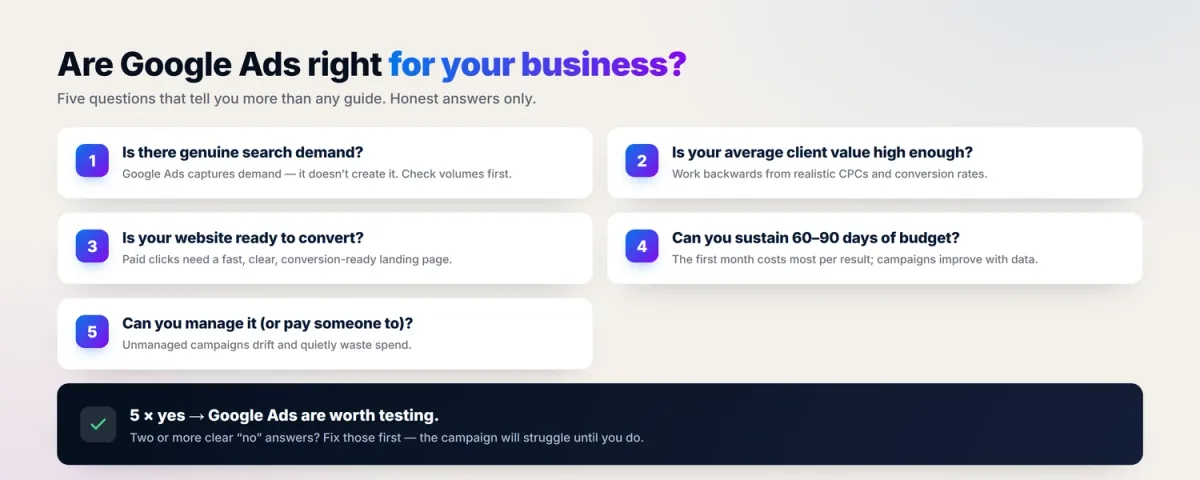
Rather than a general answer, here are five questions that will tell you more than any guide can.
1. Is there genuine search demand for what you offer?
Use Google Keyword Planner to check monthly search volumes for your core services in your area. If total monthly searches are below a few hundred, you may not generate enough volume to run a viable campaign. Google Ads does not create demand. It captures it.
2. Is your average client or job value high enough?
Work backwards from realistic CPCs in your sector and a reasonable conversion rate. If your average client is worth £2,000 and your cost per enquiry is likely to be £50 to £100, the maths work. If your average sale is £80 and your CPC is £5, they probably do not.
3. Is your website ready to convert?
This is the question most business owners skip. A Google Ads campaign sends paid traffic to a landing page. If that page is slow, unclear, or does not have a compelling call to action, you are paying for clicks that go nowhere. Before spending money on ads, make sure you have web design that converts. It is the most important factor in determining your cost per enquiry.
4. Can you sustain at least 60 to 90 days of consistent budget?
The first month of any campaign is the most expensive per result. Campaigns improve as they gather data. If you are likely to pause after four weeks because results are not yet strong, you will pay the setup cost without getting to the payoff.
5. Can you actively manage the campaign, or budget for management?
Campaigns left to run unmanaged deteriorate. Broad match keywords expand into irrelevant territory. Bids become inefficient. Competitors adjust their strategies and your position shifts. Active management is not optional if you want consistent performance.
If you can say yes to all five, Google Ads are likely worth testing for your business. If you have two or more clear no answers, address those first. Once you have decided to test it, our guide to paid advertising for UK small businesses covers which campaign type to start with and why running four at once is the most expensive beginner mistake.
What Does It Actually Cost? UK Benchmarks by Industry
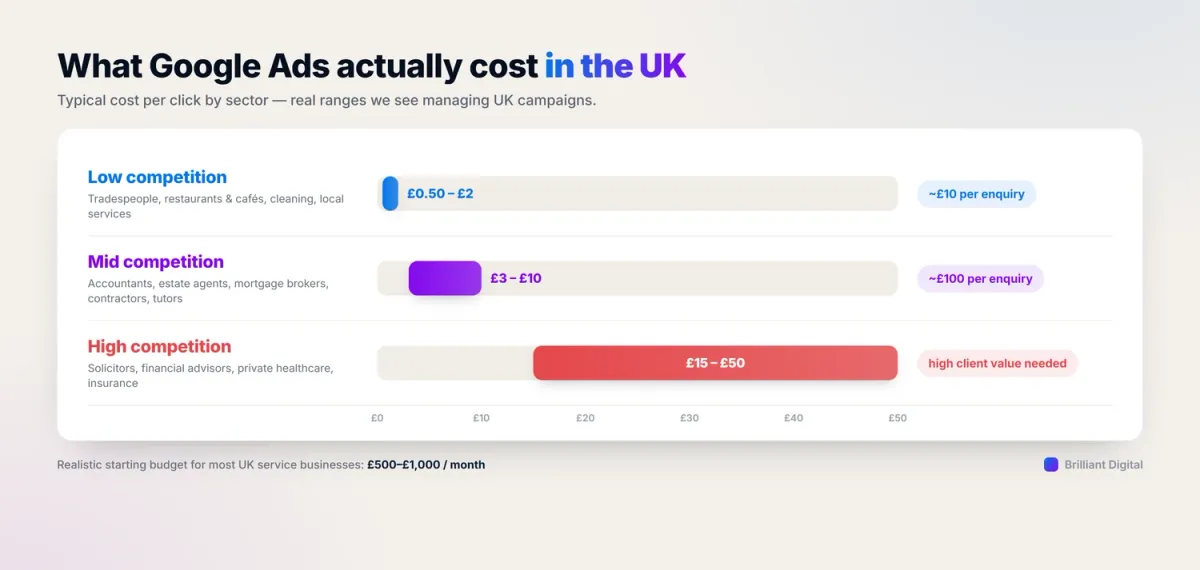
One of the most frustrating gaps in most content on this topic is the reliance on US dollar figures. Here are realistic UK cost per click ranges based on what we see managing campaigns across UK sectors.
Low competition (£0.50 to £2.00 per click)
Local tradespeople, restaurants, cafes, cleaning services, non-specialist local services. At £1 per click with a 10% landing page conversion rate, your cost per enquiry is £10. These are often the most straightforward campaigns to run profitably.
Mid competition (£3 to £10 per click)
Accountants, estate agents, mortgage brokers, marketing agencies, general contractors, private tutors. At £5 per click with a 5% conversion rate, your cost per enquiry is £100. The maths still work if your services carry sufficient value.
High competition (£15 to £50 per click)
Solicitors, financial advisors, private healthcare, insurance, personal injury claims, rehab and addiction services. These sectors require either very high client values or very high conversion rates to generate a positive return. Many small businesses in these sectors are better served by SEO and content marketing as their primary channel, with paid advertising playing a supporting role.
For a realistic budget starting point: most UK service businesses need £500 to £1,000 per month to generate meaningful data and results. That figure covers your click costs and leaves enough volume to test and improve. Adding professional management costs on top of that is worth factoring in if you are not running the campaigns yourself.
For a deeper breakdown of how to improve your Google Ads campaign once it is running, we have a separate guide covering the core levers you can pull.
Google Ads vs SEO vs Facebook Ads
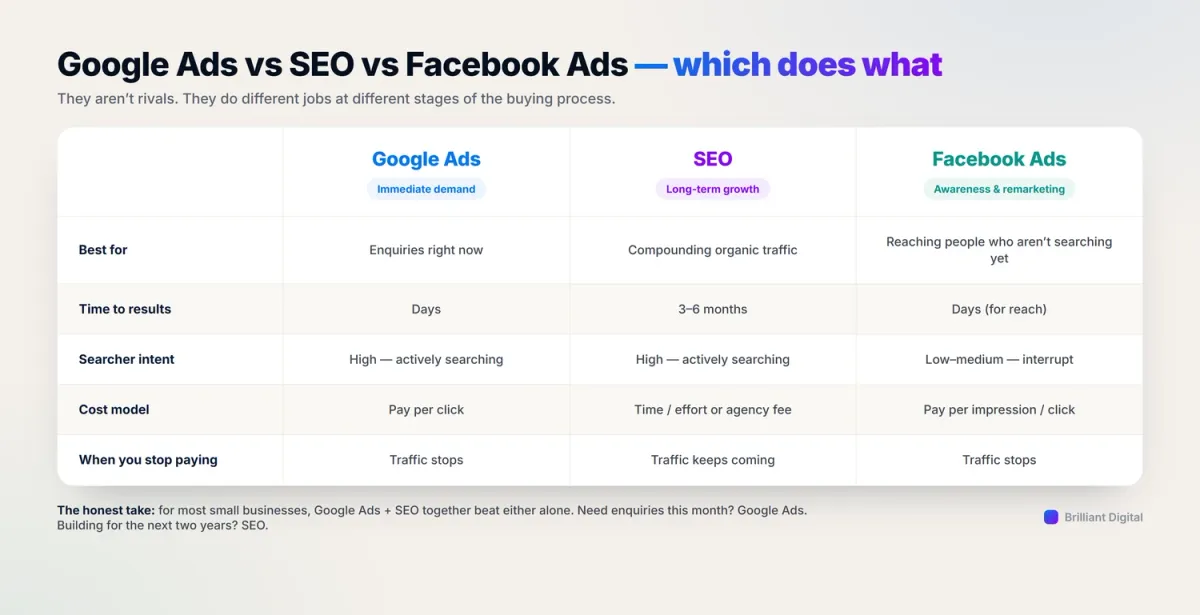
These three channels are often compared as if you have to pick one. In practice, they serve different purposes and different stages of the buying process.
The honest recommendation: for most small businesses, Google Ads and SEO together outperform either alone. Google Ads gives you immediate visibility while your SEO builds. SEO eventually reduces your dependence on paid traffic. Facebook Ads are most useful for awareness campaigns, specific offers, and remarketing to people who have already visited your website.
If you only have budget for one, the choice depends on your timescales. Need enquiries this month? Google Ads. Building for the next two years? SEO should be the foundation. We compare the two channels in depth — real costs, timelines and ROI — in our PPC vs SEO guide.
Common Mistakes That Waste Google Ads Budget
This is where we see most of the damage when we audit accounts for new clients. The ads are usually not the problem. The structure and management is.
Mistake 1: Not doing proper keyword research
The most expensive keywords are not always the most valuable. Broad terms like "accountant" or "plumber" attract searchers at every stage, many of whom are researching, not buying. Specific long-tail keywords, such as "self-assessment tax return accountant Bristol" or "24-hour emergency plumber Leeds", often have lower CPCs and much higher conversion rates because the intent is explicit. We constantly see businesses bidding aggressively on head terms while ignoring the long-tail terms that would convert far better for less money.
Mistake 2: Not using negative keywords
Negative keywords are the terms you tell Google you do not want to appear for. Without a comprehensive negative keyword list, your ads will show for irrelevant searches and you will pay for clicks that have no chance of converting. A solicitor bidding on "legal advice" without negatives will show up for "free legal advice", "legal advice Reddit", "legal advice for landlords" (if they only work with tenants), and hundreds of other irrelevant variants. We have audited accounts where 30 to 40% of spend was going to searches with zero conversion intent, purely because no negative keywords had been set up.
Mistake 3: Not tracking conversions
If you do not know which clicks turn into enquiries, you cannot optimise the campaign. You are flying blind. Google Ads has built-in conversion tracking that connects ad clicks to form submissions, phone calls, and other actions on your website. Setting up conversion tracking correctly is not optional. Without it, Google's automated bidding has nothing to optimise towards, and you have no way to know whether the campaign is working.
Mistake 4: Not actively managing the campaign
A Google Ads campaign is not a set-and-forget tool. Keywords drift. Competitors change their bids. Your quality scores fluctuate. Google rolls out new match type behaviours and automated features that need to be reviewed. We review client accounts weekly at minimum: checking search term reports for wasteful queries, adjusting bids on underperforming keywords, testing new ad copy, and monitoring conversion rates. Campaigns managed this way consistently outperform those that are left to run unattended.

Frequently Asked Questions
Are Google Ads worth it for small businesses?
Yes, in most cases, provided the fundamentals are in place: search demand exists for your services, your budget can sustain a proper learning period, and your landing page is set up to convert. The failure rate for Google Ads is high, but most failures are avoidable with better setup and management.
How much should I budget for Google Ads in the UK?
For most UK service businesses, £500 to £1,000 per month is the minimum for a campaign that generates useful data. In highly competitive sectors (legal, financial, healthcare), £1,500 to £2,500 per month is more realistic. Below £500 per month, most campaigns do not generate enough click volume to optimise effectively.
How long does it take to see results from Google Ads?
You can receive your first enquiries within days of launching. But meaningful, optimised results typically take 60 to 90 days. The first month is the most expensive per result because the campaign is still learning. Performance tends to improve consistently from month two onwards, assuming active management.
Can I manage Google Ads myself, or do I need an agency?
You can manage Google Ads yourself if you are prepared to invest time in learning the platform properly. The interface is accessible, but the strategy behind keyword selection, bidding, and ongoing optimisation takes experience to get right. Many business owners find that the time cost and the learning curve makes professional Google Ads management worthwhile. The key question is whether your time is better spent running your business or managing your campaigns.
When are Google Ads NOT worth it?
When there is insufficient search demand for your services. When your cost per click is so high relative to your margins that the maths cannot work even with strong conversion rates. When your landing page is not ready to convert visitors. When your budget is too small to generate meaningful data. And when you do not have the time or resource to manage the campaign actively.
Are Google Ads better than Facebook Ads?
For most service businesses seeking direct enquiries, yes. Google Ads targets people who are actively searching for your service. Facebook Ads reach people based on demographics and interests, which means you are interrupting someone who may or may not need you right now. Google Ads typically delivers higher purchase intent and a shorter sales cycle. Facebook Ads are more effective for brand awareness, specific offers, and remarketing.
Ready to Find Out if Google Ads Are Right for You?
If you have read this far and you are still not sure whether Google Ads are the right move for your business, that is exactly the conversation we can help with.
We manage Google Ads for UK businesses across a range of sectors. Whether you have a campaign that is not delivering, or you are starting from scratch and want an honest assessment before committing budget, get in touch. No obligation, no hard sell. Just a straight conversation about what is possible for your business.