You have a limited budget. You need your business to show up on Google. And you keep hearing two things: “you should be running Google Ads” and “you need to invest in SEO.”
Both cost real money. Both take genuine effort. And if you pick the wrong one for where you are right now, you waste time and budget getting to the same place you started.
This guide is written from an unusual position. Brilliant Digital manages Google Ads campaigns for clients AND builds SEO-driven websites and content. We have no commercial reason to push you towards one or the other. What we have is direct experience of what works, when, and for which types of businesses.
Here is the honest answer to the PPC vs SEO question, based on real numbers, real results, and more than a decade of working with small businesses across the UK.
Key Takeaways
- PPC (pay-per-click) delivers immediate visibility through paid ads. You pay each time someone clicks. Stop paying, and the traffic stops too.
- SEO (search engine optimisation) earns organic traffic through content and technical work over time. It takes longer but compounds.
- PPC gets you results in days. SEO typically takes 3 to 12 months to show meaningful movement.
- SEO has a lower cost per enquiry over the long term. PPC costs more per click but starts working immediately.
- Most small businesses benefit from both. The right starting point depends on your budget, timeline, and what you are selling.
- PPC conversion data (which keywords generate actual enquiries) is one of the most useful inputs you can give your SEO strategy.

What Is PPC? Pay-Per-Click Explained
PPC, or pay-per-click, is a form of paid search advertising where your ads appear at the top of Google results and you pay a fee each time someone clicks. The most common platform is Google Ads. You bid on specific keywords, set a daily budget, and your ads show when people search for those terms. The cost per click varies by industry and competition.
How it actually works in practice
Google Ads runs on an auction system. Every time someone searches a keyword you have bid on, Google runs a near-instant auction to decide which ads appear and in what order. Your position is not just determined by the highest bid. Google factors in your Quality Score, which combines your expected click-through rate, ad relevance, and landing page experience. A well-optimised ad from a smaller budget can outrank a lazy campaign with a bigger spend.
Typical UK ad spend for small businesses ranges from £500 to £2,000 per month, depending on the industry and the competitiveness of the keywords targeted. On top of that, if you use an agency or freelancer to manage the campaign, you will pay a management fee of £300 to £800 per month.
The most important thing to understand about PPC: the day you stop paying, the traffic stops. There is no residual effect. If your account runs out of budget, your ads disappear from the results page immediately.
What Is SEO? Search Engine Optimisation Explained
SEO, or search engine optimisation, is the process of improving your website so it ranks higher in Google's organic (unpaid) results for the keywords your customers are searching for. It involves technical improvements to your site, creating well-structured content, and building the credibility that Google rewards with higher rankings.
What SEO actually costs
The investment is largely time and expertise rather than a media spend. If you do it yourself, expect to commit 10 to 20 hours a month to writing content, technical checks, and keyword research. Hiring a freelance SEO consultant typically costs £500 to £1,500 per month. A specialist SEO agency charges £800 to £3,000 per month, depending on the scope of work.
There is no direct payment to Google for SEO. Your website itself is part of the investment, and how much a website costs varies depending on what you need. But the time investment is real. And the timeline is honest: most websites see their first meaningful movement after 3 to 6 months. Consistent, reliable organic traffic typically comes after 6 to 12 months of sustained work.
Ranking in Google does not mean appearing number one for everything. In practice, it means appearing on page one for a growing set of relevant searches, which builds a compound audience over time that PPC alone cannot achieve.
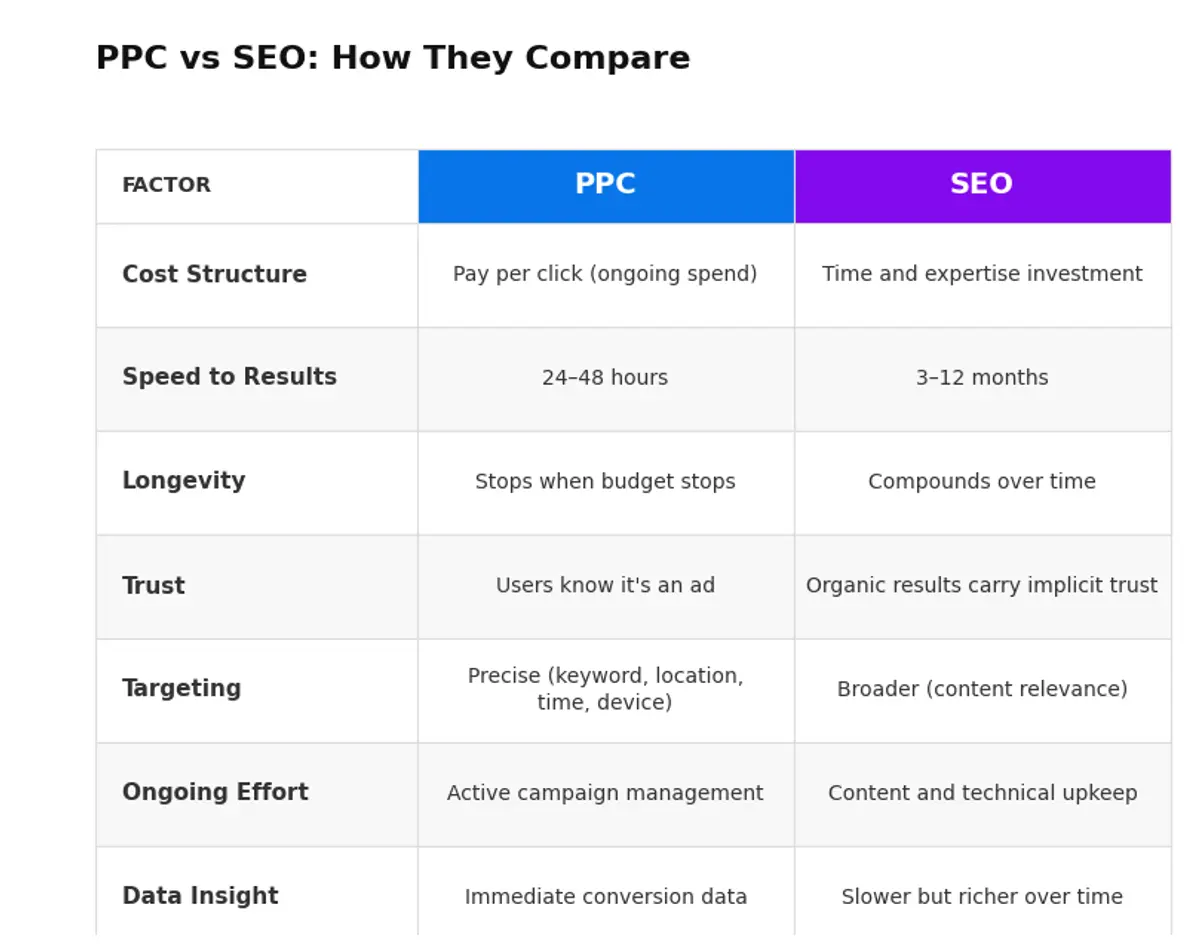
PPC vs SEO: Key Differences at a Glance
Factor: Longevity | PPC: Stops when budget stops | SEO: Compounds over time
The core trade-off is this: PPC buys you visibility immediately, but it is a tap. Turn it off and the water stops. SEO is more like building a pipeline. Expensive and slow to build, but once it is in place, it runs with far less ongoing cost and keeps delivering even when you are not actively working on it.
The Cost of PPC vs SEO in the UK
This is where most articles wave their hands. Let us use actual numbers.
PPC costs
A small business running Google Ads in the UK typically spends:
- Ad spend: £500 to £2,000 per month
- Agency management fee: £300 to £800 per month
- Total monthly investment: £800 to £2,800
The cost per click varies significantly by industry. Low-competition sectors like landscaping or local retail might pay £1 to £3 per click. Mid-range industries such as accountancy or tradespeople run £3 to £8 per click. High-competition sectors including legal, finance, and property regularly see £10 to £30 per click. The more you pay per click, the more carefully the campaign needs to be managed to stay profitable. If you are starting from scratch, our guide to paid advertising for UK small businesses covers what to budget for paid advertising, worked out from your own cost per click and average job value rather than a headline figure.
SEO costs
A realistic UK investment for SEO:
- Freelance: £500 to £1,500 per month
- Agency: £800 to £3,000 per month
- DIY: 10 to 20 hours per month of your own time
The real comparison: cost per enquiry over 12 months
Here is a worked example for a UK trade business targeting local customers:
PPC scenario: £800/month ad spend, £400/month management. 500 clicks/month at £1.60 average CPC. 5% conversion rate on the landing page = 25 enquiries/month. Monthly cost: £1,200. Cost per enquiry: £48. Over 12 months: £14,400 for 300 enquiries.
SEO scenario: £1,000/month agency fee for 12 months = £12,000 total. Months 1 to 3: minimal traffic, essentially zero enquiries from SEO. Months 4 to 6: 20 to 30 organic visits/month, 2 to 4 enquiries. Months 7 to 12: growing to 100 to 200 visits/month, 8 to 16 enquiries/month. Year 1 total: roughly 60 to 80 enquiries at a cost of £12,000. Cost per enquiry: £150 to £200.
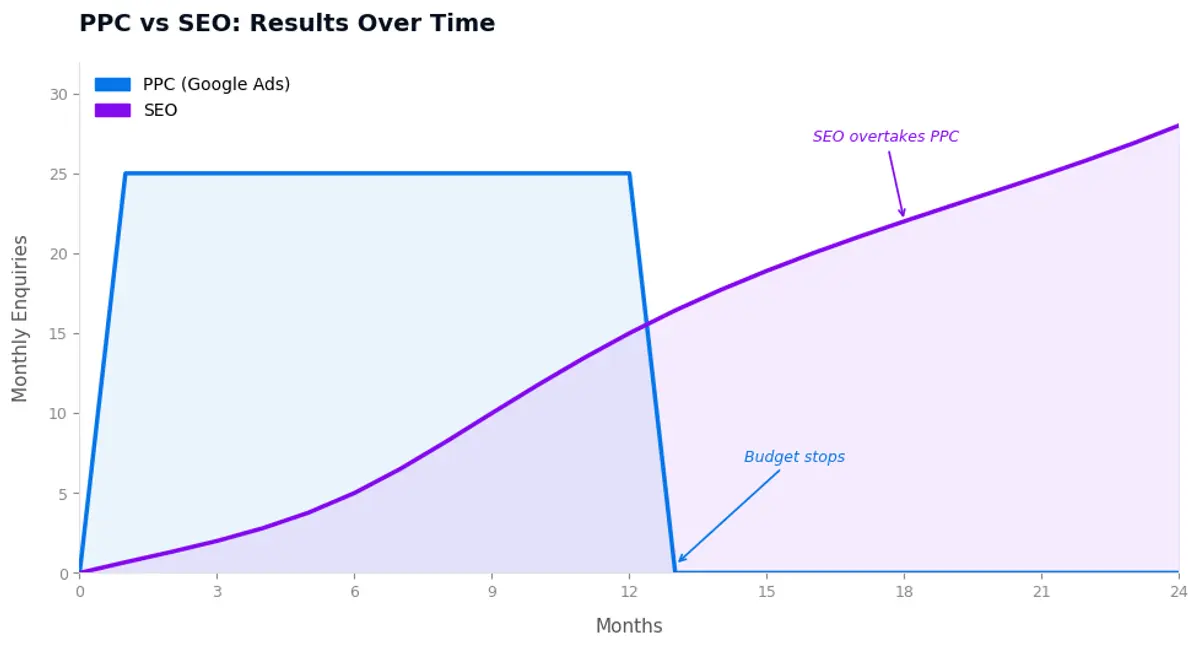
On paper, PPC wins year one. But in year two, the SEO investment keeps compounding. The agency fee continues, but the traffic base is larger and the cost per enquiry falls steadily. By year three, SEO typically delivers a lower cost per enquiry than PPC for most service businesses. That is the honest version of "SEO is cheaper in the long run."

Speed and Timeframe: Which Gets You Results Faster?
PPC wins this without question. If you need immediate results, paid search delivers them.
With a Google Ads campaign, your ads can appear in search results within 24 to 48 hours of the account going live. You will have meaningful click data within 2 to 4 weeks. The first serious optimisation cycle, where you start cutting poor-performing keywords and adjusting bids based on real data, typically happens at the 4 to 6 week mark.
SEO follows a completely different clock. A new or newly improved page takes 1 to 3 months just to get fully crawled and indexed. Ranking movement, if the keyword research was sound, often begins at 3 to 6 months. Consistent, substantial organic traffic is typically a 6 to 12 month project. There is no shortcut to that timeline, regardless of how good the content is.
"Results" means different things for each channel. A PPC result is a click you can measure today. An SEO result is a position that builds audience over years. Neither is better. They operate on different timescales.
And to directly answer one of the most common questions we hear: is PPC still relevant in 2026? Yes, genuinely. The format has evolved, Google has added more ad placements and automation, but paid search still generates a substantial share of commercial enquiries for service businesses. The fundamentals of running effective Google Ads have not changed.
ROI and Long-Term Value
This is where SEO wins, unambiguously, but only if you are patient enough to get there.
The data on organic search is compelling. Research by Backlinko found that the number one position in organic search results receives approximately 27.6% of all clicks for that query. Positions two and three receive roughly 15% and 11% respectively. The traffic drop-off as you move down the page is steep, and anything beyond page one receives almost no organic traffic at all.
For PPC, Wordstream's analysis of Google Ads benchmarks puts the average return on investment at around 200%. That is a £2 return for every £1 spent, which is a solid result, but it only holds while you keep spending. According to Firstpage Digital, well-executed SEO targeting transactional content can deliver returns of 748% over time.
The difference is the compounding effect. PPC delivers a linear return: spend £1,000, get £2,000 back. Do that every month. SEO works differently. The content you create today can continue generating traffic and enquiries for years, without additional spend. The return-on-investment calculation looks worse in year one and dramatically better by years two and three.
The honest caveat: SEO ROI takes longer to materialise. If you are a new business that needs enquiries in the next 90 days, waiting 12 months for SEO to build is not a practical option. This is not a reason to dismiss SEO. It is a reason to be clear-eyed about what each channel delivers and when.

Targeting and Control
PPC gives you a level of targeting precision that organic search simply cannot match.
With Google Ads, you can target:
- Specific keywords with exact match control
- Geographic areas down to postcode level
- Specific times of day and days of the week
- Device types (mobile, desktop, tablet)
- Audience demographics and past behaviour
- People who have already visited your website (remarketing and retargeting)
For businesses with a narrow target market, this precision is a genuine advantage. A commercial solicitor in Manchester who only wants to reach business owners within 10 miles, searching between 9am and 5pm, on desktop devices, can achieve exactly that with Google Ads. The ability to layer these targeting parameters means budget goes only where it is most likely to convert.
SEO is broader. You create content around relevant keywords and Google decides how to rank and display it. You can influence this through careful keyword research and content structuring, but you have less moment-to-moment control. For businesses building brand awareness or targeting broad informational searches, this is not a disadvantage. For niche B2B or service businesses with a tightly defined customer profile, PPC targeting is worth the premium.
Not Sure Which Channel Fits Your Business?
If you are reading this and thinking "this all makes sense, but I still don't know which to do first," you are not alone. Most business owners we speak to are in exactly the same position. Brilliant Digital manages Google Ads campaigns and builds SEO-optimised websites, so we can give you a straight recommendation based on your specific situation. No obligation.
Trust and Credibility: Organic vs Paid Results
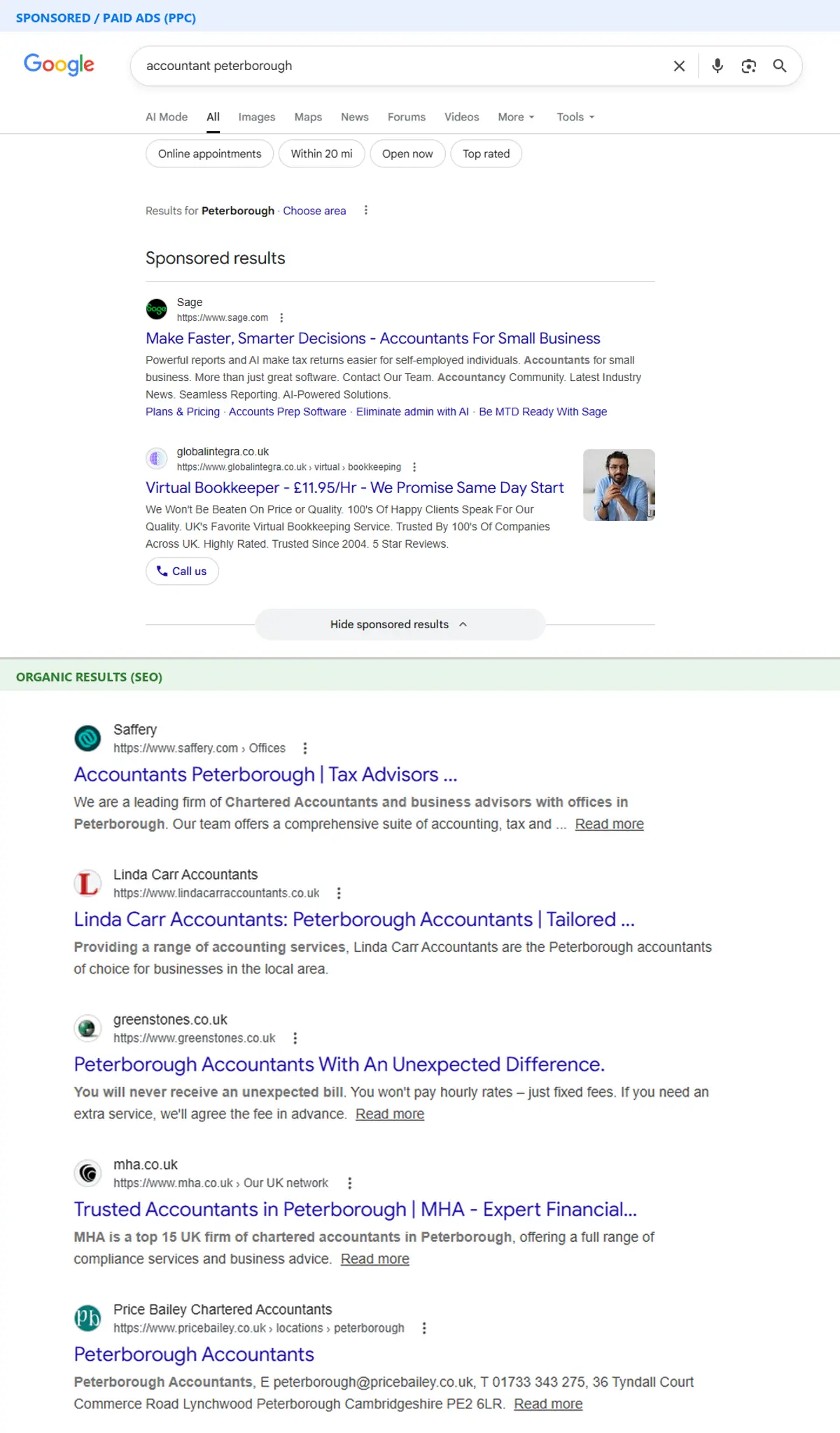
Users trust organic search results more than paid ads. This is consistent across research into search behaviour and it reflects how people understand Google's model.
Organic ranking implies that Google considers your content genuinely useful for that search. It is an implicit endorsement. Paid ads have a small label, but many users scroll past them deliberately, particularly for informational searches where they are doing research rather than ready to buy.
That said, the trust advantage for organic results varies significantly by search intent. For commercial, transactional searches, "plumber near me" or "emergency locksmith London," users often click the ads precisely because those businesses are clearly ready to take a booking. The immediacy of PPC can actually work in your favour here.
The trust consideration matters most for research-phase queries. If someone is searching what is SEO and how it works or exploring options before making a decision, an organic result from a credible source tends to get more attention and deeper engagement than a paid placement. Building domain authority through consistent SEO work means Google increasingly associates your site with those research queries over time.
When PPC Is the Right First Move
Some business situations point clearly towards starting with paid search. Here is when PPC should come first:
- You are a new business that needs enquiries in the next 30 to 60 days. SEO cannot deliver on that timeline. PPC can.
- You have a seasonal or time-sensitive campaign. A campaign for Christmas bookings or a summer promotion cannot wait 12 months. PPC lets you be precise about timing.
- You are testing demand for a new service. Running a small Google Ads campaign is one of the fastest ways to find out whether people are actually searching for what you are planning to offer. The keyword research and search query data is invaluable.
- You operate in a competitive local market. If the organic results for your industry are dominated by established businesses with strong domain authority, getting to page one through SEO alone takes years. PPC puts you on page one tomorrow.
- Your service has a high value per conversion. In legal, property, finance, or specialist B2B services, a single enquiry can be worth thousands of pounds. Paying £20 to £50 per click makes sense when a conversion is worth £5,000. This is why these industries have the highest CPCs.
- You need conversion data quickly. If you are trying to understand which search terms actually generate enquiries (not just clicks), Google Ads gives you that data in weeks. That data then informs your longer-term SEO strategy.
We wrote a separate piece on whether Google Ads are still worth it for small businesses if you want to go deeper on PPC specifically.
One common question: is £10 a day enough for Google Ads? The honest answer is: it depends heavily on your industry. £10 a day (£300/month) in a low-competition sector like local cleaning or gardening services might generate 5 to 10 clicks per day, which is enough to test the market. In a competitive sector like law or mortgages, £10 a day might buy you 2 to 3 clicks. There is no universal answer. The right budget is the one that gives you enough clicks to draw meaningful conclusions, and that number varies by your cost per click. Understanding how to use negative keywords properly is essential to making smaller budgets work efficiently.
When SEO Is the Right First Move
For other businesses, SEO is the more logical starting point:
- You want to reduce long-term dependence on ad spend. If you are currently spending heavily on PPC and want to build a channel that does not stop when the budget does, SEO is the answer. It is a deliberate de-risking of your marketing mix.
- You are targeting local "near me" searches. Local SEO, including your Google Business Profile and location-specific content, remains one of the highest-return SEO investments for service businesses with a physical presence.
- You have genuine expertise to write about. If your business has real depth of knowledge, blog content and guides convert well both for search rankings and for building trust with prospects who find you through organic search.
- Your budget is genuinely tight. If you can only afford £300 to £500 per month, SEO work (even at a modest pace) builds cumulative value. PPC at that budget level often does not generate enough volume to be meaningfully optimised.
- You are in a trust-dependent industry. Sectors where buyers do extensive research before committing, financial advice, healthcare, legal services, professional B2B services, benefit disproportionately from appearing in trusted organic results. The implicit endorsement of a first-page ranking matters more in these industries.
Is SEO worth it anymore in 2026? Yes. But the question deserves a direct answer. AI search, including Google's AI Overviews, has changed how some queries are answered, with AI-generated summaries appearing above traditional results. This does affect click-through rates for certain informational searches. However, commercial and transactional queries still drive organic clicks, local searches are largely unaffected, and well-structured expert content from credible UK sources is now being cited by AI Overviews rather than ignored by them. This is actually a new content opportunity, not a threat, for businesses that produce genuinely useful, well-attributed content.
Will SEO be replaced by AI? Not in the sense of becoming irrelevant. The nature of what earns visibility is evolving, original expertise, structured content, and genuine authority matter more than ever because AI systems are looking for credible sources to cite. What is changing is that thin, generic content that used to rank purely on volume will not hold up. If you have real expertise and communicate it clearly, SEO remains one of the best long-term investments in your marketing. If you want the fuller argument, including the cost of ignoring search altogether, read why SEO matters for small businesses.

The Honest Answer: Most Small Businesses Need Both
PPC and SEO are not competitors. They are complementary, and the most effective marketing strategies use them together deliberately.
Here is how they work together in practice:
PPC data improves SEO. When you run a Google Ads campaign, you can see exactly which search queries led to clicks and, more importantly, which led to conversions. This is the single most reliable source of insight about what your customers are actually searching when they are ready to buy. Feeding those high-converting search terms into your SEO content strategy means you are writing about topics with proven demand, not theoretical keyword volume.
SEO reduces PPC costs over time. SEO is a long-term strategy. As your organic rankings improve, you can reduce ad spend on the keywords where you now rank organically, putting more budget behind the terms where you are not yet competitive. This gradual shift is how established businesses lower their cost per enquiry year on year.
Appearing twice on a results page builds credibility. When someone searches a keyword and sees your business in both the paid ads and the organic results, it signals market authority. It is the search equivalent of being mentioned by multiple trusted sources.
PPC covers the gap while SEO builds. If you commit to an SEO programme today, you will not see significant results for at least 3 to 6 months. Running PPC during that period means you are not sitting with zero Google visibility while you wait. The channels fill each other's gaps.
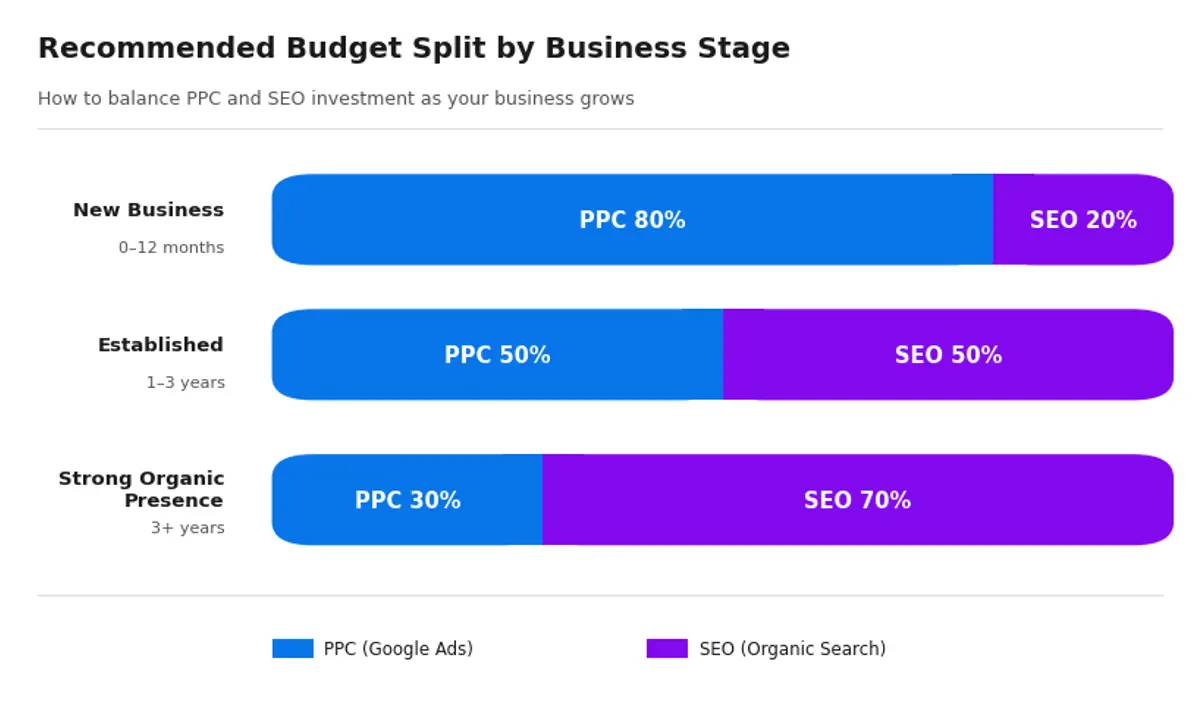
Budget split recommendations by business stage:
These are starting points, not rigid rules. The right split depends on your industry, margins, and how well each channel is performing for your specific business.
Frequently Asked Questions
Is PPC better than SEO?
Neither is universally better. PPC delivers faster results with precise targeting but requires ongoing spend. SEO takes longer but compounds over time without paying for every click. PPC suits immediate enquiries and market testing. SEO suits long-term, cost-efficient visibility. Most businesses benefit from both, shifting the balance as organic rankings mature.
Is PPC harder than SEO?
They are difficult in different ways. PPC requires constant monitoring, bid management, and ad copy testing. Mistakes cost real money in real time. SEO requires technical knowledge, consistent content creation, and patience for results that take months. Both require genuine skill to do properly.
How much does PPC cost compared to SEO?
In the UK, a managed Google Ads campaign typically runs £800 to £2,800 per month. SEO runs £800 to £3,000 per month. PPC buys traffic that stops when spending stops. SEO builds a compounding asset. Cost per enquiry tends to favour PPC in year one and SEO from year two onwards.
Is SEO being phased out? Will AI replace SEO?
No, but it is evolving. Google's AI Overviews now return AI-generated summaries for some queries, reducing click-through rates on certain informational searches. Commercial, transactional, and local searches remain largely unaffected. Businesses producing structured, authoritative, expert-led content are gaining visibility. Thin, generic content is losing it.
What is the difference between paid and organic search?
Paid search means your website appears because you are paying through the Google Ads auction. You pay each time someone clicks. Organic search means your website appears because Google's algorithm judges your content relevant and trustworthy. You pay nothing per click. Paid results carry an "Ad" label. Organic results typically earn more trust.
Is £10 a day enough for Google Ads?
It depends on your industry. In low-competition sectors where clicks cost £1 to £2, £10 a day generates 5 to 10 clicks, enough to test the market. In competitive sectors where clicks cost £10 to £30, £10 a day buys fewer than 5 clicks, which is not enough for useful data.
What to Do Next
If you are trying to work out whether Google Ads, SEO, or a combination makes sense for your business right now, the most useful thing we can offer is a straight conversation.
Brilliant Digital manages Google Ads campaigns for clients across the UK and builds SEO-optimised websites with content designed to rank. Because we do both, we have no reason to push you towards one or the other. We will tell you honestly what we think based on your budget, your industry, and what you are trying to achieve.
No obligation, no jargon-heavy audit process. If you want to talk through your situation, get in touch. Or if you want to explore what Google Ads management looks like in practice, take a look at how we approach campaigns.