
How much does it cost to host a website in the UK? Most small businesses pay somewhere between £3 and £40 a month, and a fair chunk of that does not need to be spent at all.
Web hosting is the service that stores your website's files on a server and delivers them to visitors whenever someone types in your domain. That is genuinely all it is. The tiers and "premium" add-ons layered on top are largely decoration.
This guide walks through the whole spectrum honestly: shared hosting, managed WordPress, VPS, cloud, dedicated servers, and the option most hosting guides leave out. Brilliant Digital does not sell hosting, so we have no reason to steer you towards the expensive tier. We build websites, and we know exactly what they cost to keep online.
By the end, you will know what you should actually be paying, and where the industry overcharges.
Key Takeaways
- Typical UK hosting costs range from £3 to £40 a month, depending on hosting type.
- Shared hosting suits most brochure sites. VPS and dedicated servers are routinely sold to businesses that will never need them.
- The renewal-price trap is the biggest hidden cost. A £2.99 introductory rate can jump 200 to 300% after the first term.
- Modern static hosting (Cloudflare Pages, Netlify, Vercel) can cost £0 to £5 a month for a well-built small business site.
- Hosting is rarely where the real cost lives. Keeping an ageing WordPress site secure usually costs more than the hosting bill itself.
The quick answer: UK hosting costs at a glance
Website hosting in the UK typically costs between £3 and £200+ a month, driven almost entirely by hosting type rather than website size. Shared hosting sits at the bottom, dedicated servers at the top, and a newer category, modern static hosting, can push the cost close to zero for a well-built small business site.
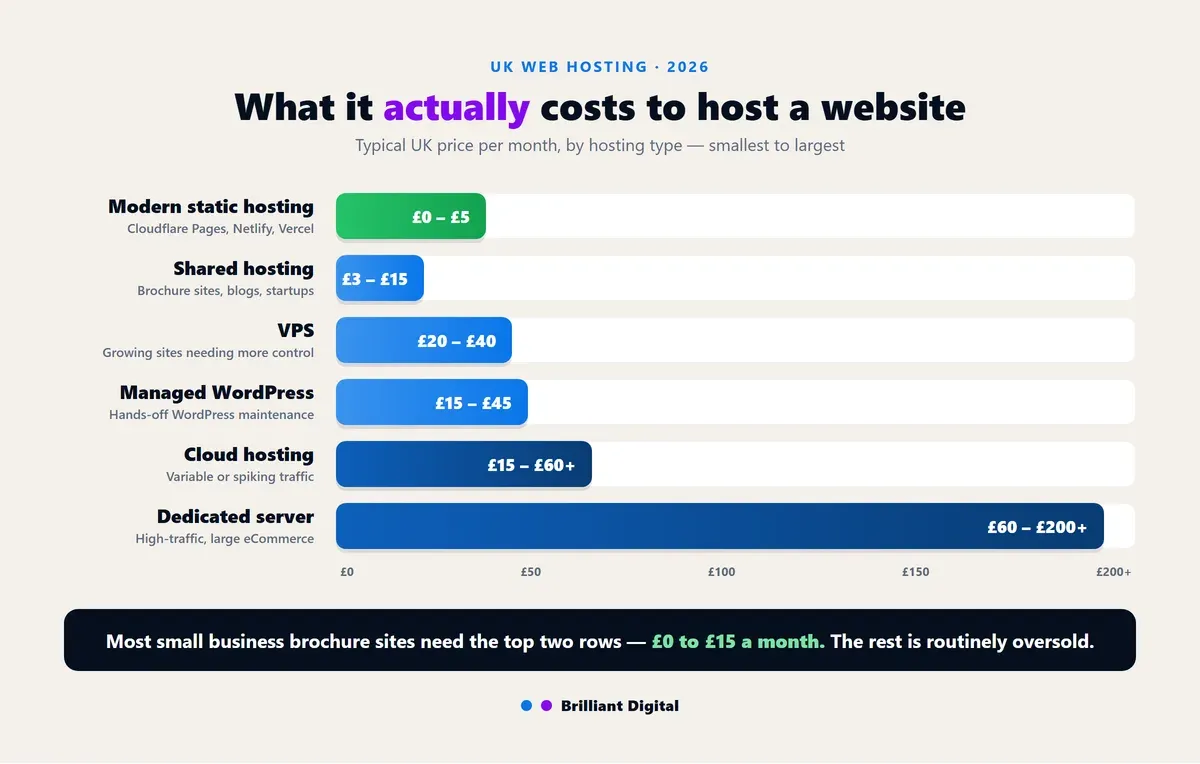
Real UK pricing bears this out. GoDaddy's entry-level shared plan sits around £3.99 a month, Fasthosts prices shared hosting from roughly £5.75, and IONOS often runs promotional first-year rates near £1 before the price resets. These headline rates shift constantly, but the ranges above reflect what businesses actually pay once add-ons and renewals are factored in.
What you're actually paying for: hosting types explained
Every hosting type is, at its core, a way of renting server space. The real differences are how much of that server you get to yourself, how much technical management is handled for you, and how the price scales as your site grows.
Every plan advertises the same handful of specs: storage (how much space your files take up), bandwidth (how much data can be transferred to visitors each month), and uptime (the percentage of time the server stays online, usually quoted as 99.9% or higher).
Think of it like renting property. Shared hosting is a room in a house share, sharing the water bill and broadband. VPS is a self-contained flat, walled off with its own guaranteed resources. Dedicated hosting is renting the whole house outright.
Shared hosting Your website sits on a server with dozens, sometimes hundreds, of other websites, sharing the same processing power, memory, and bandwidth. It is the cheapest option because the cost is split so many ways. For a typical brochure site with modest traffic, it is genuinely fine. The downside: if another site on the server gets hammered with traffic or hit by an attack, yours can slow down too.
VPS (Virtual Private Server) A VPS still shares a physical server with other users, but each account gets a fixed slice of resources nobody else can touch. You get more control, including root access (the ability to configure the server yourself), and more consistent performance. It suits sites that have outgrown shared hosting but do not yet need a server of their own.
Dedicated hosting An entire physical server, reserved for one website or business. Maximum control, maximum performance, maximum price. Very few small businesses need this. It suits large eCommerce operations or sites with specific compliance requirements.
Cloud hosting Instead of one physical server, your site runs across a network of virtual servers that scale up or down automatically. This handles traffic spikes well, a seasonal sales rush or a product going viral, without the site falling over. Pricing is usually based on usage, so costs can be less predictable than a flat fee.
Managed WordPress hosting A package built specifically around WordPress, handling updates, backups, and security patching on your behalf. It costs more than generic shared hosting, but for a business without in-house technical staff, it removes a genuine maintenance burden.
The option most hosting guides skip: modern static hosting
Platforms like Cloudflare Pages, Netlify, and Vercel host static and Jamstack websites, sites built with frameworks like Astro rather than a database-driven CMS, on global content delivery networks. There is no shared server to slow down, no plugins to patch, and generous free tiers that cover most small business traffic outright.

This is not a hobbyist workaround. It is how a growing number of professionally built small business sites are hosted in 2026. Every Brilliant Digital client site is built on Astro and Cloudflare, part of why we moved to a modern stack away from WordPress and Webflow. The result for hosting cost specifically: often £0, occasionally a few pounds a month once a custom domain and email routing are added.
What actually drives the price
Four things determine what you will pay for hosting: traffic, storage and bandwidth, whether the plan is managed or unmanaged, and contract length. Traffic is the biggest lever. Most small business sites use a fraction of the capacity they are sold.
- Traffic: More visitors means more server resources needed to serve pages without slowing down. A five-page brochure site with 500 visitors a month needs almost nothing. An online shop with 50,000 monthly visitors needs considerably more headroom.
- Storage and bandwidth: Text and a handful of images take up almost no space. Video libraries and large product catalogues push storage and bandwidth needs up quickly.
- Managed vs unmanaged: Managed hosting includes updates, patching, and support, and costs more. Unmanaged hosting hands you full control and full responsibility, and costs less, provided someone can actually run it.
- Contract length: Providers routinely discount multi-year contracts against the monthly rate, then quietly restore the full price at renewal.
Here is the honest bit most hosting companies will not tell you: most small business websites are sold VPS or dedicated hosting they will never need. A five-page site for a local plumber does not need a dedicated server with root access and 32GB of RAM. It needs reliable shared hosting, or increasingly, a modern static hosting plan that costs a fraction of the price and performs better.
The costs nobody quotes you upfront
The advertised hosting price is rarely the full picture. A handful of additional costs, some unavoidable, some optional, tend to show up after signup: the domain, an SSL certificate, professional email, backups, migration fees, and a renewal price hike almost nobody reads the small print on.
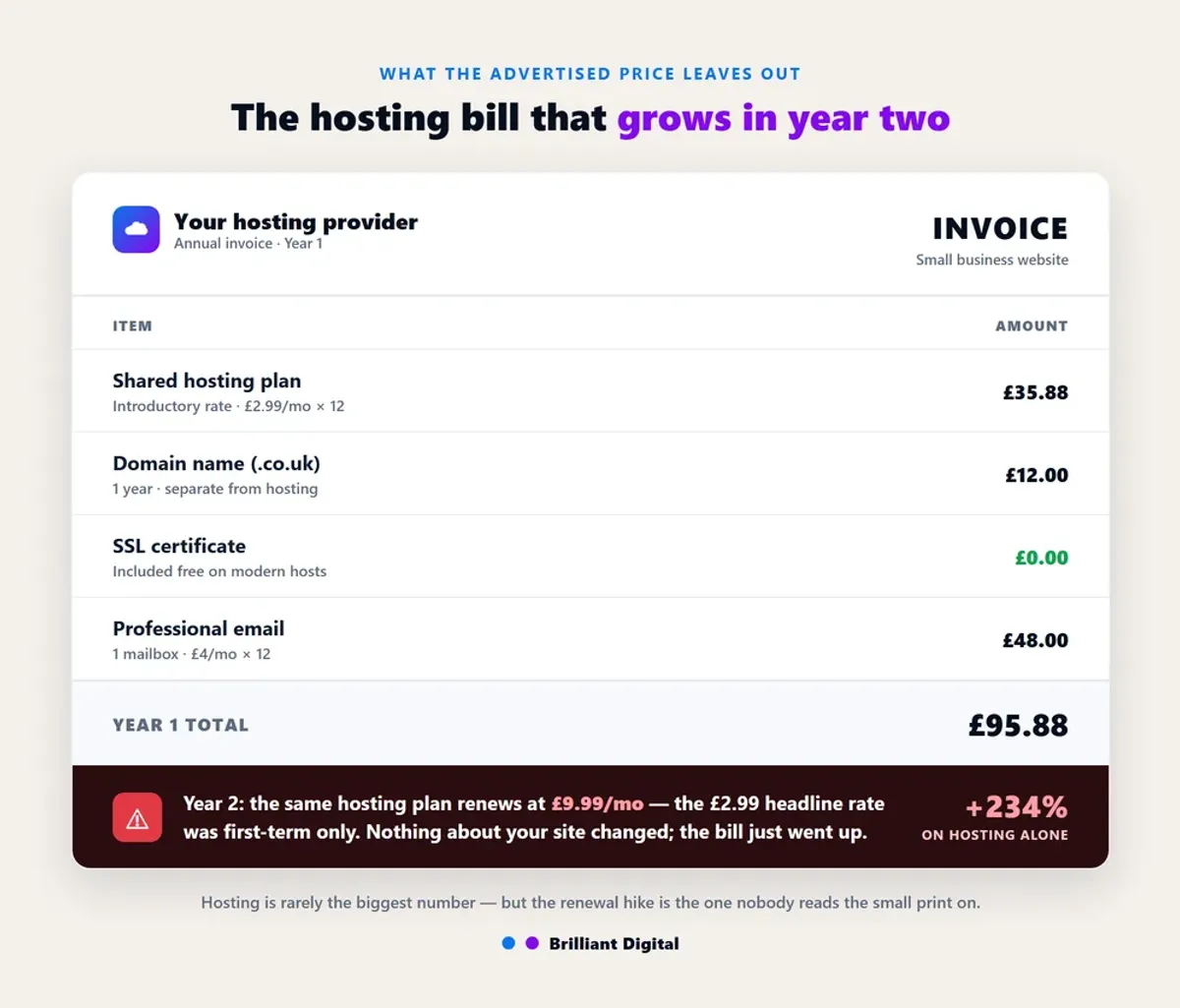
- Domain name: £10 to £15 a year for a standard .co.uk or .com. Non-negotiable, and separate from hosting even though many providers bundle the first year in.
- SSL certificate: The padlock that secures your site, and now a baseline Google ranking factor. Most modern hosts include a free SSL certificate (via Let's Encrypt or similar) as standard. Some older or budget providers still charge £50 to £100+ a year for it.
- Professional email: A @yourbusiness.co.uk inbox is rarely included free. Expect to pay separately, typically £2 to £6 a month per mailbox, through Google Workspace, Microsoft 365, or the host's own email product.
- Backups and restores: Many budget plans include backups but charge a separate fee to actually restore one, sometimes £20 to £50 per restore.
- Migration fees: Moving an existing site to a new host is sometimes free, sometimes a one-off service fee, particularly for larger or more complex sites.
The renewal-price trap costs UK businesses the most. Providers routinely advertise an introductory rate, £2.99 a month is a common headline figure, that applies only to the first term. Renewal pricing then jumps 200 to 300%, turning a £2.99 plan into £9 or £12 a month with no warning beyond a line in the terms and conditions.
Multiply that across several years and an unreviewed hosting account can cost two or three times what was originally budgeted. Always check the renewal price before you sign, not just the sign-up price.
Can you host a website for free?
Yes, but with real limits. Free website builder tiers (Wix, WordPress.com, Google Sites) will host a basic site at no cost, but usually with adverts on your pages, a subdomain instead of your own domain name, and little control over performance or design. For a business that wants to look credible, free builder tiers are rarely worth the trade-off.
Here is the nuance most hosting guides miss. A free builder tier and free static hosting are not the same thing. A properly built static site, one coded rather than assembled from a drag-and-drop template, can genuinely be hosted free or near-free on Cloudflare Pages, Netlify, or Vercel, complete with your own domain, no adverts, and enterprise-grade performance.
The catch is not the hosting cost. It is that building a site this way requires proper development, not a builder subscription.
Which raises the real question most people asking about hosting costs actually mean: not "what does hosting cost" but "what does it cost to keep a website running properly". Those are very different numbers.
Hosting cost vs the real cost of keeping a site alive
Hosting and "keeping a website running" get conflated constantly, and that confusion is where cheap hosting quietly becomes expensive. Hosting is just the server bill. Keeping a site alive, especially a WordPress site, means updates, plugin management, security monitoring, and fixing whatever breaks when those pieces fall out of sync.
A WordPress site typically runs a core install plus a theme plus somewhere between five and twenty plugins, each maintained by a different developer, each needing regular updates, and each capable of breaking the site or opening a security hole if left unpatched. None of that shows up on the hosting invoice. It shows up as a developer's hourly rate when something goes wrong.
We have covered the real cost of running WordPress in detail elsewhere, and the short version is that the £5-a-month hosting plan is rarely the number that matters. It is everything sitting on top of it.
This is precisely the maintenance burden a modern static stack removes: no plugins, no plugin-related emergencies, and a bigger saving over three years than any hosting discount.
So what should you actually budget?
Budget by business type rather than by hosting plan. A local tradesperson's brochure site, a growing eCommerce store, and an established B2B company have genuinely different hosting needs. Pricing a small brochure site like an online shop is one of the most common ways businesses overspend.

- Local tradesperson or brochure site: £0 to £180 a year (£0 to £15/month), plus a domain at around £12 a year. On a modern static stack, hosting can sit at £0.
- Growing eCommerce site: £240 to £720 a year (£20 to £60/month) for cloud or managed hosting that handles traffic spikes and payment processing reliably.
- Established B2B company: £360 to £1,200+ a year, depending on integrations, traffic, and whether email and backups are bundled or bought separately.
Our honest take: for a typical brochure site built on a modern stack, hosting is a rounding error, often £0 to £60 a year. That is not a sales pitch, we do not sell hosting. It is the reason we think most small businesses are looking at the wrong line item.
The bigger cost that determines whether a website earns its keep is the build itself: the strategy, the copy, the conversion design. If you want a sense of that number, we have broken down what a website costs to build in the UK in detail.
Frequently Asked Questions
How much will it cost me to host a website?
Most UK small business websites cost between £3 and £40 a month to host, depending on hosting type. Shared hosting starts around £3 to £15 a month, while a well-built static site on a modern stack can cost £0 to £5 a month. Larger or high-traffic sites cost more.
Do I need to pay to host a website?
Not necessarily. Free website builder tiers exist, and a properly built static site can be hosted free or near-free on platforms like Cloudflare Pages. Most established businesses still choose a paid plan for reliability, support, and the ability to use a custom domain without limitations.
How much is 1 year of hosting?
A year of UK web hosting typically costs £36 to £180 for shared hosting, £180 to £540 for managed WordPress, and £240 to £2,400+ for VPS, cloud, or dedicated plans. Modern static hosting can cost as little as £0 a year for a small business brochure site.
Can I host my own website for free?
Yes, using platforms like Cloudflare Pages, Netlify, or Vercel for a properly coded static site, or a free builder tier for a basic starter site. Free builder tiers usually come with adverts and a subdomain, while free static hosting can support a fully custom, ad-free domain.
How much does website hosting cost in the UK?
UK hosting prices range from around £3 a month for basic shared hosting to £200+ a month for dedicated servers. Most small business brochure sites fall between £3 and £15 a month, though modern static hosting can bring that closer to £0 for the right kind of build.
Is it worth hosting my own website?
It is worth using proper hosting rather than a free builder tier if your website represents your business. Whether it is worth self-managing a server depends on your technical skill. For most business owners, a straightforward managed or static hosting plan is worth the small cost for the reliability.
What to do next
If you take one thing from this guide, take this: on a modern stack, hosting a small business website is close to the cheapest part of having one. The money that matters goes into the build, the strategy, copy, and design that turns visitors into enquiries, not into a creeping monthly hosting bill dressed up as a "premium" plan.
We have built more than 150 websites since 2014, every one on Astro and Cloudflare, and hosting has stopped being something our clients think about at all. If you are weighing up a new website and want an honest view of where your budget should go, take a look at what we build.