Ask three PPC agencies what their management fee covers and you'll likely get three different answers, none of them very specific. One quotes a flat monthly rate. Another wants a percentage of your ad spend. A third asks you to book a call before they'll say anything at all.
None of that tells you what you're actually paying for. Some of the vagueness is deliberate. A number without context is easier to quote than an honest "it depends," even when "it depends" happens to be the more useful answer.
PPC management is the ongoing work of running a Google Ads account properly: researching keywords, writing and testing ads, adjusting bids, and making sure the budget goes toward people who are actually likely to buy. The fee pays for someone to do that work consistently, not just set it up and walk away.
This guide breaks down the three common pricing models, what each one actually suits, and what a PPC manager does with your money week to week. If you're still weighing up whether Google Ads is worth it at all for your business, that's worth answering first; this guide assumes you've already decided to invest and want to know what you're paying for.
Key Takeaways
- PPC management fees come in three models: flat/fixed fee, a percentage of your ad spend, or a monthly retainer. None is universally "better"; each suits a different budget size.
- Your ad spend and management fee are separate. The money you pay Google, Bing, or Meta for clicks is not the same as what you pay an agency or freelancer to manage the account.
- A realistic UK management fee for a small business runs from around £400 to £2,500+ a month, scaling with ad spend and platform complexity.
- The clearest sign of good management isn't the price. It's whether you can see exactly what was done each week.
- DIY PPC can work for small, simple accounts. It stops making sense once the time cost of learning and monitoring outweighs what hiring help would cost.
What Is PPC Management?
PPC management is the ongoing process of planning, running, and optimising paid advertising campaigns, most commonly on Google Ads, so that ad spend turns into enquiries rather than wasted clicks. It covers everything from the initial keyword research through to the weekly bid adjustments that keep the budget working.
In practice, it breaks down into six parts:
- Keyword research and negative keywords: finding the search terms worth bidding on, and building a list of terms to exclude so the budget isn't spent on irrelevant searches
- Campaign structure and setup: organising ad groups so each one targets a specific product, service, or intent
- Ad copy and testing: writing headlines and descriptions, then testing variations to see what actually gets clicked
- Bid and budget management: adjusting how much is bid for each keyword, and how the daily budget is distributed to get the best return on ad spend (ROAS)
- Conversion tracking: making sure the account knows which clicks turned into enquiries, calls, or sales, not just clicks
- Reporting: a regular, honest account of what happened and why
Any agency or freelancer offering "PPC management" should be doing all six. If a quote only covers the first two, it's an account setup, not ongoing management.
The difference between someone doing this properly and someone collecting a fee for very little shows up in specific places: a search terms report that's never been reviewed, a negative keyword list with a handful of entries after six months, or conversion tracking that was never actually checked to confirm it's recording real enquiries rather than page views. None of these are visible from the outside unless you know to ask about them.
What Does PPC Management Cost in the UK?
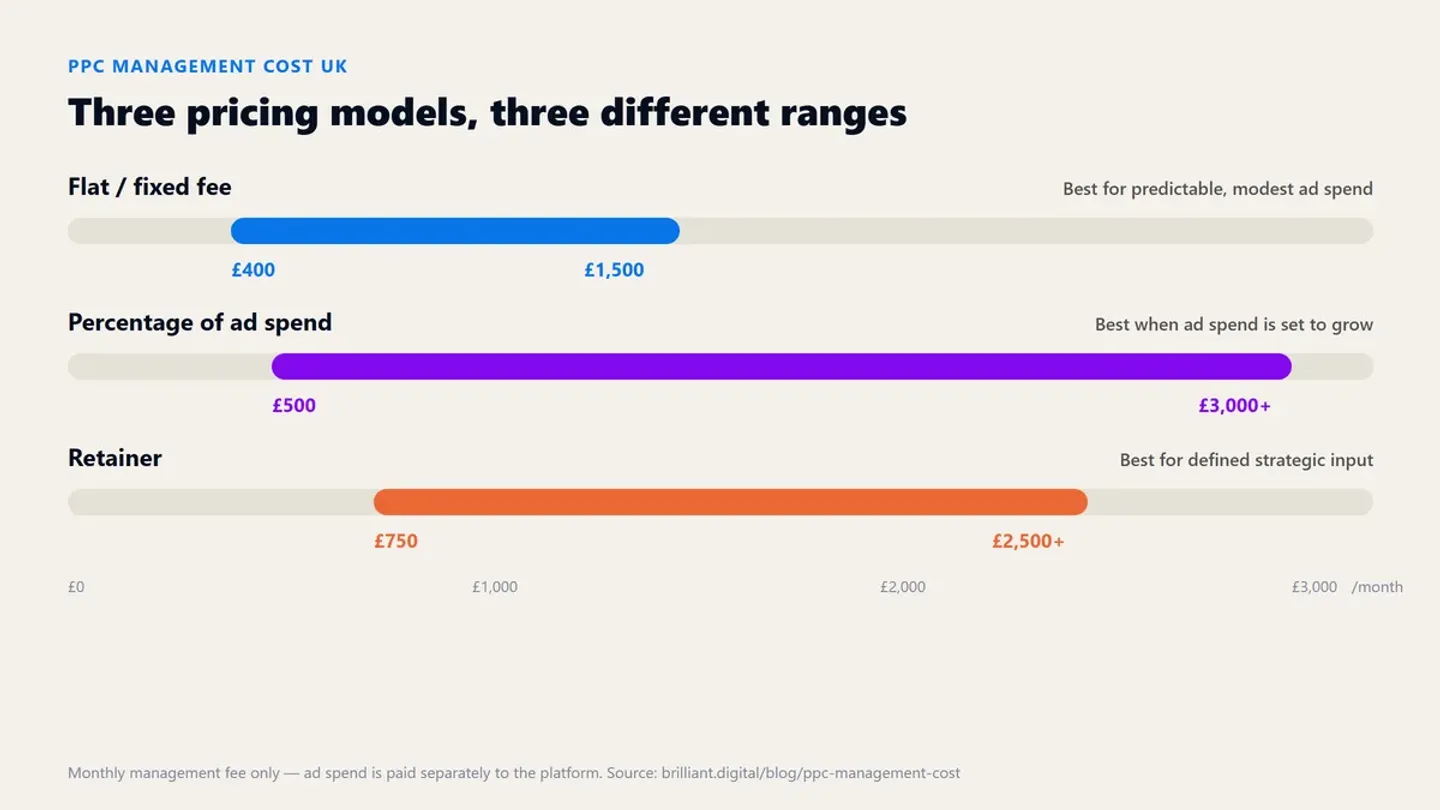
Most UK PPC management fees fall into one of three pricing models: a flat monthly fee, a percentage of your ad spend, or a negotiated retainer. Each one suits a different kind of business, and the right choice depends more on how your budget behaves than how big it is.
- Flat / fixed fee. A set monthly amount regardless of ad spend. Typical UK range: £400-£1,500/month. Pick this if your ad spend is modest and predictable, and you want a cost you can budget for.
- Percentage of ad spend. A fee calculated as a slice of what you spend on ads, commonly 10-20%. Typical UK range: £500-£3,000+/month, scaling with spend. Pick this if your ad spend is likely to grow, and you want the agency's incentives to scale with yours.
- Retainer. A negotiated monthly fee tied to an agreed scope of work, reviewed periodically. Typical UK range: £750-£2,500+/month. Pick this if you need a defined amount of strategic input and reporting, not just bid adjustments.
A few things worth knowing before you compare quotes:
Your ad spend is paid separately. The management fee above does not include what you actually spend on clicks through Google, Bing, or Meta. That money goes to the platform, not the agency. Some quotes make this clear, others bury it in the small print, so always ask for the two numbers separately.
Percentage-of-spend has a built-in tension. If an agency earns more the more you spend, their incentive isn't always aligned with spending efficiently. That's not a reason to avoid this model; plenty of agencies manage it honestly. But it is a reason to ask how they define success beyond "we increased your spend."
Set-up fees are usually separate from the monthly rate. Building a new account from scratch (structure, tracking, the first round of ad copy) is more work than maintaining one, and most agencies charge for it as a one-off. If a quote has no set-up fee at all, ask what corners were cut.
Where you land within each range depends on a few predictable factors. More platforms (Google plus Microsoft plus Meta, say) means more work, so expect the fee to scale accordingly. A genuinely competitive industry (legal services and home improvement are common examples) demands more hands-on bid management than a niche B2B product with little competition. And an account running several thousand pounds a month in ad spend needs closer attention than one running a few hundred pounds through a single campaign.
For context on how competitive this space is: businesses advertising for terms like "PPC management service" are themselves paying an average cost-per-click of roughly £30-£44 (DataForSEO, 2026). That's a reasonable sense of how much agencies are willing to spend just to be found by someone looking for one.
What a PPC Manager Actually Does, Week to Week
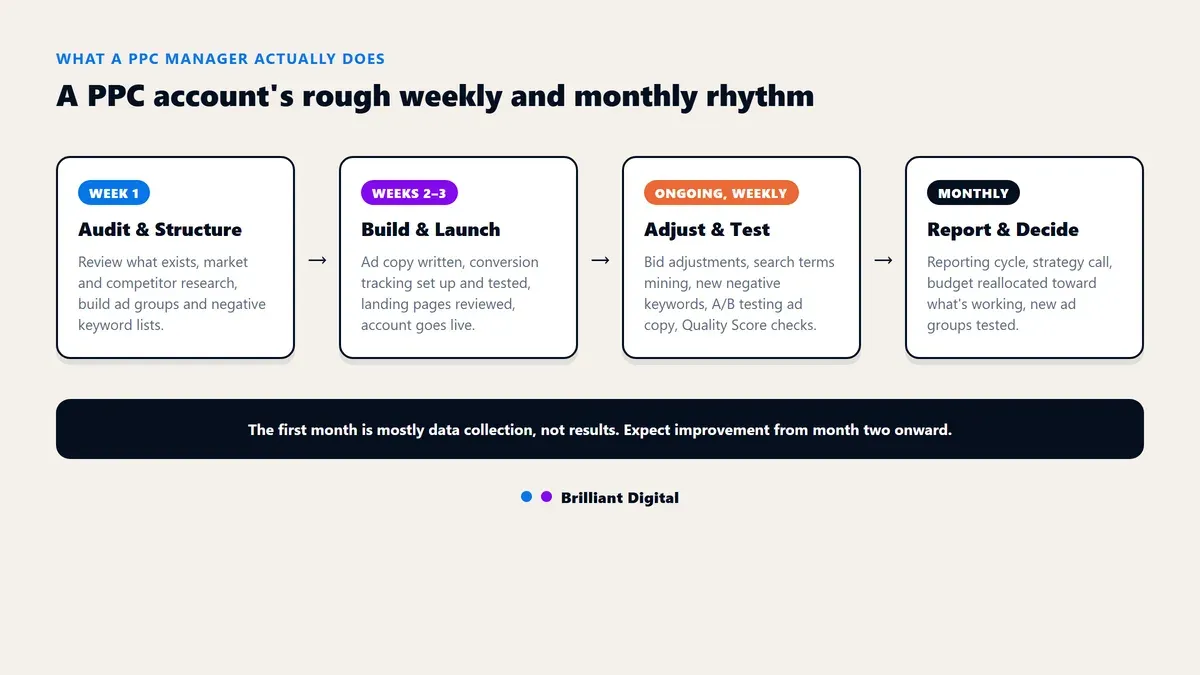
A PPC manager's work follows a rough pattern: account structure and research in week one, build and launch over the next two weeks, then ongoing weekly bid adjustments, keyword mining, and ad testing once the campaign is live, with a monthly reporting cycle on top.
Week 1: audit and structure. A new account starts with a review of what already exists (if anything), some market and competitor research, and building the campaign structure: ad groups, initial keywords, negative keyword lists.
Weeks 2-3: build and launch. Ad copy gets written, conversion tracking gets set up and tested, and the account goes live. Landing pages get reviewed too, since an ad sending traffic to the wrong page wastes the budget before it has a chance to work.
Ongoing, weekly: bid adjustments based on what's converting, mining the search terms report for new keyword opportunities and new negative keywords, A/B testing ad copy variations, and checking Quality Score issues that push up cost per click.
A single search terms report review can turn up a dozen phrases triggering ads that have no business being there, a plumbing business discovering its ads are showing for "plumber jobs near me" rather than "emergency plumber," for instance. Catching that early is the difference between a campaign that improves steadily and one that quietly bleeds budget for months without anyone noticing.
Monthly: a proper reporting cycle, a strategy call to review what changed and why, and a look at whether the budget allocation across campaigns still makes sense. This is also when the bigger decisions get made: increase the budget on a campaign that's working, pause one that isn't, or test a new ad group entirely.
The first month is mostly about gathering data, not results. Google's own Smart Bidding systems need a learning period, typically around one to two weeks of consistent activity, before performance stabilises. Expect the first few weeks to be about getting the structure right, with results tending to improve from month two onward once there's enough data to optimise against.
DIY vs Hiring a PPC Manager
Running PPC yourself makes sense in genuinely narrow circumstances, and hiring help makes sense in most others. The dividing line is usually time, not money: DIY works when you have the spare hours to learn and monitor the account properly every week, and hiring works when you don't.
DIY tends to work when:
- Your ad spend is small and you're testing whether PPC is worth pursuing at all
- You have the time to learn keyword research, bid management, and conversion tracking properly, not just switch campaigns on and leave them
- Your account is simple: one product or service, one obvious audience, one platform
Hiring makes more sense when:
- You don't have the spare hours each week to review and adjust the account properly
- You want someone bringing patterns from other accounts, not learning from scratch on yours
- You're past the testing phase and the budget is big enough that mistakes get expensive
Consider two businesses spending the same £800 a month on ads. One is a sole trader running a single campaign for a local service, checking it for twenty minutes on a Sunday evening. The other is a growing business with three product lines, testing landing pages, and trying to work out why last month's conversion rate dropped. The first can probably manage without help for a while longer. The second is already past the point where DIY is the efficient choice, whatever the monthly fee might suggest.
Neither option is automatically the right one. A sole trader spending £500 a month on ads for a local service probably doesn't need an agency yet. A business ready to commit £3,000 a month, with nobody in-house who can monitor it weekly, is paying for inefficiency either way: either in wasted ad spend from neglect, or in an agency fee that buys back the time.

How to Choose a PPC Provider
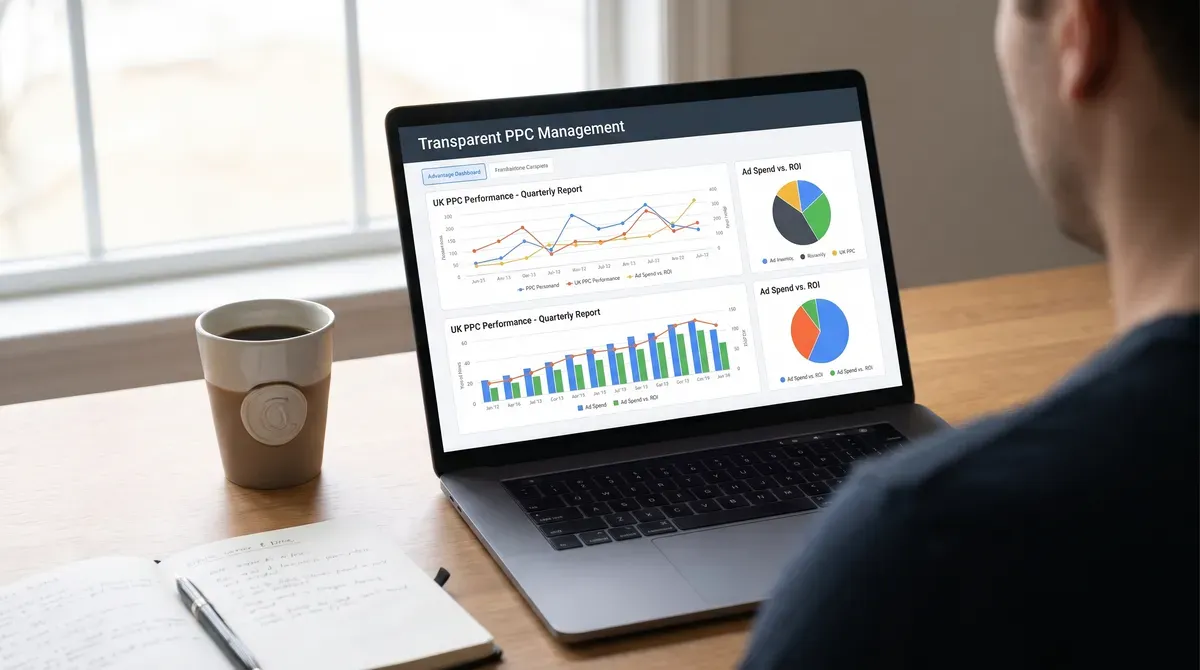
The price on a quote tells you less than the answers to a few direct questions: how is success measured, who owns the account data, and what happens if you decide to leave. Good management shows its working; poor management hides behind a dashboard.
None of this requires technical knowledge to assess. It requires asking the provider to show their working, the same way you'd want from anyone handling money on your behalf.
What good management looks like:
- Transparent reporting that shows exactly what changed and why, not just a dashboard screenshot
- Full ownership of your own Google Ads account, meaning you keep access if you ever leave
- A clear plan for the first 90 days, not a vague promise of "ongoing optimisation"
- Honesty about what PPC can and can't fix. If your website isn't converting, more traffic to it doesn't help
- A willingness to say "this probably isn't worth doing yet" rather than finding a way to bill for it anyway
Red flags worth taking seriously:
- Guaranteed results. Nobody controls the auction, and a guarantee is usually a sign of inexperience, not confidence
- No visibility into where the ad spend is actually going
- Reporting that only shows clicks and impressions, with no mention of what any of it actually cost to acquire a lead
- Reluctance to hand over account access, or vague answers about what happens if you leave
If you already have an agency managing your account and you're not sure whether any of this is actually happening, that's worth checking before signing anything new. We're happy to look at an existing account and tell you honestly what we see. Get in touch and we'll talk it through, no lengthy proposal required.
Beyond Google: Bing, Meta and LinkedIn Ads
PPC management isn't limited to Google Ads, even though it's usually where businesses start. Microsoft Advertising, Meta Ads, and LinkedIn Ads all run on the same pay-per-click principle, but each reaches a different audience and suits a different kind of business.
Microsoft/Bing Ads reaches a different, often older and higher-income audience, and typically costs less per click than Google. For many small businesses it's worth running alongside Google rather than instead of it. It won't replace Google as the main channel for most businesses, but as a lower-cost supplement it often produces a respectable share of leads for a fraction of the spend.
Meta Ads (Facebook and Instagram) work differently to search ads: instead of capturing people actively searching for something, they put the business in front of people based on interests and behaviour. Useful for building awareness, less useful for catching someone who's already decided to buy. It tends to work best alongside search advertising rather than instead of it: Meta builds awareness of a business, and Google or Bing then captures the search that awareness eventually triggers.
LinkedIn Ads make sense almost exclusively for B2B, where the ability to target by job title or industry outweighs the higher cost per click. That cost is often several times higher than Google's, which only makes sense when the value of a single converted lead justifies it, as it typically does in B2B.
A good PPC manager should be able to say honestly whether a platform beyond Google is worth the budget, rather than recommending all of them because more platforms means a bigger retainer. For the basics of paid advertising beyond Google specifically, our guide to paid advertising for UK small businesses covers the fundamentals.
Frequently Asked Questions
How much does PPC management cost?
Most UK businesses pay somewhere between £400 and £2,500+ a month for management, depending on the pricing model and how complex the account is. This is separate from the ad spend itself, which goes to the platform (Google, Bing, Meta), not the agency.
How does PPC work?
You bid on keywords relevant to your business, and your ad appears when someone searches for them. You only pay when someone clicks the ad, hence "pay-per-click." Where your ad appears depends on your bid and your Quality Score, a measure of how relevant your ad and landing page are to the search.
What does a PPC manager do, exactly?
They research keywords, build and structure campaigns, write and test ad copy, manage bids and budgets, set up conversion tracking, and report on results. The ongoing part, adjusting and improving week to week, is what separates management from a one-off setup.
Is PPC better than SEO, or do I need both?
Neither is universally better. PPC gets you visibility immediately but stops the moment you stop paying. SEO takes longer to build but keeps working without an ongoing spend. Our PPC vs SEO comparison goes through the trade-offs in more depth.
How do I manage PPC myself if I'm not ready to hire someone?
Start with a small, simple campaign: one product or service, tight keyword targeting, and a solid negative keyword list from day one. Set up conversion tracking before you launch, not after. Expect the first few weeks to be about learning, not results.
How long does it take to see results from PPC?
Expect the first two to four weeks to be mostly about data collection, not results. Google's bidding systems need a learning period to find their footing. Most businesses see a clearer picture of what's working by month two, with performance typically improving from there as the account matures.
What to Do Next
If you're weighing up whether to manage PPC in-house or bring someone in, the honest answer usually comes down to time rather than budget. Someone needs to be looking at the account every week, whether that's you or someone you're paying to do it. There's no universal right answer here, only the one that matches how much time you genuinely have to give the account the attention it needs.
We've been doing this since 2014, long enough to have built over 150 websites and run Google Ads for small businesses across a lot of different industries. At Brilliant Digital, we manage Google Ads for a small number of clients, by design. No account managers juggling thirty accounts, no handoffs, just direct access to Alex. Have a look at our Google Ads management service, or tell us about your business and we'll come back to you honestly about what's possible.