
Nobody needs convincing that customer testimonials work. Every business owner we speak to already believes it. The problem is never belief. It is that asking feels awkward, the replies come back vague, and the testimonials that do arrive end up buried on a page nobody visits.
This guide fixes all three. You will get the exact words to send, three questions that stop your customer staring at a blank screen, and the places on your website where testimonials actually change someone's mind.
There is also one thing you need to know that almost every article on this topic still gets wrong. The UK rules on reviews changed in April 2025, and one of the most commonly repeated pieces of testimonial advice is now specifically named in the regulator's guidance. We will come to that.
Key Takeaways
- A customer testimonial is a positive statement you request and publish yourself. A review is left independently on a platform like Google. The difference matters more than it used to, legally.
- Specific beats glowing. "They saved us about six hours a week on admin" persuades. "Great service, highly recommended" does not.
- The blank page is why people do not reply. Send three short questions instead of asking for "a few words" and your response rate climbs.
- Placement beats volume. Three testimonials next to the enquiry form will do more than thirty on a separate testimonials page.
- The UK rules changed in April 2025. Under the Digital Markets, Competition and Consumers Act 2024, certain review practices are now automatically unlawful, and the guidance explicitly covers reviews you publish on your own website.
What is a customer testimonial?
A customer testimonial is a positive statement from a customer about their experience with your business, which you request, and which you publish on your own marketing, usually your website. It is different from a review, which a customer leaves independently on a third-party platform such as Google, Trustpilot or Checkatrade.
That distinction used to be a technicality. It is worth understanding properly now, because the rules that govern one increasingly govern the other.
Testimonial or review: what is the difference?
The practical differences come down to who controls it and where it lives.
- Who asks: you ask for a testimonial. A review is usually left unprompted, or after an automated request.
- Who publishes: you publish testimonials on your own site. Reviews are published by the platform.
- Who can remove it: you choose which testimonials to display. You cannot remove a genuine review you dislike.
- What it looks like: testimonials are usually longer and more specific. Reviews are often a star rating plus a sentence.
One important point that catches people out. The definition of a "consumer review" in UK law is deliberately broad. It covers a review of a product, a trader, or any other matter relevant to a buying decision, and the guidance states it does not have to be written by a consumer to fall within the definition. In practice, treat the testimonials on your website with the same care as reviews on Google.
Why customer testimonials work
Testimonials work because they answer the question every prospect is silently asking: has this gone well for someone like me? You can claim you are reliable. A customer saying you turned up when you said you would is a different kind of evidence, because they have nothing to gain by saying it.
There are three things a good testimonial does that your own copy cannot.
- It handles objections you cannot raise yourself. A customer saying "I was worried about the cost, and it turned out to be worth it" addresses price resistance far better than a paragraph about value.
- It makes the abstract concrete. "Professional service" means nothing. "They rebuilt our booking system and we stopped losing Saturday bookings" means something.
- It reduces the risk of choosing you. Most buying decisions for a service are risk decisions. Evidence that other people took the same risk and were fine is what tips them.
We have been building websites since 2014, and across 150+ projects the pattern has been consistent. The sites that convert well are rarely the prettiest. They are the ones where a visitor can find proof quickly, close to the point where they are deciding whether to get in touch. That is one of the key elements of a good website, and it is one of the cheapest to fix.
The seven types of customer testimonial
Not all testimonials do the same job. A one-line quote builds general reassurance. A results testimonial closes a sale. Most small business websites use only the first type, which is why their testimonials feel decorative. Here are the seven worth knowing, roughly in order of persuasive power.
Most collections of testimonial examples online are really collections of designs, which is useful if you are choosing a layout and useless if you are trying to work out what to actually put in one. These are sorted by what the testimonial says, not how it looks.
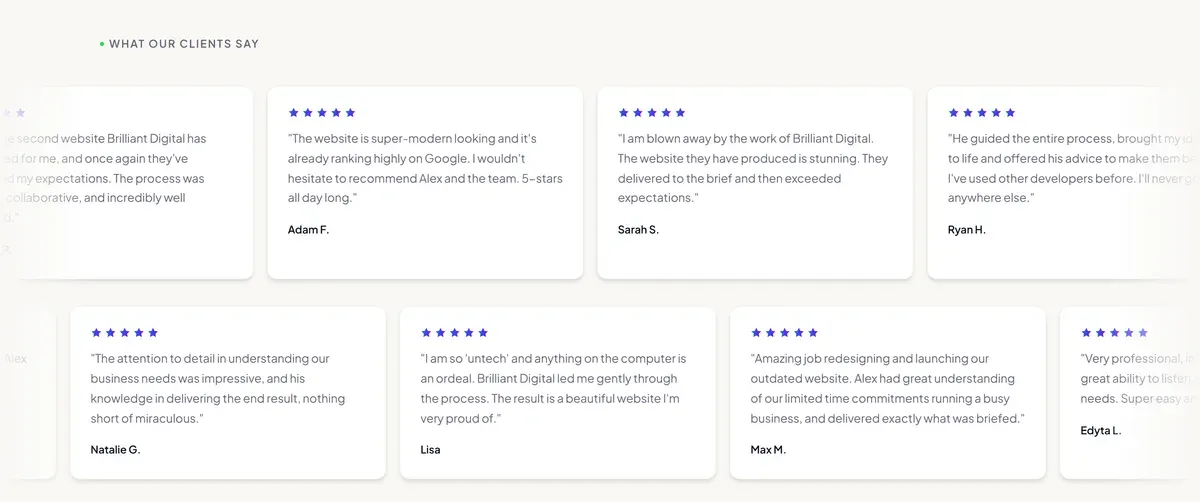
1. The quote testimonial
The standard format: a sentence or two, a name, ideally a photo. Quick to collect and easy to display. Weakest on its own, useful in volume.
2. The results testimonial
The strongest written format, because it contains a number or a specific outcome. Use the Before, After, Result structure:
- Before: what the problem was
- After: what you did about it
- Result: what changed, ideally measurable
"We were getting maybe two enquiries a month through the site. Brilliant Digital rebuilt it in September. We had eleven in October." That is a results testimonial, and it does more work than twenty compliments.
3. The video testimonial
Hardest to get, hardest to fake, and therefore the most credible. A thirty second phone video from a real customer beats a polished studio piece, because the roughness is the proof. Ask at the point where someone has just told you they are pleased.
4. The review-platform testimonial
A screenshot or embed of a genuine Google review or Trustpilot rating. The platform's branding carries credibility your own page cannot, because the visitor knows you could not have written it yourself. If you are not already collecting Google reviews, setting up your Google Business Profile is the first step.
5. The case study
A full write-up of one project: the situation, the work, the outcome. Slower to produce, but it does double duty as a testimonial and as a page that can rank in search.
6. The social media screenshot
An unsolicited compliment posted publicly. Screenshot it, and ask permission before you republish it. The informality is what makes it believable.
7. The named client list
Not strictly a testimonial, but it works alongside them. Recognisable names or logos provide reassurance at a glance. Only useful if your customers would recognise the names.
How to ask for a customer testimonial
Ask within a few days of the moment someone tells you they are pleased, make the request specific, and give them the questions to answer. Most testimonial requests fail not because the customer is unwilling, but because "could you write us a few words?" hands them a blank page and a vague brief.
When to ask
The best moment is immediately after a customer expresses satisfaction unprompted. An email saying "this is exactly what we wanted" is an open door. Ask then, while the detail is fresh and the goodwill is real. Waiting three months means asking someone to recall how they felt, which produces generic answers.
The email to send
Adapt this. It works because it is short, it explains why you are asking, it sets the effort expectation honestly, and it does the hard part for them.
Subject: A quick favour
Hi [Name],
Really pleased the [project/job] worked out well for you.
Would you mind if we used a short testimonial from you on our website? It genuinely helps people who are deciding whether to get in touch with us.
To make it easy, you could just reply to this email answering these three questions in a sentence each:
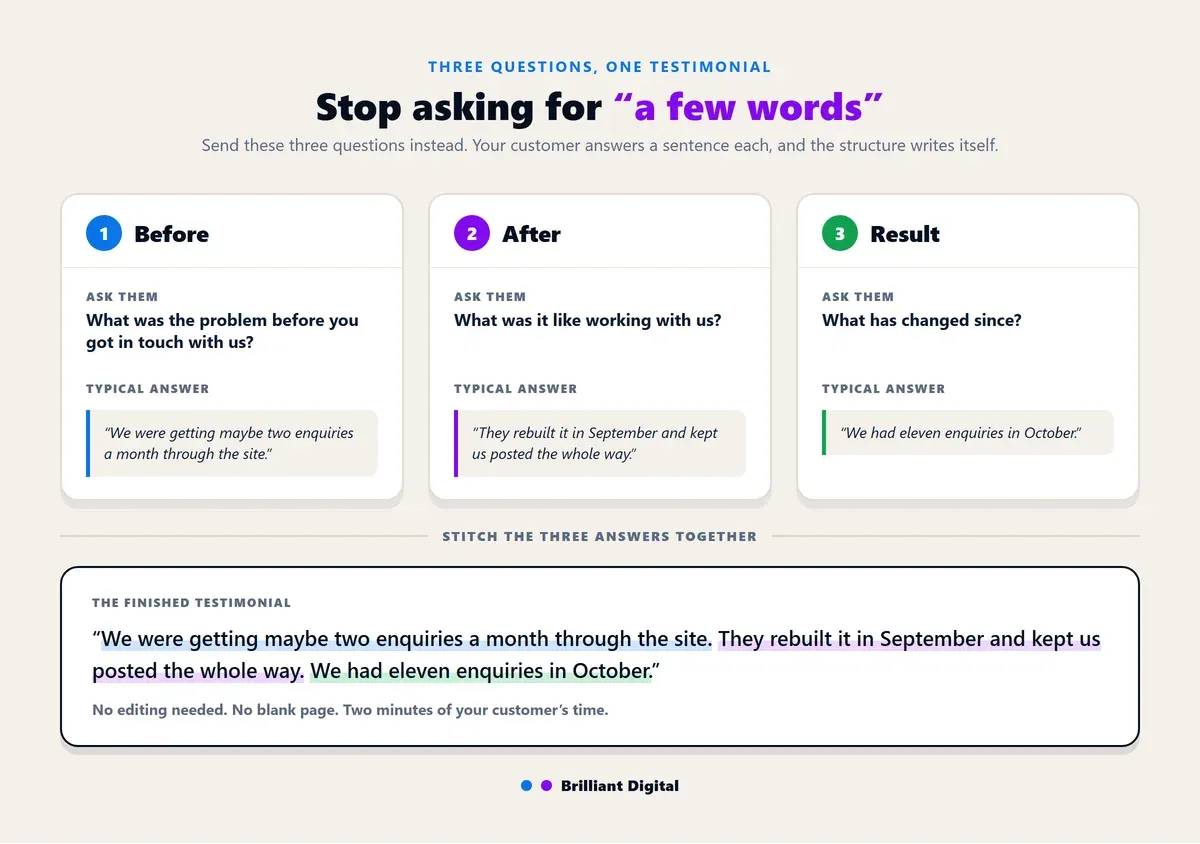
1. What was the problem before you got in touch with us?
2. What was it like working with us?
3. What has changed since?
No need to make it polished. We will tidy up the wording and send it back for you to approve before anything goes live. Two minutes at most.
Thanks,
Three questions that solve the blank page
Those three questions are the important part, and they are worth understanding rather than just copying.
- "What was the problem before?" produces the setup. Without it, a testimonial has no tension and reads as flattery.
- "What was it like working with us?" produces the reassurance about process, which is what nervous prospects actually want.
- "What has changed since?" produces the result, which is the part that persuades.
Answer those three in order and you have a Before, After, Result testimonial without your customer ever needing to know what one is.
Always send it back for approval
Tidy the grammar, cut it to length, then send the edited version back and ask them to confirm they are happy. This is good manners, it protects you, and people almost always say yes. Never publish a testimonial your customer has not seen in its final form.
What if you have no testimonials yet?
Every business starts here, and nobody else writing about this seems to mention it. Three honest options:
- Ask past customers, even old ones. A testimonial about work from two years ago is still valid. Be upfront that you are building the page.
- Use what you already have. Search your inbox for phrases like "thank you" and "delighted". You will find compliments you forgot about. Ask permission to use them.
- Say nothing rather than fake something. An empty testimonials section is a small problem. An invented one is now a legal problem, and it is more obvious than people think.
Not sure your website is making the most of the proof you already have? Tell us about your business and we will give you an honest view of what is and is not working. No hard sell. Get in touch.
Where to put testimonials on your website
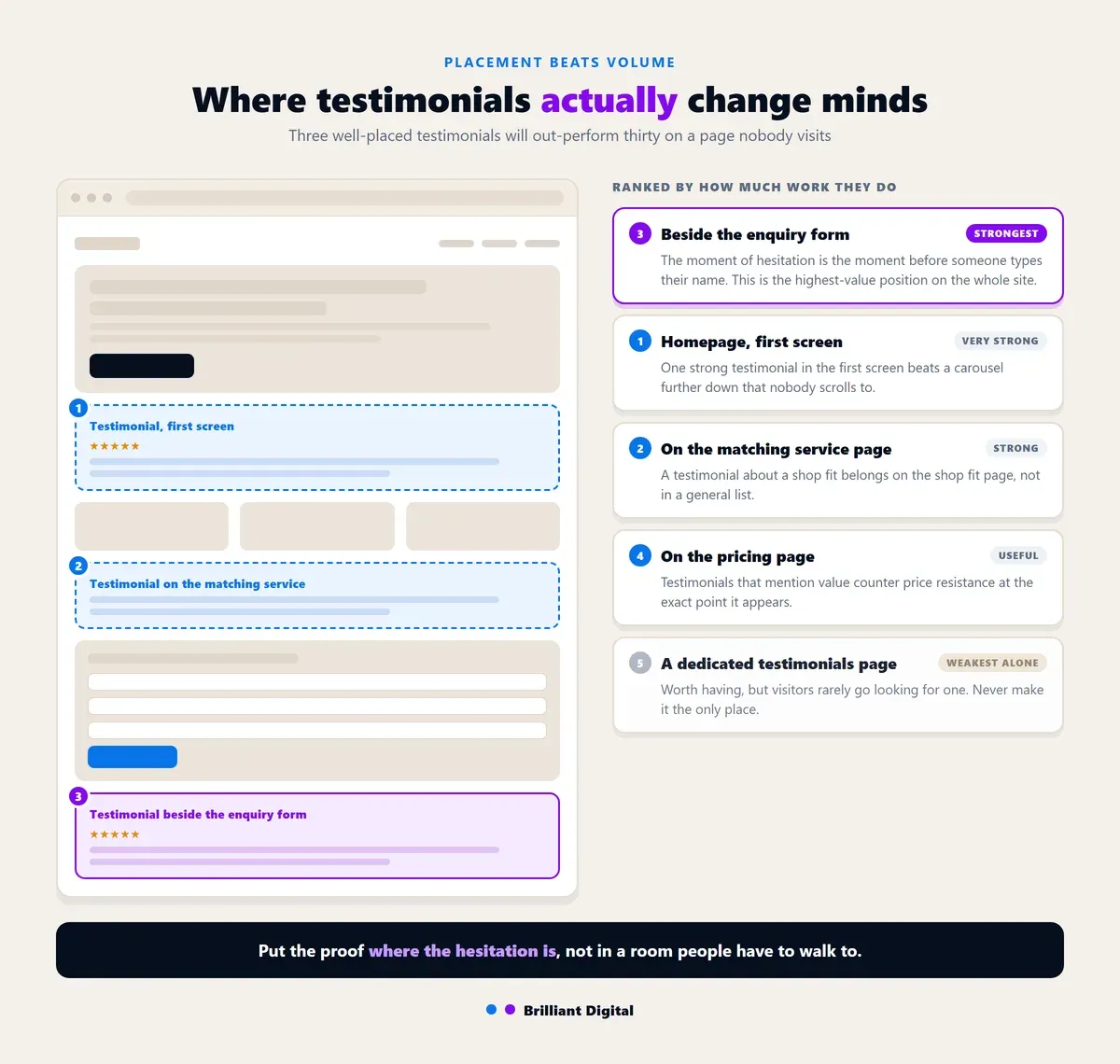
Put testimonials next to the decisions they support, not in a single block on a separate page. A dedicated testimonials page is worth having, but it is the least valuable placement, because visitors rarely go looking for one. The persuasion happens where hesitation happens. The same logic applies to the words around them, and where to place proof in your copy is part of writing a page that gets enquiries.
Here is where they earn their place:
- On the homepage, above the fold or just below it. One strong testimonial in the first screen does more than a carousel further down.
- Next to the enquiry form. This is the highest-value position on the entire site. The moment of hesitation is the moment before someone types their name.
- On each service page, matched to that service. A testimonial about a shop fit belongs on the shop fit page, not the general list.
- On pricing pages. Testimonials that mention value directly counter price resistance at the exact point it appears.
- On a dedicated testimonials page. Useful for people who want to dig, and useful as a link target. Just do not make it the only place.
One placement people forget: if you run Google Ads, the landing page your ad points at needs its own testimonial, matched to the promise in the ad. You have paid for that click. Sending it to a page with no proof on it is the most expensive place to leave a testimonial out.
A few practical points on presentation. Use full names where the customer allows it, because initials read as invented. Add a photo, a business name and a location if you can, since specificity is what makes a testimonial credible. Keep them short enough to actually be read. And avoid auto-rotating carousels, which move on before anyone has finished reading.
If you want to go further on this, our guide to maximising conversion rates on your website covers the other elements that sit alongside social proof, and the pages every successful website needs covers where they fit structurally.
The UK rules changed in 2025, and most advice has not caught up
In April 2025, a set of practices relating to consumer reviews became "banned practices" under the Digital Markets, Competition and Consumers Act 2024, usually shortened to the DMCC Act, meaning they are automatically unfair and unlawful. The Competition and Markets Authority published its guidance, Fake reviews: CMA208, on 4 April 2025. It applies to reviews published on your own website.
We are a web agency, not a law firm, so treat this as a prompt to read the guidance rather than as legal advice. But it matters, because almost every popular article on testimonials was written before the rules changed and has not been updated since.
What is actually banned
The guidance covers three broad areas:
- Fake reviews. A review that "purports to be, but is not, based on a person's genuine experience". This includes asking staff to write reviews.
- Concealed incentivised reviews. Reviews given in exchange for a benefit, where that fact is not made clear.
- Publishing reviews in a misleading way. This is the one that catches honest businesses out.
The advice everyone repeats, that the guidance names
Here is the part worth reading twice. On cherry-picking, CMA208 says the practice "might be done either through suppressing negative reviews that have been submitted or by encouraging just those who are satisfied to leave reviews".
Read that second half again. "Only ask your happy customers" is the single most repeated tip in this entire topic. It appears in the advice published by some of the largest software companies in the world, and it is what AI assistants will tell you if you ask them today.
Two important qualifications, because this is easy to overstate. The guidance's concern is presenting a selection that does not reflect what customers are reporting overall. Having a testimonials page made up of genuine, happy customers is not in itself unlawful, and the guidance is clear that a review is not fake just because you dislike it. What is named is systematically filtering who gets asked, editing or withholding genuine negative reviews, and discouraging people from leaving them.
The practical read: ask everyone, publish honestly, and never make resolving a complaint conditional on somebody not leaving a review.
Incentives: the discount and prize draw distinction
This is a genuinely useful detail that we have not seen covered anywhere else. Under the guidance, "commissioning" a review is not limited to paying cash. It includes discounts, vouchers, freebies, free stays and event invitations. Any of those must be disclosed.
But there is a specific carve-out. The guidance notes that offering the chance to earn a reward which does not guarantee a direct benefit, giving the example of entering reviewers into a prize draw, is unlikely to amount to commissioning.
So a £10 voucher for every review is an incentive you must disclose. A monthly prize draw for everyone who leaves one is treated differently. If you run either, read the guidance rather than taking our summary as the final word.

This is being enforced
It is not theoretical. In its first year of direct consumer enforcement, the CMA ran a sweep of review platforms and sent advisory letters to 54 firms, reporting that "90% of the businesses we contacted then took action to improve their policies". In March 2026 it opened investigations into five companies over misleading reviews.
One last thing that is easy to miss. Aggregate claims count too. The guidance treats overall ratings and review counts as "consumer review information", which must be accurate. We say 180+ five-star reviews on our own homepage, and it is our job to make sure that number is correct and stays correct. If your site says "hundreds of happy customers", make sure you could evidence it.
Frequently Asked Questions
What is a customer testimonial?
A customer testimonial is a positive statement about your business, given by a customer at your request, which you then publish on your own marketing. The key difference from a review is control: you decide where a testimonial appears, whereas a review sits on a third-party platform such as Google or Trustpilot.
What makes a good customer testimonial?
Specificity. A good testimonial names a real problem, describes what happened, and states what changed, ideally with a number or a concrete outcome. Vague praise like "excellent service" persuades nobody. Adding a full name, photo and business name makes it more credible again.
How do I politely ask a customer for a testimonial?
Ask shortly after they have told you they are pleased. Keep the request short, explain that it helps people deciding whether to contact you, and send three specific questions rather than asking for "a few words". Offer to tidy the wording and send it back for approval.
Where should testimonials go on a website?
Next to the decisions they support: on the homepage, beside your enquiry form, and on the relevant service page. The enquiry form is the highest-value position, because it is where hesitation happens. A dedicated testimonials page is worth having, but it is the weakest placement on its own.
Can I offer a discount in exchange for a review?
You can, but under the CMA's guidance a discount is an incentive, and incentivised reviews must be clearly disclosed. Reviews that hide the fact they were incentivised are a banned practice. The guidance treats prize draws differently, as they do not guarantee a benefit.
How many testimonials do I need on my website?
Three genuinely specific testimonials placed well will outperform thirty generic ones on a separate page. Aim for enough to cover each of your main services, so a visitor sees proof relevant to what they are actually buying, rather than proof in general.
Getting this right on your own website
Most small business websites already have the raw material. The testimonials exist, sitting in an inbox or on a Google Business Profile, and they are simply not on the page where somebody is deciding whether to get in touch. That is a fixable problem, and usually a quick one.
If your website is not turning visitors into enquiries, proof placement is one of the first things we look at. We have built 150+ websites since 2014, and we have 180+ five-star reviews of our own, so this is a problem we have solved from both sides.
Tell us about your business and what you are hoping to achieve online, and we will come back to you honestly about what we think. No lengthy proposals, no hard sell. Get in touch.