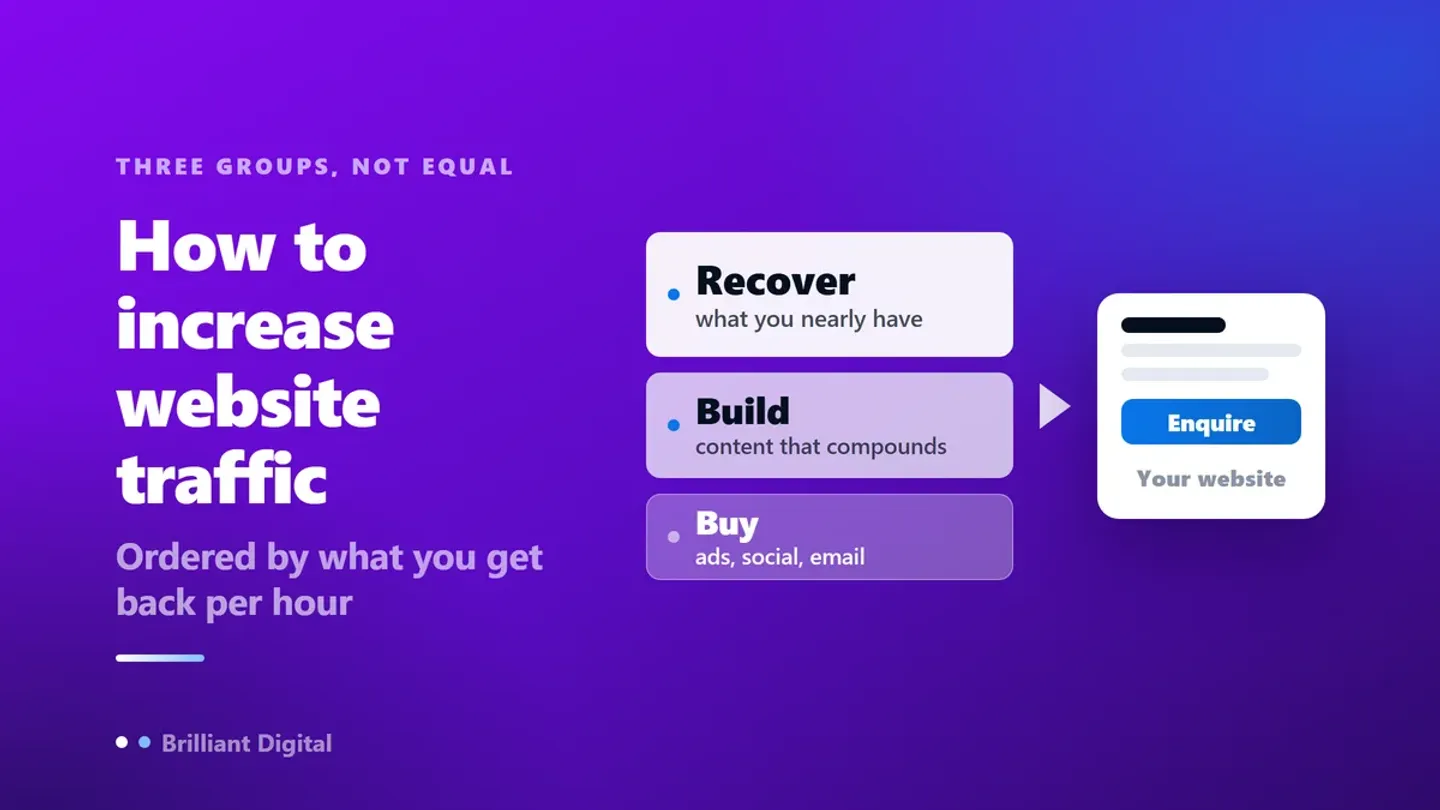
To increase website traffic, work through three groups in this order. First, recover what you have nearly earned already: get indexed, complete your Google Business Profile, and improve the pages already sitting on page two. Second, build the thing that compounds, which is content answering the questions your customers actually ask. Third, and only then, buy attention through paid ads, social or email.
Most articles on this subject give you twenty-seven or thirty-nine tactics of equal weight. That is not a plan, it is a list. If you run a business and have four hours a month for marketing, a flat list of thirty-nine jobs leaves you doing the easy one instead of the one that matters.
Website traffic is the number of people who visit your website, and where they come from matters far more than how many there are. Most guides on this topic are written by someone with a traffic product to sell, and it shows in the order they put things in. We build websites. That is the only reason this list is ordered the way it is.
Key Takeaways
- If you serve a local area, your Google Business Profile is the fastest win available. It can move within days, and it sits at number six or lower in almost every article you will read.
- Improving a page that already ranks on page two beats writing a new one, and it is a fraction of the work.
- Expect days for paid ads and email, weeks for your Business Profile, and months for search and content. Anyone promising traffic faster than that without spending money is guessing.
- Organic social media is the lowest-return hour for most small local businesses. It is not useless, it is just far down the list.
- A visit is not an enquiry. Forty people who need what you sell are worth more than a thousand who do not.
Where website traffic actually comes from
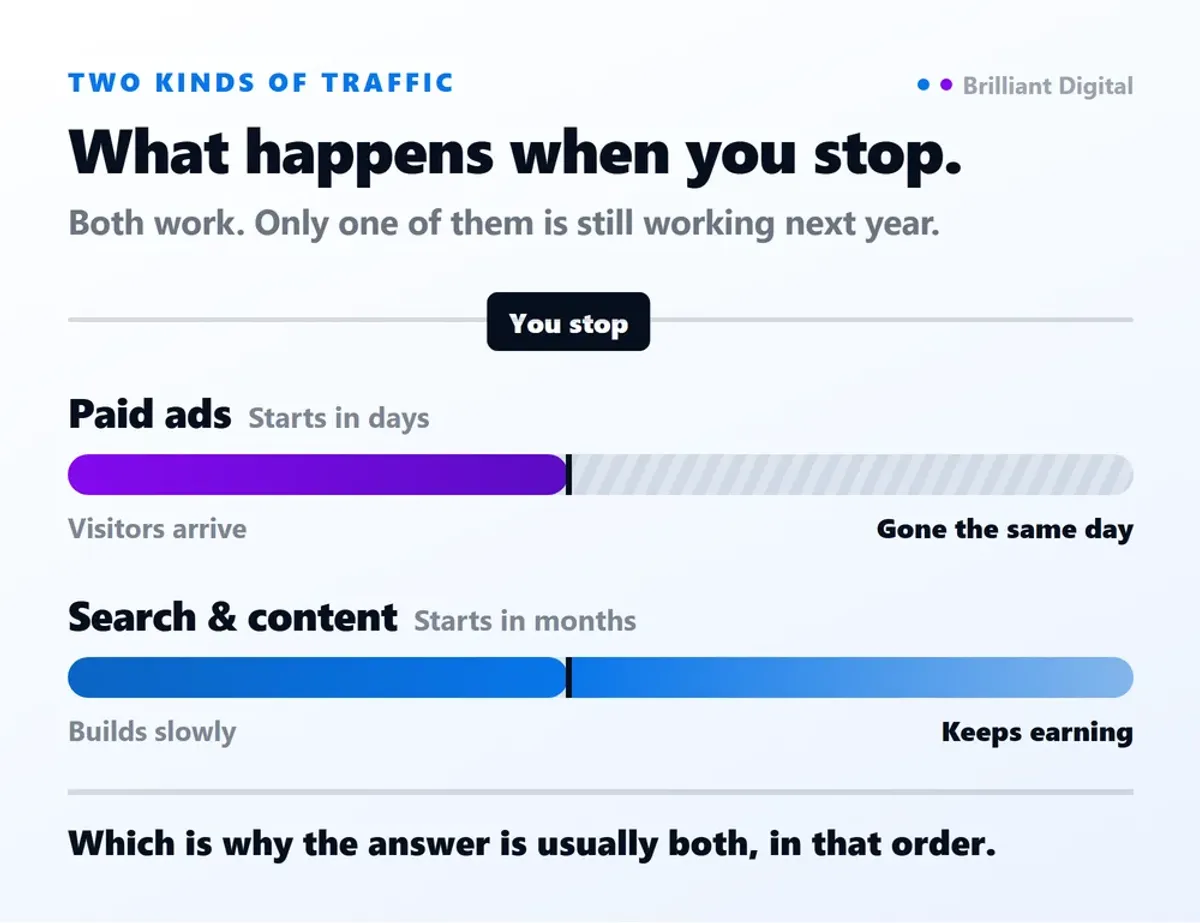
Website traffic arrives through five doors: organic search, direct visits, referrals from other websites, social media, and paid advertising. Each one behaves differently. Search and referrals compound quietly over months. Paid traffic arrives the day you switch it on and stops the day you switch it off.
Knowing which door your visitors use changes what you should work on. A business getting almost everything from direct visits has a discovery problem, not a website problem. A business getting nothing from search usually has something broken rather than something missing.
Here is the part almost nobody puts at the top: more traffic is not the goal. More enquiries are.
We have seen sites double their visitor numbers and take exactly the same number of phone calls, because the extra visitors were never going to buy anything. If your website turns one in fifty visitors into an enquiry, doubling traffic doubles your enquiries. If it turns none of them into an enquiry, doubling traffic doubles nothing.
Which is why the cheapest traffic win is often not traffic at all. Adding the things that make a stranger trust you, such as testimonials and reviews, costs nothing in visitors and changes what happens to the ones you already have.
So as you work through the list below, keep asking a second question alongside "will this bring more people?" The second question is "will it bring the right ones?"
Start here: the traffic you already almost have
The first three jobs are the cheapest on the list and they gate everything after them. They recover traffic you have nearly earned already: searches where you should appear and do not, and pages sitting just outside where anyone looks. Most sites we see have a problem here while the owner works on something further down.
1. Check that Google can actually find you
Type site:yourdomain.co.uk into Google. What comes back is roughly what Google has indexed. If you see far fewer pages than your website has, or nothing at all, you have found your problem, and it is not a marketing problem.
The usual causes are dull and fixable: a noindex tag left on from the staging site, a robots.txt file blocking crawlers, no sitemap submitted, or pages that nothing links to. Google Search Console is free and will tell you the status of any page on your site.
If this is where you are, we have written in more detail about why a website does not show up on Google, including how to read what Search Console is telling you.
2. Fill in your Google Business Profile properly
If you serve customers in a particular area, this is the highest-return hour on this entire page. A complete profile can put you in the map results for searches you would never rank for organically, and it can move within a week rather than a quarter.
Fill in all of it, not the minimum: primary category, every service you offer, opening hours, service area, photos taken this year rather than in 2019, and a description written for a customer rather than for Google. Google's own guidance covers the mechanics.
Then ask for reviews, consistently. Most businesses simply never ask. We have covered this properly in the power of Google Business Profile, and there are more tactical wins in our 13 local SEO tips.

3. Improve the pages that already rank on page two
Nobody tells you this, and it is the single most efficient traffic job available to a small business. A page sitting at position 15 for a search your customers actually make is already most of the way there. Moving it into the top ten is a rewrite and a few links. Getting a brand new page to position 15 takes months.
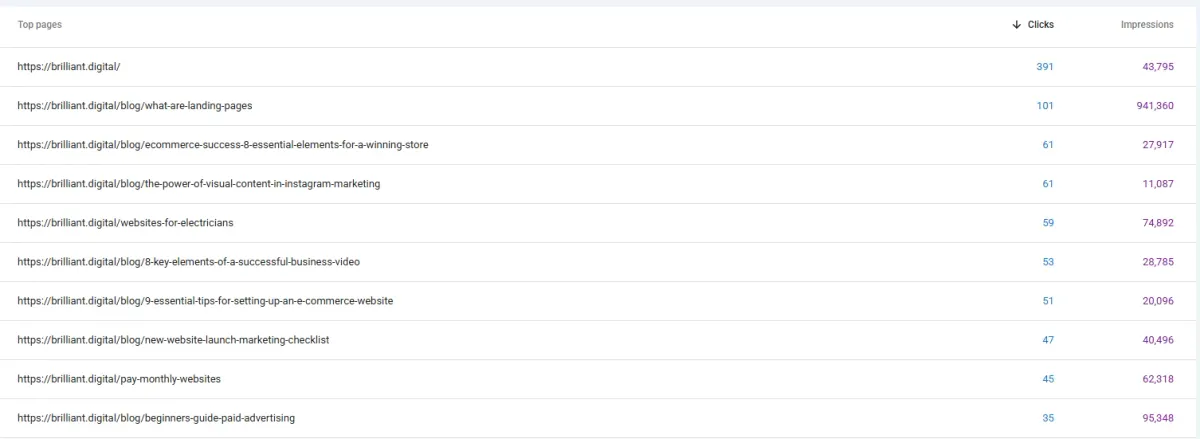
Open Search Console, sort by impressions, and find the pages getting seen but not clicked. Those are your candidates. Rewrite the title so it answers the search rather than describing the page, tighten the opening paragraph, and add the detail the page is missing.
If you want the full method, that is what how to improve your Google ranking covers, in order of impact.
Then build the thing that compounds: content and search
Content and search are where traffic starts to build on itself. A page that answers a real question keeps earning visitors for years without further spend, which is exactly what paid traffic cannot do. The trade-off is honest: this is the slowest group on the list, and the first results usually take months.
4. Write for the questions your customers actually ask
The mistake is chasing the big, obvious search term. "Web design" gets enormous volume and you will never rank for it. "How much does a website cost for a plumber" gets far less, and the people typing it are three steps closer to spending money.
Listen to what customers ask you on the phone. Those questions, written down in their words, are your best content plan. They are also the phrasings people now type into AI assistants, which tend to be longer and more conversational than old-style search terms.
This is the whole argument for search being worth the wait, and we have made it at length in why SEO matters for small businesses.
5. Write fewer, better pages
The advice to blog every week is usually wrong for a small business. Ten thin posts nobody reads do less than two genuinely useful pages that answer a question properly.
We would rather see a business publish one substantial page a month, keep it updated, and link it sensibly to the rest of the site. If you want a framework for deciding what to write, our guide to building a content marketing strategy sets out how to choose topics that earn their place.
6. Make the site fast, and make it work on a phone
Speed will not push a bad page to the top of Google. But a slow site loses visitors you already paid for or earned, which is a more expensive problem than it sounds. Most people give up on a slow page before they see any of your work.
Compress your images, cut the plugins you do not use, and test it on an actual phone on mobile data rather than on office wifi. Our article on how to improve website speed covers the fixes in order of impact.
What AI answers are doing to your traffic
Search this article's own subject on Google and you will see an AI-generated answer sitting above every result, in the space a featured snippet used to occupy. That is the biggest change to how informational traffic works in a decade, and three of the most-visible articles on this topic do not mention it at all.
The practical effect for a small business is twofold. General "what is" and "how do I" searches send fewer clicks than they used to, because the answer appears on the results page. But being cited in those answers is becoming valuable in its own right, and the sources being cited are not always the biggest brands.
What earns a citation is roughly what earns a good ranking: a clear, direct answer near the top of the page, specific rather than vague claims, and a page that is obviously about one thing. Google documents how its AI features in Search work and what makes content eligible.
The stronger lesson is one we would give anyway: stop relying on a single source of visitors.
The channels that buy attention: paid, social and email
The last group buys attention rather than earning it. Paid search works immediately and stops immediately. Email is the most underrated of the three because the audience is already yours. Organic social is the one most small businesses start with and the one that returns least per hour spent.
7. Paid search, when you need traffic this week
Google Ads is the only item on this list that produces qualified visitors the same day. That is genuinely useful when you have launched something, have capacity to fill, or need to test whether a page converts before investing months in ranking it.
It is also the easiest way to waste money quickly. We run Google Ads for clients, so we will say the uncomfortable part: most underperforming accounts are not failing because of the ads, they are failing because the budget is spread across searches that were never going to convert.
If you are weighing this against the slower route, we have compared the two honestly in PPC vs SEO and looked at whether Google Ads are still worth it for small businesses. If you would rather someone else ran it, that is what our Google Ads management is for.
8. Social media, with realistic expectations
Organic social media is worth doing if your work is visual or your customers are genuinely active on a platform. A builder posting finished jobs, a florist posting arrangements, a consultant posting on LinkedIn where their buyers actually are: all reasonable.
What does not work is posting the same thing to five networks and waiting. Pick one platform, post things worth clicking on, and send people to a specific page rather than your homepage. Your homepage is written for everybody, which means it is written for nobody in particular.
9. Email, the channel you already own
Email goes to people who have already told you they are interested, which makes it the highest-converting channel on this list and the cheapest to run. It also cannot be taken away by an algorithm change.
Give people a reason to join the list beyond "sign up for updates", send something genuinely useful rather than something you had to fill, and link to one page per email.
What to skip
Some of the advice you will find is a waste of your time, and no article that sells traffic services will tell you so:
- Traffic bots. Services promising thousands of visitors for a few pounds send automated traffic. It buys you nothing, it converts at zero, and it makes your analytics useless.
- Buying followers. Same problem, different platform. An audience that is not real cannot become a customer.
- Mass directory submissions. Being listed in two hundred directories nobody uses does not help. A handful of relevant, local, real ones does.
- Posting identical content everywhere. It takes five times the effort of doing one platform well and performs worse.
If you are not sure which of the nine jobs above applies to your site, that is a reasonable thing to ask about. Tell us what your website is doing now and we will tell you honestly where we would start.
How long does it take to increase website traffic?
There is no single answer, because each channel runs on a different clock. Paid ads produce visitors the same day. Your Google Business Profile moves in weeks. Search and content take months. As a realistic guide for a small business starting from a website that already works:
- Paid search: days. Traffic starts the day the campaign goes live.
- Email: immediately, if you already have a list. Months, if you are starting one from nothing.
- Google Business Profile: one to four weeks for local map visibility to change.
- Improving pages that already rank: four to eight weeks to see movement in Search Console.
- New content and search: three to six months before it earns steady traffic, longer in competitive subjects.
- Links and mentions: six months or more, and never on a predictable schedule.
Two honest caveats. These assume the work is actually done rather than started. And if someone promises meaningful search traffic in thirty days without spending anything on ads, they are either selling you something or guessing. Search is the slowest of those clocks, and we have set out how long SEO takes to work stage by stage.

Can you really get 1,000 visitors a day?
For most small UK businesses, this is the wrong target. A local trades business does not need a thousand daily visitors and will never get them from its own market, because the market is not that big. Chasing that number usually means chasing searches made by people who will never become customers.
Forty visitors a day who need what you sell will do more for your business than a thousand who found you by accident. If you want a number to aim at, use enquiries per month rather than visitors per day.
The businesses that genuinely need thousands of daily visitors are publishers and national e-commerce brands, where traffic is the product. If that is you, the list above still applies, it just runs at a different scale.
How to tell if any of it is working
You need two free tools and three numbers. The tools are Google Analytics and Search Console. The numbers are: how many enquiries you got, which pages produced them, and which channel those visitors arrived through. Everything else is interesting rather than useful.
Set up conversion tracking so that a form submission or a phone tap is recorded as an event. Without that, you are counting visits and guessing at the rest, which is how businesses end up celebrating a traffic increase that produced no work.
Ignore bounce rate as a headline metric. A visitor who reads your prices, sees your phone number and rings you is recorded as a bounce.
Give any change eight weeks before judging it, and compare like with like. Most businesses have a seasonal pattern, and comparing December with January tells you about the calendar rather than about your marketing.
Frequently Asked Questions
How can I increase website traffic for free?
Every job in the first two groups above is free apart from your time: fixing indexing problems, completing your Google Business Profile, improving pages that already rank, and answering real customer questions in your content. Free means unpaid, not effortless. Expect weeks to months rather than days.
How do I increase website traffic organically?
Organic traffic comes from unpaid search results. You increase it by making sure Google can index your pages, targeting the specific questions your customers ask rather than broad industry terms, improving pages already ranking on page two, and earning genuine mentions from other websites. It compounds slowly and then keeps paying.
Do website traffic bots work?
No. Traffic bots send automated visits that never read anything, never enquire and never buy. They inflate your visitor count, corrupt your analytics so you cannot tell what is genuinely working, and risk problems with advertising platforms. There is no version of this that helps a real business.
How do I get traffic without using social media?
Search, email and referrals will carry a small business perfectly well without any social presence. Focus on your Google Business Profile, content answering customer questions, an email list, and relationships with complementary local businesses. Plenty of the sites we build get almost no traffic from social media.
Why is my website traffic dropping?
The common causes are a technical change that stopped pages being indexed, a redesign that lost URLs or content, seasonal variation, or AI-generated answers absorbing clicks on general informational searches. Check Search Console for indexing errors first, then compare the same months year on year before assuming the worst.
What to do next
More traffic only helps if your website turns visitors into enquiries. That is the half of the problem this list does not solve, and it is the half we spend our time on: we have built over 150 websites since 2014, and the ones that work are the ones where the visitor knows what to do next.
If your traffic is fine but the phone is quiet, the problem is the website, not the marketing. Have a look at how we build websites, or tell us what is happening and we will give you an honest read on where we would start. No hard sell, just a straight conversation.