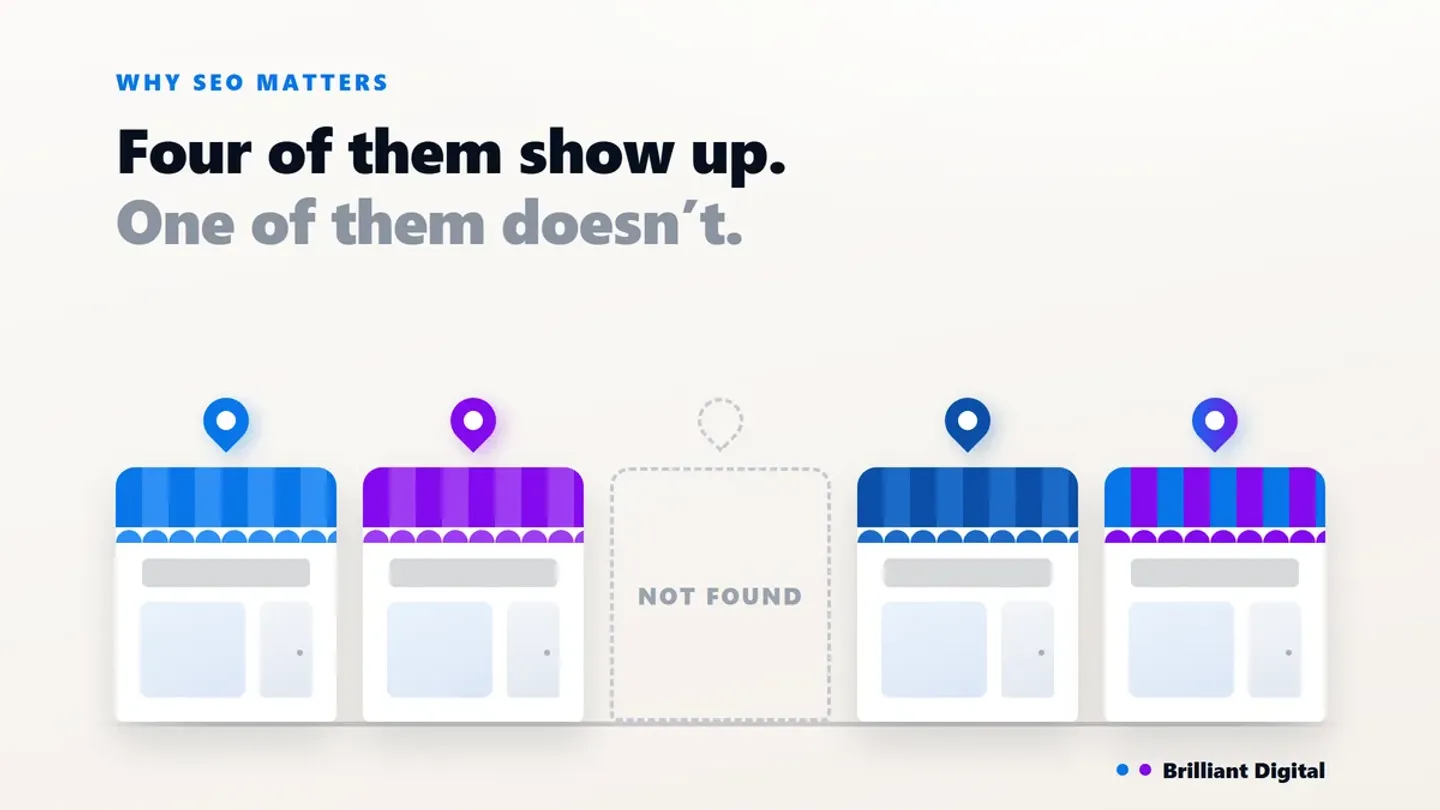
Most small business owners we speak to put SEO in the same mental box as a company car or a rebrand. Nice one day. Not this year.
That framing is the problem. The useful question is not "what would SEO do for me?" but "what is it already costing me to be invisible when my customers search?" Because they are searching. Today. For exactly what you sell.
This article is the honest version: the genuine reasons it matters, the real cost of ignoring it, and the situations where SEO is not the right first move at all.
Key Takeaways
- SEO is important for small businesses because it puts you in front of people already looking to buy, without paying for every click.
- Organic visibility compounds. Ads stop the day you stop paying. Rankings keep working.
- Local search is where most small businesses win. A claimed Google Business Profile is the single highest-return first step, and it is free.
- The cost of ignoring SEO is quiet, not dramatic. You do not lose customers you had. You never hear from the ones who found a competitor instead.
- SEO is not always the right first move. If you need enquiries this month, paid ads are the faster channel.
Why SEO matters for small businesses: the 30-second answer
SEO matters for small businesses because it makes you findable at the exact moment someone searches for what you sell, and it keeps doing so without a cost per click. It brings in people with genuine buying intent, builds credibility through ranking, and compounds over time instead of stopping when the budget does.
The plain-English version: SEO, or search engine optimisation, is the work of making your website easy for Google to understand and worth showing to the person searching. That is it. Everything else is detail.
This matters more for a small business than a large one. Big brands get found because people already know their name. You do not have that. Search is how people who have never heard of you discover that you exist.
The real reasons SEO is worth it for a small business
The benefits fall into five groups. Not seventeen. Most listicles pad the number, and the extras are the same three points wearing different hats.
It costs less than ads, and it compounds
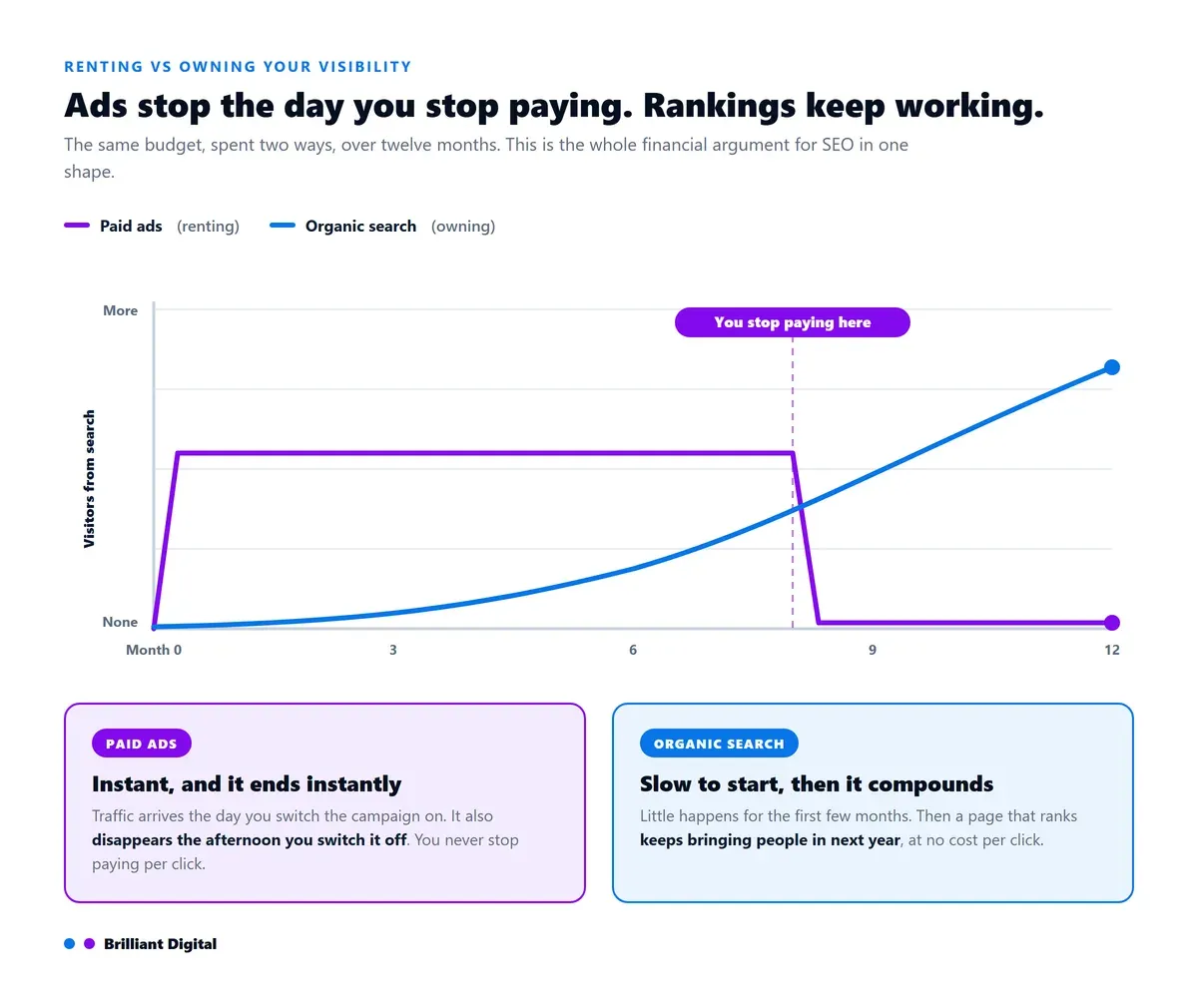
Google Ads is renting visibility. Organic search is owning it. The moment you pause a campaign, the traffic stops that afternoon. A page that ranks keeps sending you organic traffic next month, next quarter, and often years later, at no cost per click.
That is the real financial argument, and it is what makes SEO the most cost-effective marketing most small businesses have. Organic is slower to start, cheaper to sustain, and its ROI improves as the work accumulates instead of resetting every month. Most small businesses are better off eventually running both, which we cover properly in our guide to PPC vs SEO.
You get found by local customers who are ready to buy
This is where small businesses beat big ones, and it is why local SEO deserves your attention before anything else. Someone typing "emergency plumber near me" is not browsing. They are buying, usually within hours.
The behaviour is well documented: 76% of people who search for something nearby on their smartphone visit a related business within a day (Google, 2016). If you are not in those results, that visit went to someone else.
The practical first step is free. Claim and fill in your Google Business Profile, the listing that puts your business in Google Maps and the local results box. Accurate opening hours, real photos, a proper description, and a steady flow of reviews. For a lot of local businesses this alone moves the needle before a single word of website copy changes.
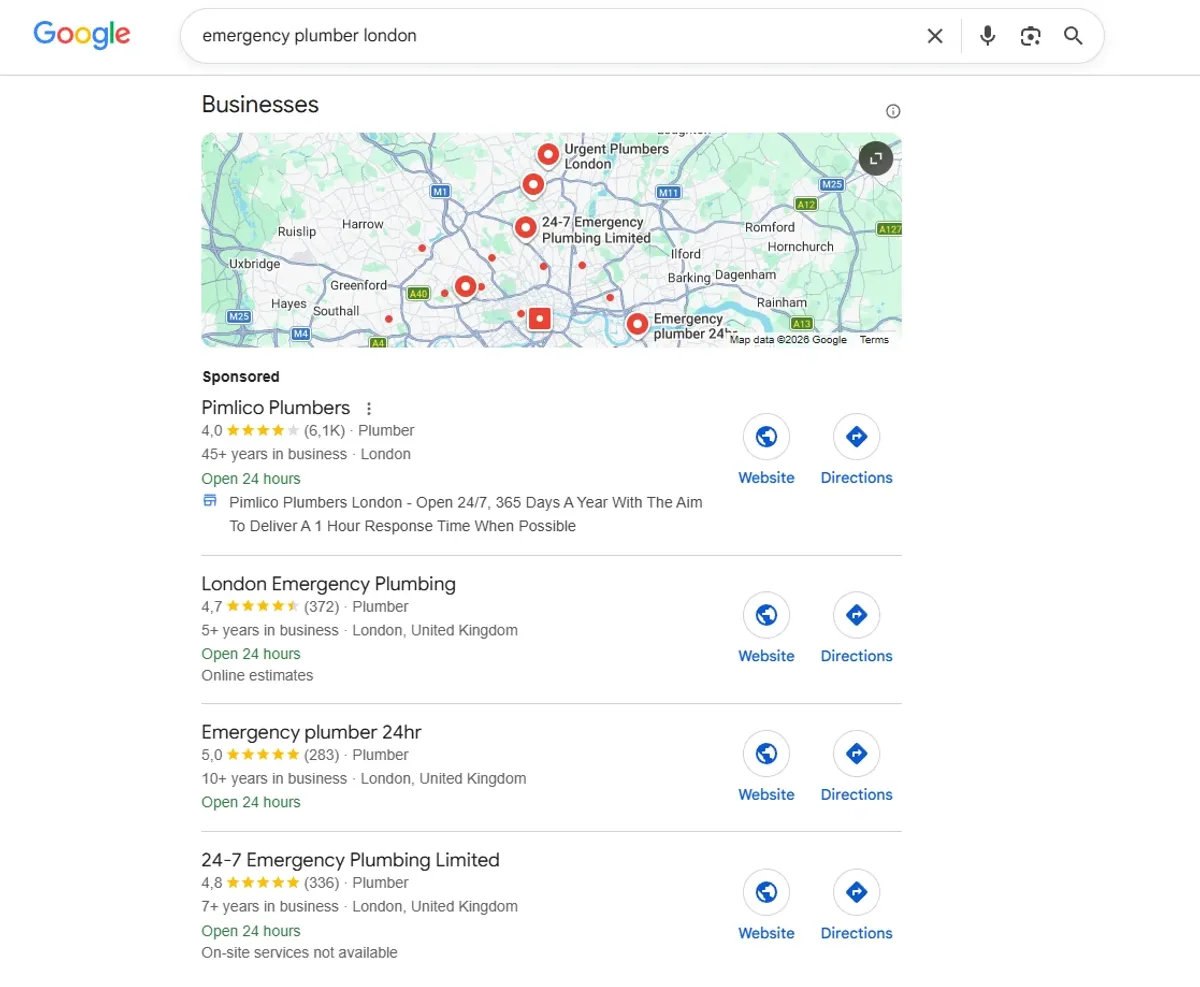
The top result is a paid ad. The three below it were earned.
Ranking builds trust before anyone speaks to you
People treat page one as a shortlist. Appearing there reads as a signal that a business is established and legitimate. Being absent reads as the opposite.
This matters most for businesses competing on trust rather than price: trades, clinics, solicitors, accountants. The enquiry often goes to whoever looks most credible in the first ten seconds, and search results are where those ten seconds happen.
It levels the playing field against bigger competitors
You will not outrank a national chain for a broad, generic term. You do not need to. Specific searches are where smaller businesses win, because the big players write for everyone and therefore for no one in particular.
- Location terms: "web design Peterborough" instead of "web design"
- Service specifics: "bathroom fitting for small flats" instead of "builder"
- Real questions: the things customers actually type, phrased the way they phrase them
These searches have lower volume and far lower competition. They also convert better, because the person searching has told you exactly what they want.
It makes the rest of your marketing work harder
Search visibility is infrastructure. A social post has a life of about a day. An email reaches only the people already on your list. A page that ranks quietly works for everyone still looking, including people who saw your post last week and are now checking whether you are any good. That steady presence builds brand awareness in the background.
What happens if you ignore SEO
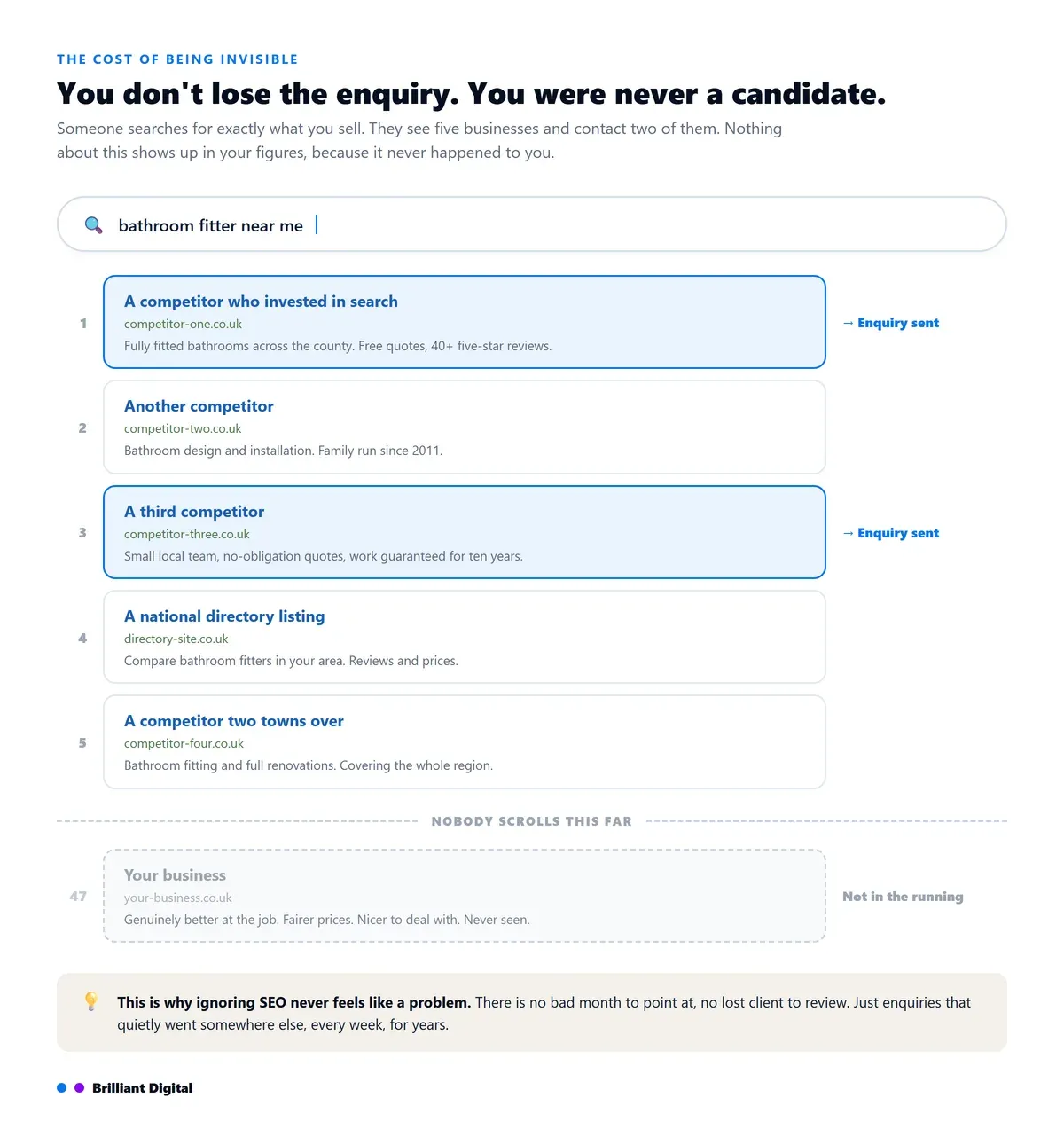
Nothing dramatic. That is exactly the problem. Ignoring SEO does not produce a bad month you can point at, which is why it stays ignored for years.
Here is what is actually happening while nothing appears to happen.
- You are absent from the shortlist. Someone searches for what you sell, sees five businesses, and contacts two of them. You were never a candidate. You will never know that enquiry existed.
- A competitor is compounding. Every month they publish and earn backlinks is a month of authority you now have to catch up on. Search advantage grows on itself, and the gap widens quietly.
- You stay dependent on channels you do not control. Word of mouth and referrals are excellent until they plateau, and they nearly always plateau. Paid ads work, but the tap closes the moment you stop paying.
- You are now invisible in AI answers too. ChatGPT, Perplexity, and Google's AI Overviews mostly draw on pages that already rank. Being absent from search increasingly means being absent from the answer entirely.
The honest scale of the catch-up: only 5.7% of pages reach Google's top ten within a year of being published (Ahrefs, 2017). Starting late is not fatal, but it is slower than most people expect.
We see the pattern most weeks. A business rings us because enquiries have gone quiet, and it turns out the phone did not stop ringing suddenly. It faded over eighteen months while a competitor built the visibility they now own. If you suspect that is you, our guide to why your website might not be showing up on Google walks through how to diagnose it yourself in about ten minutes.
SEO in the age of AI search
SEO is not being replaced by AI search. It is becoming the entry requirement for it. When someone asks ChatGPT or Google's AI Overview to recommend a supplier, the answer is assembled from web pages, and the pages it draws on are overwhelmingly ones that already rank and already read as trustworthy.
The demand shift is real and fast. Our own tracking through DataForSEO's AI Optimization data shows UK AI-search demand for this exact question doubling month on month through mid-2026.
The reassuring part: the fundamentals are the same. Clear structure, genuinely helpful content, straight answers to real questions, and visible signals that a real business wrote it. Do that and you improve your position in both at once.
When SEO is not the right first move (yet)
We build websites for a living, so this section costs us work. It is still true.
- You need enquiries this month. SEO realistically takes three to six months to show meaningful movement. If cash flow depends on the next few weeks, Google Ads is the faster channel. Start there, add SEO alongside it.
- Nobody is searching for what you sell. Genuinely new or unusual offerings sometimes have almost no search volume. Check before you invest. If the searches do not exist, no amount of optimisation creates them.
- You will not commit to the website or the content. SEO is not a one-off purchase. If nothing will be published and the site will not be improved, the money is better spent elsewhere.
SEO is the long game. It works best running alongside faster channels, not instead of them.
How to give SEO the best possible start
Most SEO advice skips the foundation, the part that quietly decides whether the rest works. You cannot optimise a website that is slow, awkward on a phone, or structured so Google cannot tell what each page is for. If you want the fixes themselves rather than the case for doing them, our guide on how to improve your Google ranking works through them in order of impact.
In order of return:
- Get the website right first. Fast, secure, sensible on mobile, one clear page per thing you sell. This is the foundation, and it is worth knowing what makes a good website before spending anything on rankings.
- Claim and complete your Google Business Profile. Free, quick, and the highest-return hour most local businesses will spend.
- Answer the questions your customers actually ask. The ones you repeat on the phone every week are the ones being typed into Google, and a little keyword research will tell you which get searched most. Publishing content consistently is the most reliable way to get found over time.
- Keep your details identical everywhere. Same business name, address, and phone number across your site, your profile, and every directory. Inconsistency is a surprisingly common drag on local rankings.
If you want the technical detail from the source, Google's own SEO Starter Guide is genuinely readable and free.
Frequently Asked Questions
Do small businesses really need SEO?
If your customers use Google to find businesses like yours, then yes. SEO is how you appear at the moment they are looking. Businesses that run entirely on referrals or contracts may not need it urgently, but almost every business with local competitors does.
Is SEO worth it for a small business?
For most, yes. SEO for small business owners targets people with active buying intent and keeps working after the spend stops. It is worth it when you can commit six months or more. It is not worth it if you need enquiries within weeks, where paid ads perform better.
How much does SEO cost for a small business?
SEO companies for small business work typically charge £350 to £1,500 a month in the UK, depending on how competitive your market is. Freelancers usually sit below that. The most affordable SEO is the part you do yourself, starting with your Google Business Profile, which costs nothing but time.
How long does SEO take to work?
Expect three to six months for meaningful movement, and up to a year in competitive markets. Local and long-tail terms move fastest. Anyone promising page one in thirty days is either targeting terms nobody searches or using tactics that eventually cause damage. If you want that laid out properly, we have published a realistic SEO timeline covering what to expect month by month.
Is SEO dead in 2026?
No, it is changing shape. AI Overviews and tools like ChatGPT answer more questions directly, but they build those answers from pages that already rank well. Being findable in search is now the requirement for being cited in AI answers, not a replacement for it.
The bottom line
SEO is visibility insurance. The cost of ignoring it never arrives as a bill, which is exactly why it goes unpaid for years while a competitor quietly takes the position you wanted.
You do not have to start with an agency. Claim your Google Business Profile, fix the obvious problems on your site, and answer the questions your customers keep asking. That is most of the value, and it costs nothing but attention.
If the website underneath it is the weak point, that is what we do. Over ten years, 150+ websites, and 180+ five-star reviews, building sites that are fast, findable, and made to bring in enquiries rather than just look good. Have a look at how we approach websites, or tell us about your business and we will come back to you honestly about what we think. No hard sell, just a straight answer.