There are three ways a business can appear on Google: paid ads at the top, the map listings in the middle, and the organic results below them. They are three separate systems, they cost very different amounts, and one of them is free.
Most articles on this subject hand you a list of tactics and leave you to work out the rest. That is the wrong shape for the question people actually ask.
Because the question is rarely "how do I appear on Google". It is "what will this cost me, and how long until it works". Almost nobody answers that plainly, so we will.
We have built more than 150 websites since 2014 and we manage Google Ads for small businesses across the UK. What follows is what each of the three routes genuinely costs, how quickly each one does anything, and how to decide which is worth your time first.
Key Takeaways
- Google shows three types of result: paid ads, the local map pack, and organic listings. A different asset drives each one.
- Your Google Business Profile is free and the fastest route to visibility for any local business. Start there.
- Google Ads is the only route that can put you on page one this week. It also stops the moment you stop paying.
- Organic ranking is the slowest route and the only one that compounds. Expect months, not weeks.
- The right answer depends on one thing: whether you need enquiries now or in six months.
The three places your business can appear on Google
Search for a local service on Google and look at the page from top to bottom. You are looking at three separate systems stacked on top of each other: paid ads, driven by a Google Ads account; the local map pack, driven by your Google Business Profile; and the organic listings, driven by your website. Each is won a different way.
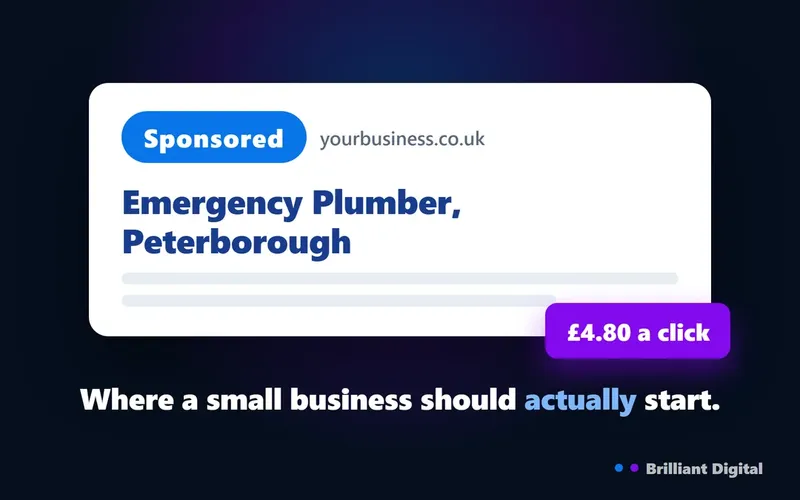
Paid ads sit at the very top, marked "Sponsored". These come from a Google Ads account. You bid on the searches you want to appear for and you pay when someone clicks.
The local map pack sits below the ads: a map with three businesses listed underneath it, each with a star rating and opening hours. This is driven entirely by your Google Business Profile, which is a free listing.
Organic results are the ordinary blue links below the map. These come from your website. Nobody pays for these positions. Google awards them based on how well it thinks each page answers the search.
Below all of that, there are often more ads.
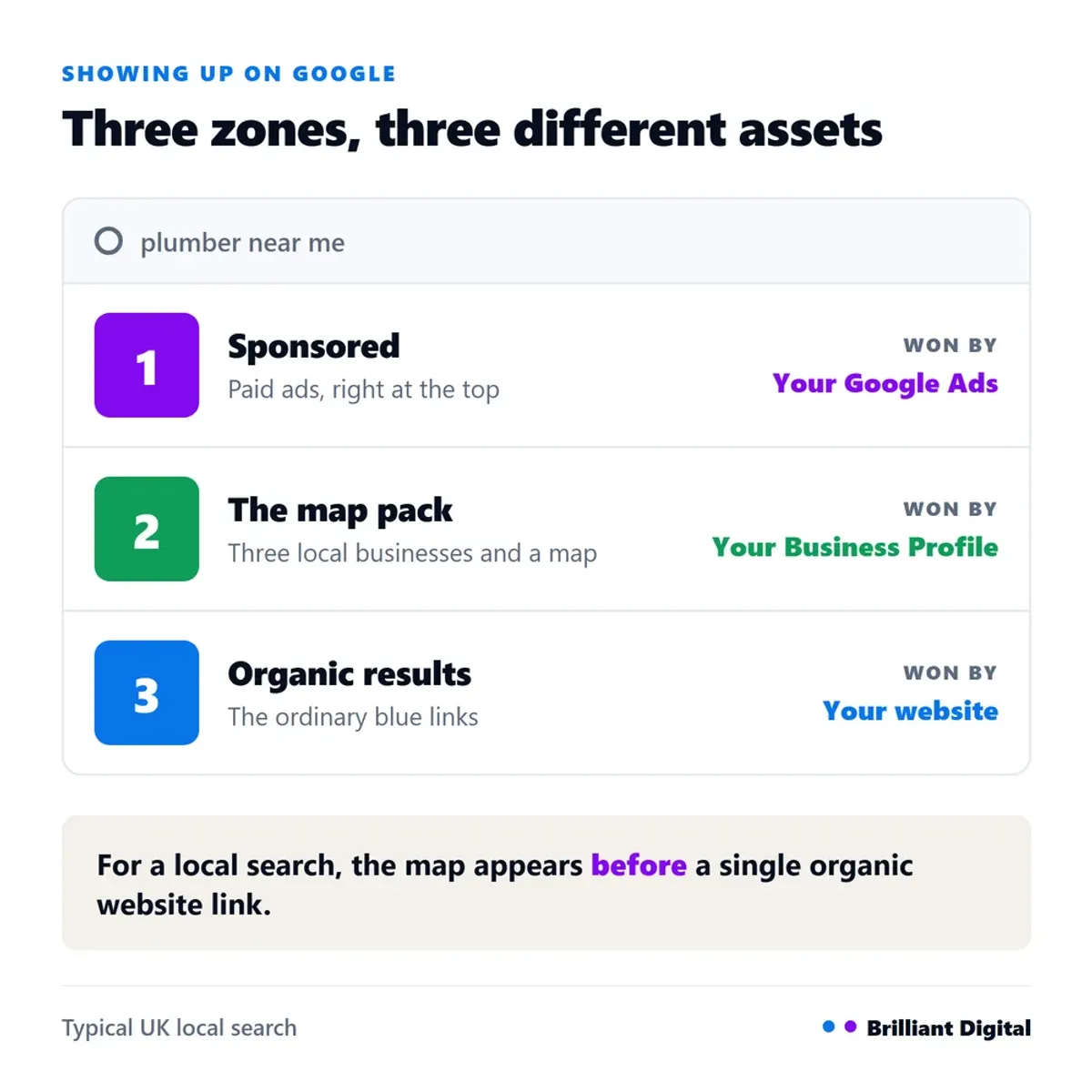
The order matters more than most business owners realise. For a local search, the map appears before a single organic website link. So a business with a well-kept Business Profile and no meaningful SEO can still be the first real result someone sees.
Three systems, three different assets:
- Google Ads account, which produces the ads
- Google Business Profile, which produces the map listing
- Your website, which produces the organic result
You can use one, two, or all three. What you cannot do is use one to influence another, and that misunderstanding costs businesses more money than anything else on this page.
Route 1: Google Ads, buying your way to the top
Google Ads is the only one of the three routes that can put you on the first page today. You bid on the searches you want to appear for, you pay when somebody clicks, and you can be live within hours. That is the whole proposition. For a business that needs enquiries this month rather than next spring, it is worth a great deal.
No other route on this page comes close to that speed, and speed is most of what you are buying.
You pay per click, not per view. Someone can see your ad a thousand times and it costs nothing until they click through to your website. That sounds generous until you look at what a click costs in a competitive sector.
The catch is that the visibility ends the day the budget does. Ads buy you attention while you are paying for it. They build nothing you keep. Turn the campaign off and by the afternoon it is as though you were never there.
That is not an argument against ads. It is an argument for knowing what you are buying. Ads are rented traffic, and rented traffic is genuinely the right purchase when you need enquiries this month.
When Google Ads is a bad idea: when the maths do not work. If your average customer is worth £80 and clicks cost you £5, you need one in sixteen clicks to convert just to break even, before you have paid yourself for the work. Running ads well is a skill, and running them badly is an expensive way to learn it.
Work backwards from your numbers before you spend anything. If your average client is worth £2,000 and your cost per enquiry lands between £50 and £100, the campaign only has to work occasionally. If your average sale is £80, look elsewhere first.
If you want a straight assessment of whether ads suit your business, that is what our Google Ads management starts with.
Route 2: Google Business Profile, the free listing most businesses skip
A Google Business Profile, formerly called Google My Business, is the free listing that puts you on Google Maps and in the local map pack. For a local business it is the single highest-return thing on this page, and it costs nothing but the half hour it takes to fill in.
It holds your opening hours, phone number, address or service area, website link, photos, and your reviews. When someone searches for your business by name, it is the panel that appears on the right.
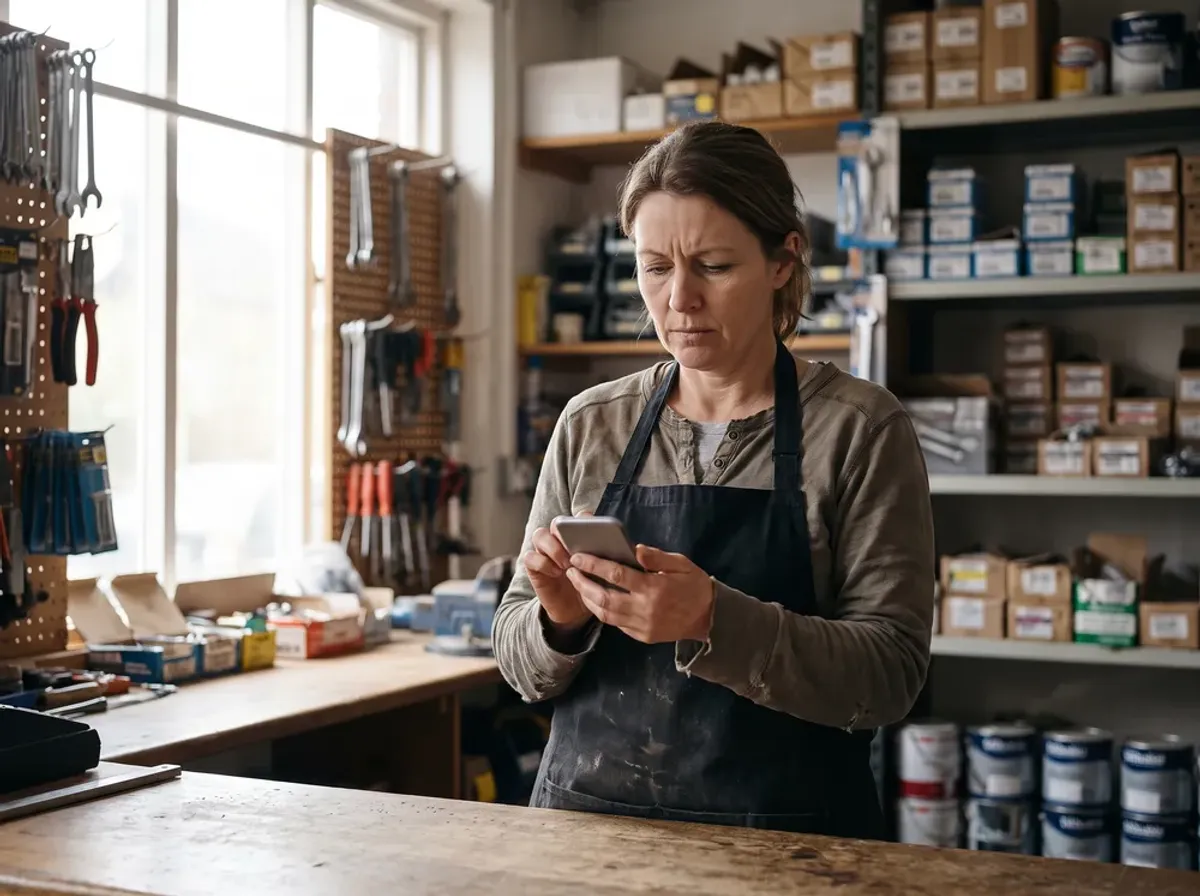
Two things matter more than the rest.
The first is verification. Your listing does not appear publicly until Google has confirmed you are real, which usually means waiting for a postcard with a code on it. Businesses regularly create a profile, never verify it, and wonder why nothing happened.
The second is reviews. Reviews are the one local ranking signal you can genuinely influence by asking, and Google lists them among its local ranking factors. We have collected more than 180 five-star reviews ourselves, and nearly all of them came from asking a customer while the work was still fresh in their mind.
Setting one up properly is its own job, with enough detail to fill an article. Our guide to adding your business to Google Maps walks through it step by step, including the service-area option for businesses that travel to customers rather than working from a shopfront.
Route 3: Organic results, earning it with SEO
Organic results are the unpaid listings below the map, and nobody can buy a position in them. Getting there is search engine optimisation, usually shortened to SEO, which is the work of making your website the best available answer to a search somebody is actually typing. It is the slowest of the three routes and the only one that keeps paying you back.
One thing to understand first, because most business owners get it wrong: it is not your website that ranks. Each individual page ranks, on its own merits, for its own searches.
That has a practical consequence. A single services page that briefly lists eight things you do will almost always be beaten by eight pages that each cover one thing properly.
The foundations are less exciting than the industry likes to pretend:
- Be indexed. Google has to know your pages exist. Google Search Console is free and tells you whether it does.
- Be fast, and work on a phone. Most local searches happen on a mobile. A slow site loses rankings and visitors at the same time.
- Answer a real question. Write the page for the person searching, not for the algorithm.
- Be consistent. Your business name, address and phone number should match everywhere they appear online.
Be honest with yourself about the timescale. Organic is the slow route. It is also the only one of the three that keeps working after you stop paying attention to it, which is exactly why it is worth starting before you need it.
If your site is already live and simply not appearing, the cause is usually specific and fixable. Our guide on why your website is not showing up on Google covers the usual suspects. For the wider picture of what moves rankings, start with how to improve your Google rankings.
What each route actually costs
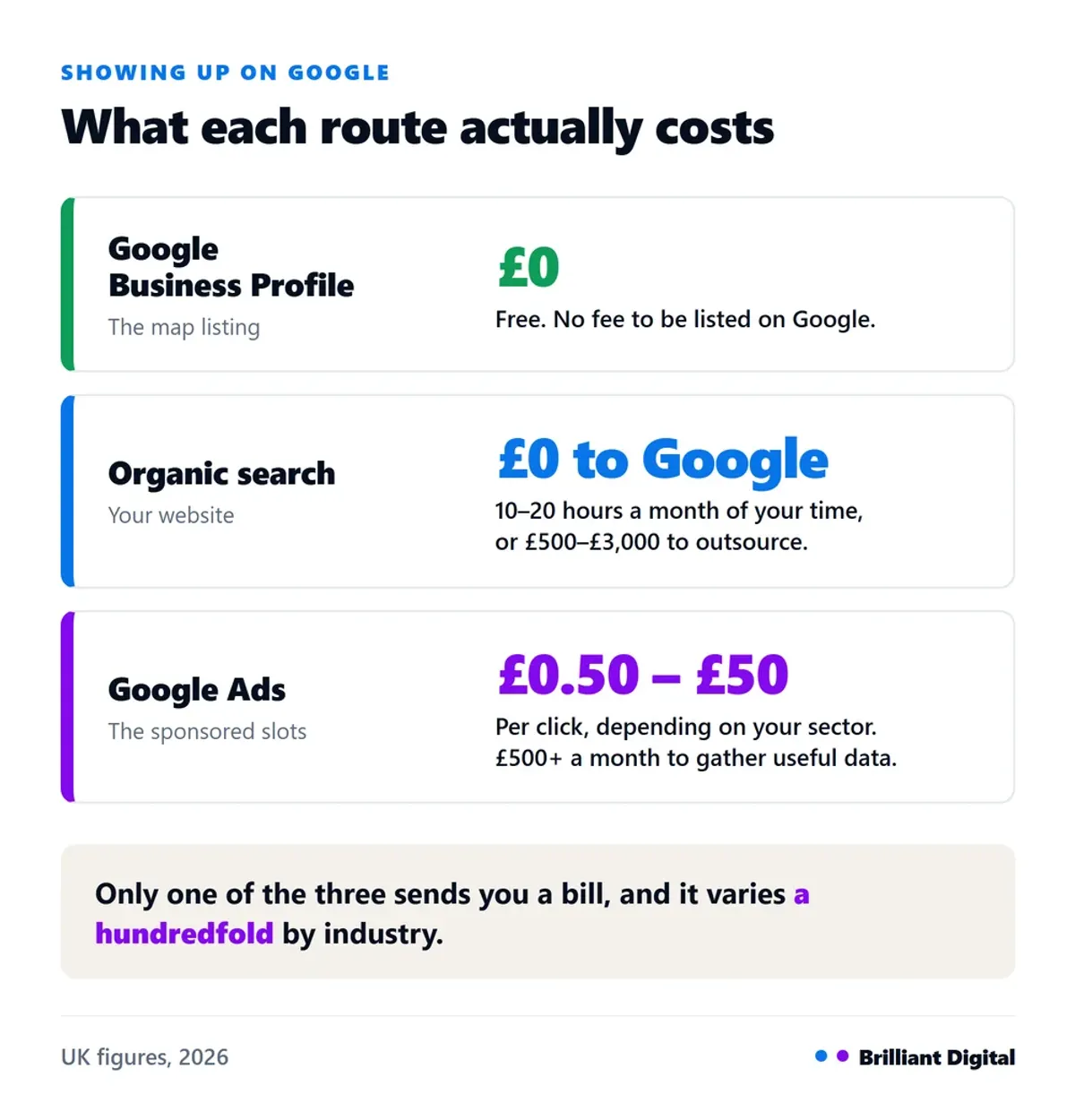
A Google Business Profile costs nothing. Ranking organically costs nothing in fees to Google, but takes ten to twenty hours a month of your time or £500 to £3,000 a month to outsource. Google Ads is the only route with a bill, and in the UK a click costs between £0.50 and £50 depending entirely on your sector.
That is the short answer. Here is the detail, because this is the part everyone skips.
Google Business Profile: £0. There is no fee to be listed on Google. None. The most valuable local visibility available to a small business costs nothing but the time to fill it in and keep it current. If you take one thing from this article, take that.
Organic search: no fee to Google, but a real cost in time or money. Google does not charge for organic positions and cannot be paid for them. The cost is the work. Doing it yourself realistically takes ten to twenty hours a month. A freelance SEO consultant typically costs £500 to £1,500 a month in the UK, and an agency £800 to £3,000.
Google Ads: the only one with a bill. What you pay per click depends almost entirely on your sector:
- Low competition, £0.50 to £2.00 per click. Local tradespeople, cleaning services, cafes, most non-specialist local services. At £1 a click with a landing page converting at ten per cent, an enquiry costs you £10.
- Mid competition, £3 to £10 per click. Accountancy, specialist trades, most professional services.
- High competition, £20 to £50 per click. Legal, finance, private healthcare. At £30 a click and a five per cent conversion rate, you are paying £600 for every enquiry.
On top of the clicks, budget realistically. For most UK service businesses, £500 to £1,000 a month is the floor at which a campaign generates enough data to be improved. Below that you get a handful of clicks a day, which is not enough to learn anything from. If you use an agency, management typically adds £300 to £800 a month.
One myth worth killing before it costs you money: you cannot pay Google to rank higher in the organic results. Ads and organic listings are separate systems with separate rules. Spending more on ads does nothing for your blue links, and Google is unusually clear about this.
How long each one takes
Google Ads works in hours. A Google Business Profile works in days, once verification clears. Organic search takes three to six months for a new website in a normal local market, and longer in competitive cities. Those three timescales are the real reason the routes complement each other rather than compete.
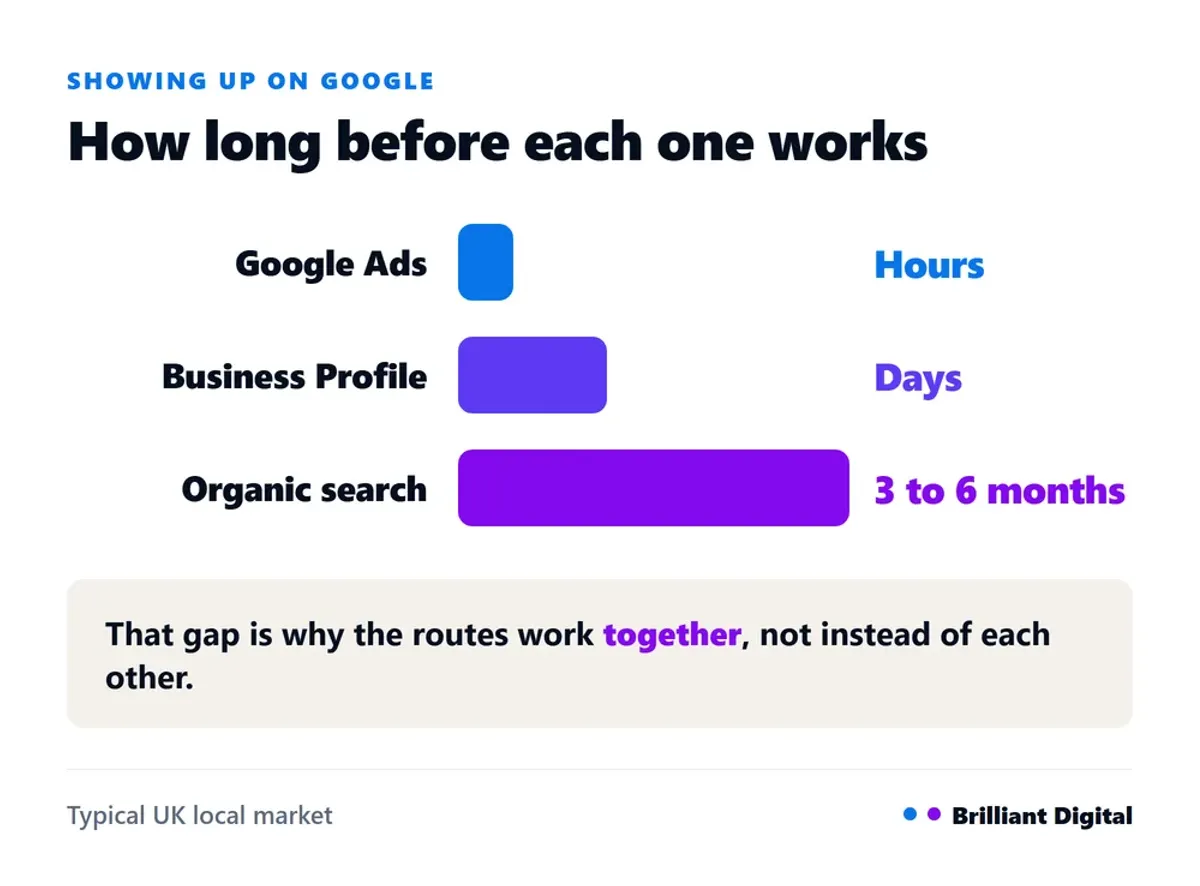
Google Ads: hours to days. A campaign built this morning can be showing this afternoon. This is the only genuinely fast option, and speed is most of what you are paying for.
Google Business Profile: days. Creating the profile takes about half an hour. Verification is the delay, and if Google posts you a code you are waiting for the post. Once verified, you can appear in local results almost immediately.
Organic search: months. Google itself says it can take a few weeks simply to notice a new site, and being noticed is not the same as ranking. For a new website in a normal local market, expect three to six months before organic search sends you meaningful traffic. In competitive urban markets it takes longer.
That gap is the entire reason the three routes work well together. Ads cover the months while organic builds, and the Business Profile costs nothing while both are happening. If you want more on filling that gap, our guide to increasing website traffic covers what else works while you wait.
Which should you pick?
If customers find you locally, start with the Business Profile, because it is free and fast. If you need enquiries this month, run Google Ads alongside it. If budget is tighter than time, put the effort into organic search and be patient. Most businesses should do all three, in that order.
Here is the reasoning behind each of those, because the order is not arbitrary.
If customers come to you locally, set up the Business Profile first. Always. It is free, it takes an afternoon, and it puts you above the organic results for local searches. There is no argument for skipping it.
If you need enquiries this month, run Google Ads. A new business, a quiet spell, or a launch with no rankings yet are all good reasons. Treat it as buying time while the free and slow routes build underneath.
If budget is tight and you can wait, put the effort into organic. It costs time rather than money and it compounds. If you can only spend one of the two, and you are not desperate for work today, spend the time.
For most businesses, the answer is all three, in this order: Business Profile in week one, basic SEO ongoing, ads when you need speed or the competition leaves you no choice.
The mistake we see most often is a business spending months agonising over SEO while an unverified Business Profile sits there doing nothing. Take the free win first. Why SEO matters for small businesses makes the longer case for the slow route, once the quick one is done.
Frequently Asked Questions
How much does it cost to be listed on Google?
Nothing. A Google Business Profile is free, and appearing in organic search results is free. Google does not charge businesses to be listed or indexed. The only route with a genuine cost is Google Ads, where you pay each time somebody clicks through to your website rather than paying to be listed at all.
Is it free to advertise your business on Google?
Listing your business is free. Advertising is not. Google Ads charges you every time somebody clicks your ad, from around £0.50 per click in low-competition sectors like local trades up to £50 or more in legal and financial services. You set a daily budget, so your monthly spend stays capped.
How much does it cost to be on the first page of Google?
Through Google Ads, expect £500 a month as a realistic floor for a small local campaign, and considerably more in competitive sectors. Organically it costs nothing in fees to Google, but takes three to six months of consistent work, either your own time or £500 to £3,000 a month for outside help.
How long does it take to get your business listed on Google?
Creating a Google Business Profile takes about thirty minutes. Verification usually takes a few days, and longer when Google posts you a card with a code on it. Your listing will not appear publicly on Search or Maps until that verification is complete, which is the step most businesses forget.
Why is my business not showing up on Google?
The usual causes are a new website Google has not indexed yet, a Business Profile that was created but never verified, or a page accidentally blocked from being indexed. Each one is fixable. Our guide on why your website is not showing up on Google works through every cause in turn.
Can I pay Google to rank higher in organic results?
No, and this is worth being clear about because it costs businesses real money. Ads and organic listings are separate systems with separate rules. Spending more on Google Ads has no effect whatsoever on your organic position, and Google's own documentation states this directly.
What to do next
If you are a local business and your Business Profile is not verified, do that this week. It is free and it is the fastest visibility you will get.
After that it comes down to timing. We build the websites that earn the organic route, and we manage the Google Ads campaigns for businesses that need customers sooner than SEO can deliver them.
If you are not sure which of the three you should be spending on, tell us what you sell and where, and we will tell you honestly. No obligation, and no hard sell. Just a straight answer about which route is worth your money.