Your website is live. You've got the logo, the pages, the about section. So why isn't the phone ringing?
This is where most small businesses get stuck. They launch a website and wait. Maybe they try a Google Ad or two. Maybe they post something on Facebook. But nothing sticks. The website sits there looking professional, generating precisely nothing.
The problem isn't the website. It's what's missing from it: content. Specifically, the kind of content that answers the questions your customers are already typing into Google. A solid content marketing strategy turns a static website from a placeholder into an enquiry generator. It's not instant, and it's not free in time. But it compounds in a way that paid advertising never can.
This guide is written for business owners, not marketers. No jargon, no theoretical frameworks, no assumed knowledge. Just a practical explanation of what content marketing actually is, why it matters for small businesses, and how to start.
Key Takeaways
- Content marketing means creating genuinely useful information that helps your ideal customers find you and trust you before they ever pick up the phone.
- A documented content marketing strategy consistently outperforms an informal, reactive approach. Writing things down matters more than you'd think.
- Blogging is the most accessible starting point for most small businesses. Low barrier to entry, high long-term payoff.
- One well-written blog post can bring in 50 visitors a month for two years or more. A Google Ad stops the moment you stop paying for it.
- You don't need expensive tools or a dedicated marketing team. You need consistency and a willingness to answer your customers' questions honestly.
What Is a Content Marketing Strategy?
A content marketing strategy is a documented plan for creating and distributing useful, relevant content that attracts and builds trust with the specific audience most likely to become your customers, with the goal of driving profitable enquiries over time.
That's the definition. Now let's break it down.
The word "strategy" matters. A content marketing strategy is not the same as a content plan (what you'll publish and when) or a content strategy (the rules about how you communicate). A strategy sits above both. It defines your goals, your audience, your chosen content types, your distribution channels, and how you'll measure success. Without it, content creation becomes reactive and inconsistent.
This distinction is covered by every serious marketing resource for a reason. A content plan without a strategy is like building a website without knowing who it's for. You might produce something. But it's unlikely to produce results.
The other term worth clarifying: content marketing. It's distinct from advertising because it earns attention rather than buying it. You're not paying to interrupt someone's feed. You're creating something useful enough that people actively seek it out.
Why Content Marketing Matters for Small Businesses
Here's the reason content marketing makes particular sense for small businesses: it compounds.
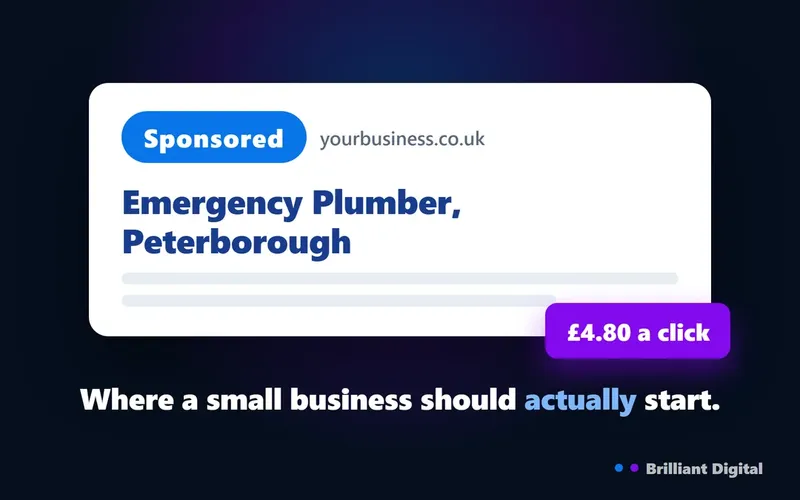
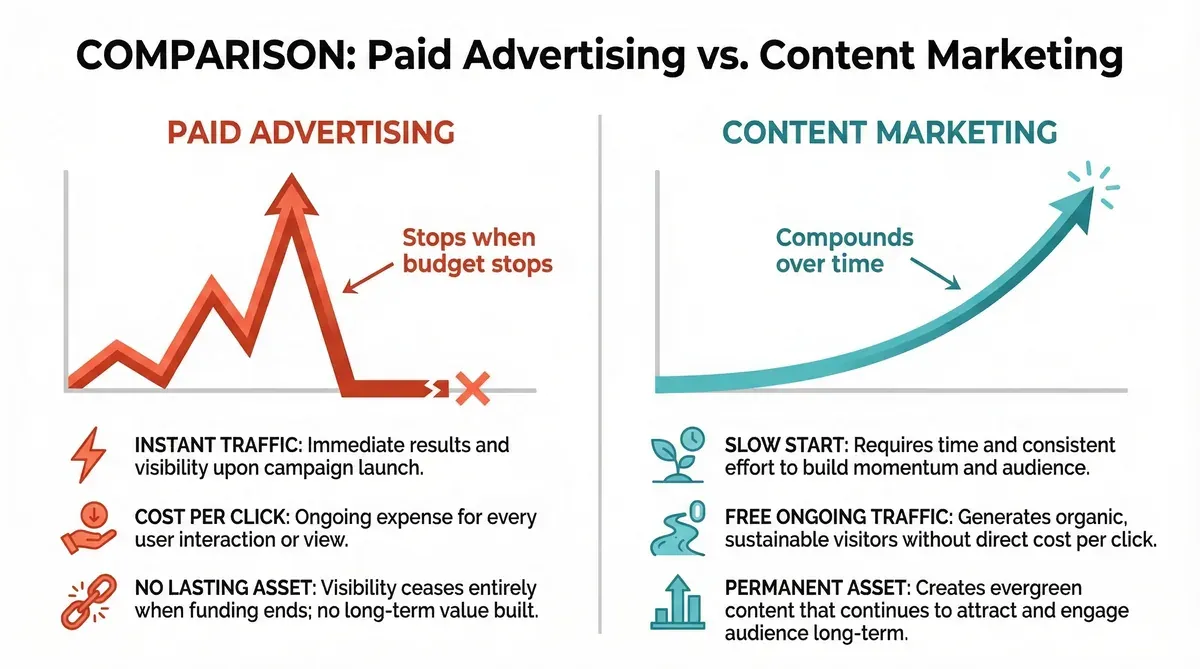
One well-written blog post targeting a specific search query might bring in 50 visitors a month once it settles into the rankings. That's not much on its own. But add 12 such posts and you're looking at 600 visitors a month, growing over time, without spending an extra penny. Compare that to Google Ads, where a single click costs anywhere from £5 to £15 in competitive industries, and you stop the moment your budget does.
The data backs this up. According to the Content Marketing Institute, content marketing generates three times more leads than outbound marketing while costing 62% less. It takes longer to get there. But the return is fundamentally different in nature, not just scale.
For a small business with a limited budget, that asymmetry is significant. You're building an asset. Every piece of useful content you publish is a permanent part of your online presence. The article you write today can bring in enquiries next year, and the year after. Brilliant Digital's own blog demonstrates this: articles we wrote years ago still generate organic traffic and enquiries from people who found us by searching for answers to questions they had about web design.
This is why blogging for business has a payoff structure that advertising doesn't. It's not about going viral. It's about showing up consistently in searches your customers are already doing.
Content marketing also builds brand awareness in a way that feels natural rather than forced. A potential customer who found your article useful already has a positive impression of you before they've visited your services page. That warm introduction shortens the trust-building process significantly.
The Content Marketing Funnel: From Search to Customer
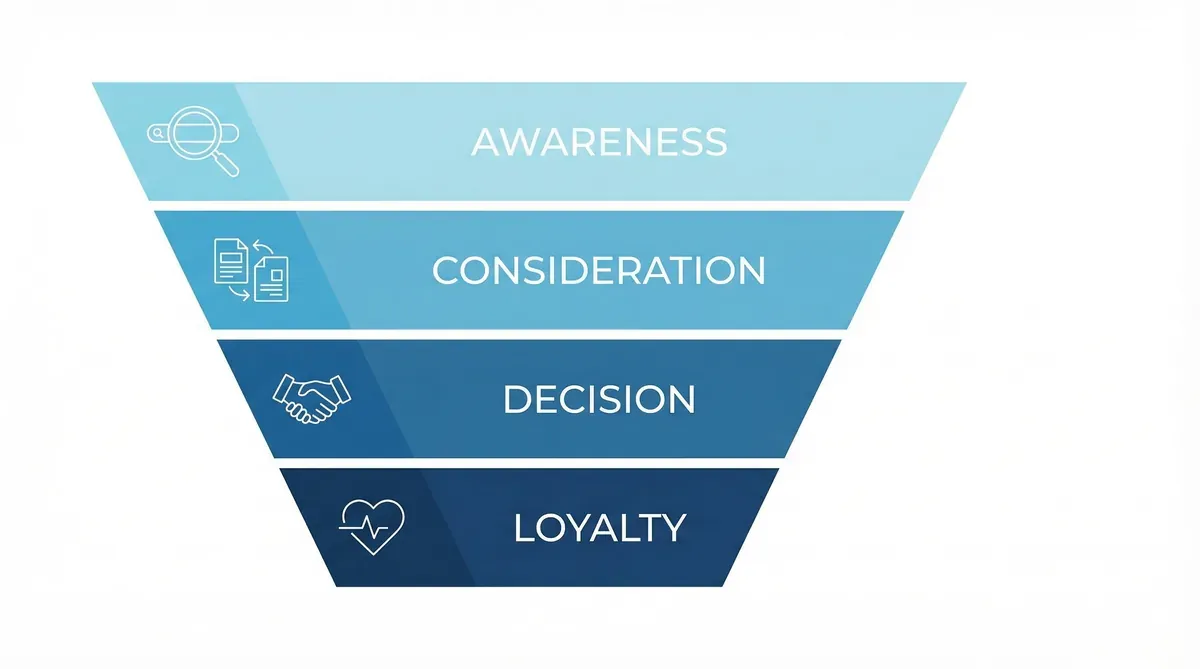
Understanding the customer journey is central to any content marketing strategy. Most people don't find a business and immediately enquire. They go through stages.
Awareness: The customer has a problem or question. They search Google. They find your article. At this point they don't know your name, and they're not looking to buy. They're looking for information.
Consideration: The article was useful. They read another one. They start to form a view of you as someone who knows what they're talking about. They might sign up for your email list or follow you on social media.
Decision: They're ready to move forward. They come back to your website. They read your services page. They look at your reviews. And then they enquire.
Loyalty: They become a customer. Good content keeps them informed, reassured, and connected. It's also what turns them into referrers.
Different content types serve different stages. A detailed how-to guide or explainer article works at the awareness stage. A comparison article or case study works at the consideration stage. A clear services page and testimonials work at the decision stage. A newsletter works for loyalty.
Take a local plumber as an example. An awareness-stage article might answer "why is my boiler making a banging noise?" A consideration-stage piece might be "should I repair or replace my boiler?" A decision-stage piece is the services page itself. Each piece serves a different moment in the customer journey.
Your approach to increasing website traffic matters across all of these stages. Content is one lever. But it only works when it's mapped to the right moment in the customer journey.
How to Create Your Content Marketing Strategy: Step by Step
This is the practical part. Seven steps, written for someone starting from scratch.
Step 1: Know What Your Customers Are Searching For
Before you write a word, you need to understand what your potential customers are actually typing into Google. This is keyword research, and it doesn't have to be complicated.
Start with Google itself. Type the beginning of a question your customers often ask and watch what autocomplete suggests. Those are real searches. Check the "People Also Ask" section in Google search results. Those are more real searches.
Then think about the questions you get asked most often in person. "How much does a website cost?" "How long does it take?" "Do I need to update my website?" Every one of those is a potential article. You already know the answers. You just need to write them down.
For more structured research, free tools like Google Search Console (once your site has some traffic) or basic paid tools like DataForSEO can give you precise search volumes and keyword difficulty scores. But don't let tool access stop you. Start with what you know.

Step 2: Define Who You Are Writing For
You don't need a full persona exercise with a stock photo and a made-up name. But you do need to be specific about who your best customers actually are.
Who are the customers you most enjoy working with? What industries are they in? What problems do they come to you with? What do they worry about? What language do they use to describe what they need?
The more clearly you can answer those questions, the more precisely you can write content that resonates. Content that tries to speak to everyone ends up resonating with no one. Pick your most common customer type and write for them.
Step 3: Pick Your Content Types
Blog posts are the most logical starting point for most small businesses. They support SEO, they're searchable, they build authority, and they don't require specialist production skills.
Beyond blogging, the main content types worth considering are: video (high effort, high engagement), social media posts (quick and wide-reaching, but doesn't compound the same way), email newsletters (excellent for existing relationships), and podcasts (relationship-building, but harder to attribute directly to enquiries).
The key rule: pick one format you can sustain. A blog updated twice a year is less valuable than nothing, because it signals neglect. One blog post a fortnight, written well and published consistently, beats an ambitious plan that collapses after six weeks.
Step 4: Create a Simple Content Calendar
A content calendar doesn't need to be a piece of software. A spreadsheet with dates, topics, target keywords, and status columns is enough.
Map out a month at a time. If you're aiming for one post a fortnight (a realistic target for most small business owners writing alongside running a business), that's two posts to plan per month. Give each one a working title, a target keyword, and a publish date.
Then stick to it. Consistency is the variable that separates content strategies that work from the ones that don't. It's not the quality of any single article. It's showing up regularly over months and years. An editorial calendar makes that possible by turning "I should write something" into "I'm writing about X on Thursday."

Step 5: Write Content That Answers Questions Better Than Anyone Else
Better doesn't mean longer. It means more specific, more honest, and more useful.
The internet is full of generic content that restates the obvious. "To run a successful business, you need good marketing." Thanks. Not helpful. What's actually useful is specific: the real questions your customers have, answered with the kind of detail that only someone who's done the work can provide.
First-hand experience beats anything a content mill or AI tool can produce on its own. If you've built 150 websites and seen what separates the ones that convert from the ones that don't, write that. If you've been asked the same question by twenty different clients, the answer deserves an article.
Search engines are increasingly good at recognising content written from genuine experience. Google calls this E-E-A-T: experience, expertise, authority, and trustworthiness. If you run a genuine business, you already have experience and expertise. You just need to put it on the page. This is also what helps your content get cited in AI-generated answers, which now appear at the top of Google results for many searches.
Step 6: Distribute Where Your Audience Spends Time
Writing and publishing isn't the end. It's the beginning.
Each piece of content should be distributed at least three times: the day it goes live, a week later with a different angle or pull quote, and again whenever it becomes relevant to a conversation you're having on social media or in email.
Share articles on LinkedIn, Facebook, and any community groups where your audience is active. Send a link to your email list. If you repurpose one article into a short LinkedIn post, a Facebook update, and an email newsletter paragraph, you've multiplied the value of that single piece of work significantly.
Repurposing blog content is a discipline in its own right. For a small business with limited time, it's essential. Don't write something once and then move on. Get every use out of it. And using social media to promote your business effectively means treating it as a distribution channel for your content, not a separate content creation task.
Step 7: Measure What Works
You don't need complex analytics to run an effective content strategy. You need answers to two questions: which posts bring in traffic, and which posts lead to enquiries?
Google Analytics (free) answers the first question. It shows which articles people are reading, where they found them, and how long they stayed. Google Search Console (also free) shows which search queries are bringing people to your site.
Set a monthly reminder to review this data. Which posts are growing in traffic? Which ones are flat? What keywords are you showing up for that you didn't plan to? More of what's working, less of what isn't. After six months, consider a content audit: review everything you've published and decide what to update, expand, or retire. It really is that straightforward at the start.
Blogging for Small Business: Where Most Strategies Should Start
If you're a small business owner with no content marketing activity at all, start with a blog. It's the most accessible format, it directly supports SEO, and it builds a permanent library of useful material that you can repurpose and refer to indefinitely.
The barrier is lower than most people assume. You don't need a journalism degree. You don't need a writing background. You need to know your subject, care about answering questions honestly, and be willing to put in the time.
And time is the honest part of this conversation. A genuinely useful blog post takes 3 to 6 hours to research, write, and edit. That's the real investment. There are no shortcuts that preserve quality, and quality is what separates content that ranks from content that sits unread.
What makes a blog post actually work? Specificity, structure, and search intent alignment. Specificity means real details, not generalities. Structure means clear headings, scannable paragraphs, and a logical progression. Search intent means you've written a post that answers what the searcher actually wanted, not just a post that contains the right words.
What most businesses get wrong: they write about themselves rather than about their customers' questions. "We're delighted to announce our new service" is not content marketing. "How to choose the right web design agency" is. One is about you. The other is about your customer.
See our guide to what SEO is and how it works for the underlying mechanics that make blogging valuable from a search perspective. And if you want a more structured approach to finding what to write about, how to create an SEO strategy covers the process in detail.

Not Sure Where to Start? Let's Talk
Content marketing works. But building it alongside a business is genuinely hard to sustain.
If you'd like to talk through how a content strategy could work for your specific business, or if you want a website built to function as a content platform from day one, get in touch with Brilliant Digital. No hard sell. Just a straight conversation about what's realistic for you.
What to Expect: A Realistic Content Marketing Timeline
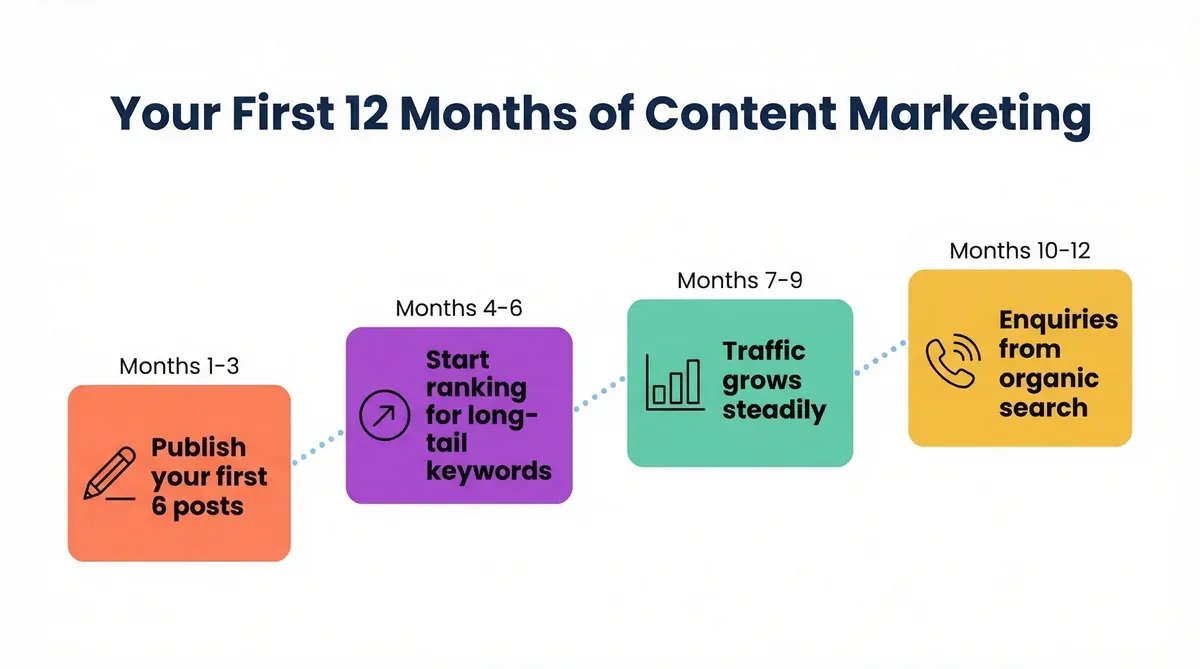
One of the most common frustrations with content marketing is that results don't come quickly. Here's what a realistic timeline actually looks like.
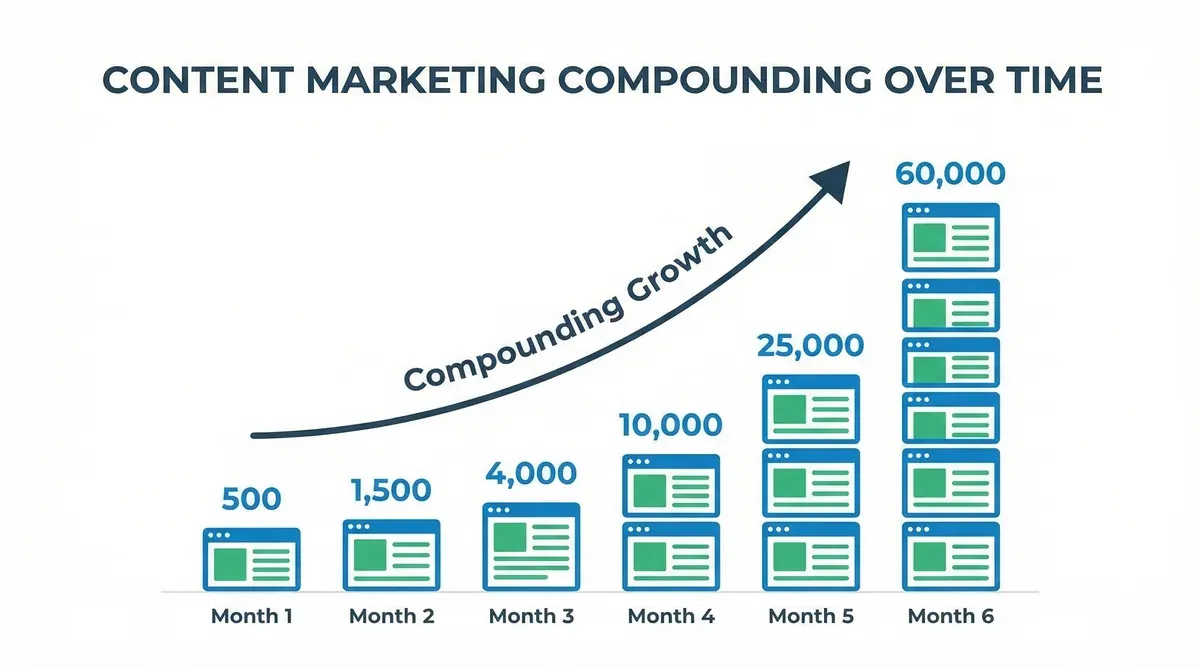
Months 1 to 3: Building the foundation. You're publishing content, but Google hasn't fully indexed it yet. Traffic is minimal. This is the period where most people give up. Don't. The work you do now is what generates results in months 6 to 12.
Months 3 to 6: Indexing begins. Articles start appearing in Google. You might show up on page 3 or 4. Organic traffic is small but measurable. You can start to see which pieces are gaining traction. This is the validation phase: you're learning what your audience responds to.
Months 6 to 12: Compounding starts. Content published earlier starts ranking on page 1 for less competitive terms. Traffic begins to grow month on month. You're generating enquiries directly from organic search, not just from referrals and word of mouth.
Year 2 and beyond: The content library becomes an asset. Your older content continues to generate traffic. New content benefits from the authority your site has built. You're competing for more valuable keywords. The monthly traffic you're generating would cost thousands in Google Ads to replicate.
This timeline assumes consistent publishing (at least one substantive post per fortnight) and a focus on keyword-targeted topics. If you're publishing sporadically or ignoring search intent, the timeline extends significantly.
Common Content Marketing Mistakes Small Businesses Make
These are the patterns that get in the way most consistently.
Writing what you want to write, not what customers search for. Your passion for your product or service is not the same as what your customers are looking for. Start with the search, then bring your perspective.
Publishing once and moving on. One article published and then forgotten contributes almost nothing. The value is in a library of content, built and maintained over time.
Ignoring SEO entirely. You don't need to be an SEO expert. But writing without any attention to what people are searching for means your content will be very hard to find. Even basic keyword research changes the impact of everything you write.
No connection to business goals. Content marketing should serve commercial objectives: more enquiries, better quality leads, improved conversion on service pages. If you can't articulate how your content connects to your business, it's hard to prioritise it when time is tight.
Trying to do everything at once. Blog, podcast, YouTube, LinkedIn, Instagram, email newsletter. Pick one and do it well. Spreading across every platform at once usually results in doing all of them badly.
Not repurposing. One 1,500-word article can become three LinkedIn posts, one Facebook post, an email newsletter section, and a pinned tweet. That's five pieces of distribution from one investment of writing time.
Expecting quick results. Content marketing's payoff is weighted towards the future. The month you publish is the worst month for results from that piece. The return builds over time, which is genuinely counterintuitive if you're used to advertising.
For more on marketing approaches that work at small business scale, see 15 small business marketing ideas that go beyond content alone.
How Much Does Content Marketing Cost?
This is the question almost nobody in the industry answers honestly. Here's a transparent breakdown.
DIY (writing it yourself): The financial cost is low. The time cost is real. A solid 1,500-word article takes 3 to 6 hours from research to publication. If you're a business owner, that time has a real opportunity cost. The approach works well if you genuinely enjoy writing and can maintain the cadence.
Freelance content writer: Typically £100 to £400 per article in the UK, depending on length, research requirements, and the writer's expertise. Quality varies enormously. A writer who understands your industry and can write to your brand voice is worth paying more for.
Agency (content strategy, SEO, and writing combined): Costs from £800 to £2,500+ per month for an ongoing retainer. You're paying for strategy, keyword research, writing, editing, SEO optimisation, and reporting. The output is more consistent and more strategically aligned. The cost is harder to justify until you understand the long-term return.
The comparison that changes perspective: In competitive industries, a single Google Ad click can cost £5 to £15. A blog post that generates 50 organic clicks per month for two years delivers 1,200 clicks over its life. After the initial investment, those clicks are free. The content marketing ROI from a single well-written article compounds in a way no ad spend can match.
The honest answer to "what should I budget?" is: start with your time if you have it, move to freelancers as you grow, and consider a specialist when you're ready to treat content as a genuine growth channel.
FAQ
What are content marketing strategies?
Content marketing strategies are documented plans for creating and distributing useful content to attract a specific audience and drive enquiries. They cover goals, audience, content types, distribution channels, and measurement. The word "strategies" (plural) sometimes refers to specific approaches within that plan, such as blogging, video, or email.
What are the 7 steps of content marketing?
Research what your customers search for, define your audience, choose content types, create a calendar, write content that answers questions better than competitors, distribute across channels, and measure results. These steps work whether you are a solo trader or a small team.
What are the golden rules of content marketing?
The three most important: be genuinely useful (not promotional), be consistent over time (a library beats one-off posts), and write for a specific audience (not everyone). A practical fourth rule: start with what your customers are already searching for, not with what you want to say. Content that serves the reader's needs first is content that earns trust and rankings.
What is the importance of content marketing?
Content marketing builds trust before a sale, attracts customers via organic search, and compounds in value over time unlike paid advertising. For small businesses, it's one of the most cost-effective ways to generate enquiries at scale. According to the Content Marketing Institute, it generates three times more leads than outbound marketing while costing 62% less, making it particularly relevant for businesses with limited marketing budgets.
What is content marketing for small businesses?
For small businesses, content marketing typically means publishing useful articles, guides, or videos that answer the questions your ideal customers are searching for online. It's a way of getting found in Google without paying for every click. The focus is on blogging, email, and social media rather than expensive production. The key advantage over larger competitors is the ability to write from genuine first-hand experience.
Is content marketing worth it for small businesses?
Yes, if you're willing to invest the time and sustain it. The payoff is not immediate. Most businesses see meaningful results from months 6 to 12 onwards. But a library of useful, well-optimised articles generates enquiries indefinitely, without ongoing ad spend. For a small business where every pound of marketing budget matters, the long-term return on content marketing is hard to match through any other channel.
What to Do This Week
You don't need to build the whole strategy before you start. Here are three actions you can take in the next seven days.
First: Write down the five questions you get asked most often by potential customers. These are your first five article ideas. They're also almost certainly questions people are searching for on Google.
Second: Pick one of those questions and write 800 words answering it as honestly and specifically as you can. Don't worry about SEO at this stage. Just write what you know. The SEO layer can be added afterwards.
Third: Publish it and share it. Put it on your website, share the link on LinkedIn or Facebook, and send it to your email list if you have one. That's a content marketing strategy in its most basic form. Start there and build from it.
If managing this alongside running a business feels like too much, Brilliant Digital builds websites designed as content platforms from the ground up, and we can help you develop a strategy that fits your capacity and your goals. Take a look at our websites service to see how we approach it.
Published by Brilliant Digital. We've built 150+ websites and helped small businesses across the UK use their online presence to grow. If you'd like to talk about what a content strategy could look like for your business, get in touch.