Someone recommends you to a friend. They say you did great work, reasonable price, turned up on time. The friend nods, says they'll look you up.
Later that evening, they Google your business name.
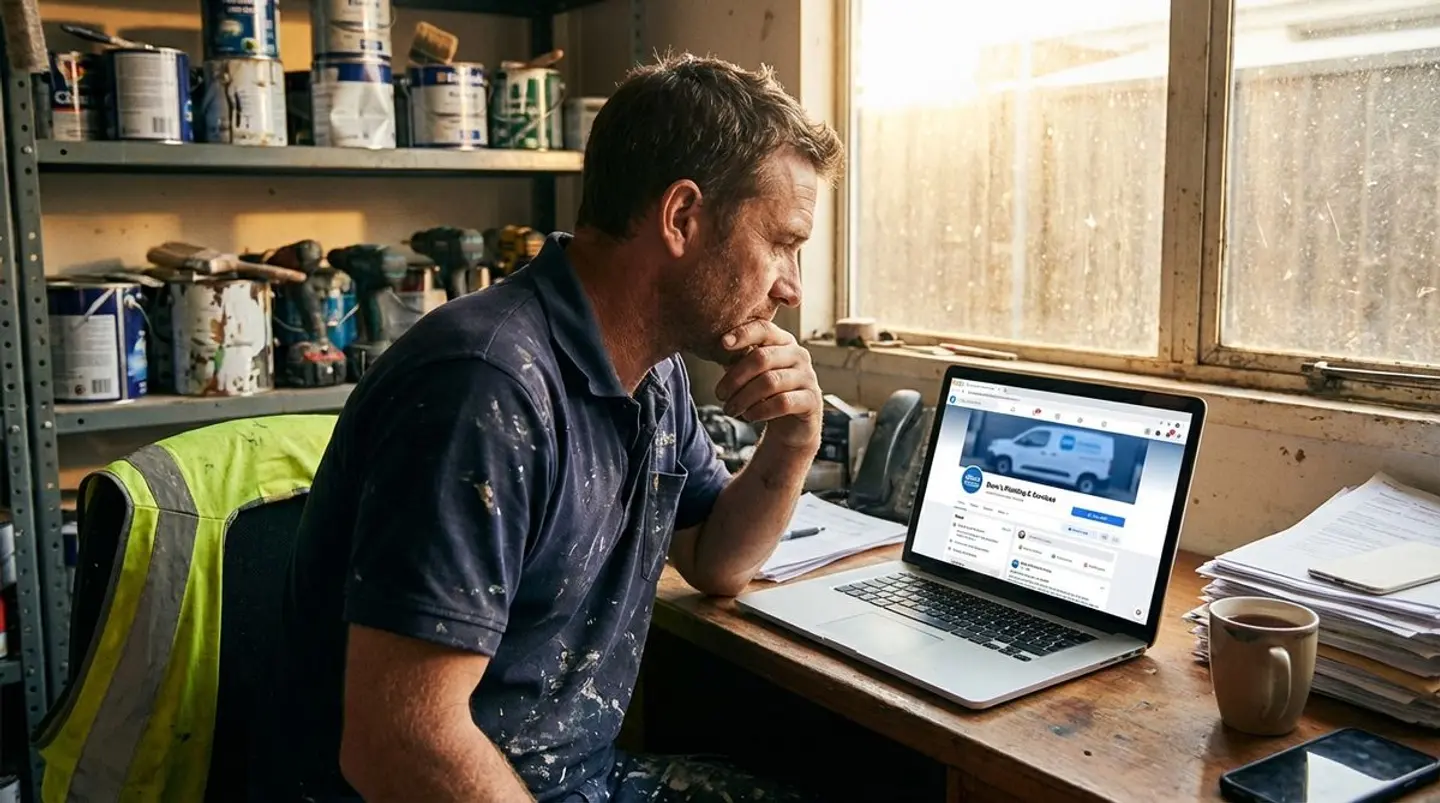
They find a Facebook page. The profile photo is a bit blurry. The last post is from four months ago. There is no website link. The page has 63 likes. They scroll for ten seconds, then click on a competitor's website instead. It looked professional. It had their services listed clearly. It had reviews and a contact form.
You never got that call. You never knew you lost it.
This is not a hypothetical. It happens every week to tradies, sole traders, and small business owners across the UK who are running on a Facebook page and calling it a digital presence.
To be clear: Facebook is a useful tool. For a lot of businesses, it has been genuinely valuable. But it is not a website. Here is why that distinction is costing you real clients.
What a Facebook Page Actually Does Well
Let's be fair. A Facebook page is not worthless.
It is free to set up. It is straightforward to use. It lets you share photos of your work, collect reviews, post updates, and get found by people who are already on Facebook. For a brand new business with zero budget, it is a legitimate starting point. Many tradespeople built their early reputation entirely on Facebook recommendations and word-of-mouth shares.
That is all true, and worth acknowledging.
But there are specific, structural limitations that Facebook pages have, and those limitations directly affect how many enquiries your business generates. Here is where it falls apart.
You Don't Own It
Think of Facebook like renting a market stall.
You can decorate it, put your best work on display, build a following of regulars. But the market owner sets the rules, can change them at any time, and can ask you to leave with no warning. Your stall, your display, your customer list: none of it belongs to you.
That is exactly what Facebook is. Your page, your posts, your reviews, your follower list: none of it is yours. You cannot export it, back it up, or take it somewhere else if you decide to leave.
Facebook can restrict your page. It can be hacked with no easy recourse. It can be caught up in a policy change that removes reach, limits features, or closes the account entirely. These are not edge cases.
In October 2021, Meta's entire platform went down for six hours. Facebook, Instagram, and WhatsApp all offline simultaneously. Businesses that relied on Facebook as their primary online presence had no way for customers to find them. That outage cost businesses an estimated £50 million globally.
A website, by contrast, is yours. Your domain belongs to you. Your content belongs to you. Your contact data belongs to you. You control everything, and you can move it to any host at any time. Nobody can take it away.
Nobody Can Find You on Google
Here is a fact that surprises a lot of people: Facebook pages barely appear in Google results for service searches.
When someone searches "plumber in Peterborough" or "electrician near me", Google returns actual websites. It returns Google Business Profile listings. It does not surface Facebook pages. Facebook's infrastructure is not built to compete in Google search, and never has been.
Google processes 8.5 billion searches every day. The overwhelming majority of buying journeys start with a search, not a social media scroll. When your mate recommends a builder, what do you do? You Google them. When you need a dentist in a new area, you Google it. Facebook is where you catch up with people. Google is where you find services.
This is a critical distinction. Facebook users are scrolling. Google users are searching with intent. They are looking for something specific right now, and they are ready to make contact.
Getting into Google's local results requires a combination of two things: a Google Business Profile and a website. The Google Business Profile gets you into the local map pack, those three listings that appear with a map when someone searches for a local service. But the website is what validates you. It is what Google reads to understand what you do, where you do it, and whether you are the right answer for that search. That is the whole case for learning to own your visibility through search instead of renting an audience on someone else's platform.
A Facebook page cannot do any of that.
The Algorithm Decides Who Sees You
This one surprises people most.
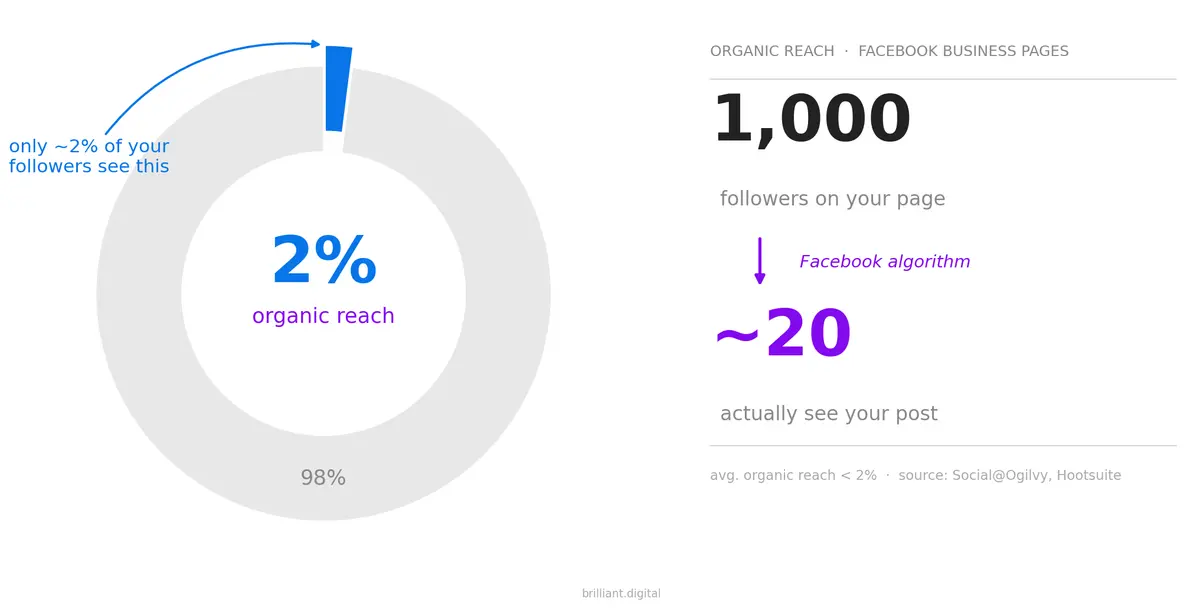
Organic reach on Facebook business pages is less than 2%. If you have 1,000 followers, on average fewer than 20 of them will see any given post. Facebook reduced organic reach deliberately and progressively over the past decade to push businesses toward paid advertising.
When you post on your Facebook page, Facebook decides who sees it. And for a business page, that number is tiny.
Your website is different. Every single person who visits your website sees everything on it. No algorithm decides for them. No post "underperforms" and gets buried. If your service page says what you do and how to get in touch, every visitor reads that.
There is a genuine irony here. Many business owners think Facebook gives them free marketing because they are not paying for ads. In reality, Facebook owns their audience. You are posting into someone else's platform, and they decide whether your message gets through.
You're Invisible to AI Search
This is something most articles on this topic miss entirely.
ChatGPT, Perplexity, Google's AI Overviews: these are now a meaningful part of how people find businesses. When someone asks an AI tool "who does website design in Lincolnshire?" or "what should I look for in a local electrician?", the AI pulls from websites. It reads content. It cites pages. It recommends businesses with an online presence.
Facebook pages are not indexed by AI search tools in any useful way. If you have no website, you do not exist in that world.
This is not a future problem. It is happening now. AI-assisted search is growing by double digits every quarter. A growing share of your potential clients, especially younger business owners and professionals, are using these tools to make decisions. No website means they will never find you through that channel.
Facebook Page vs Website: Side by Side
Here is a direct comparison.
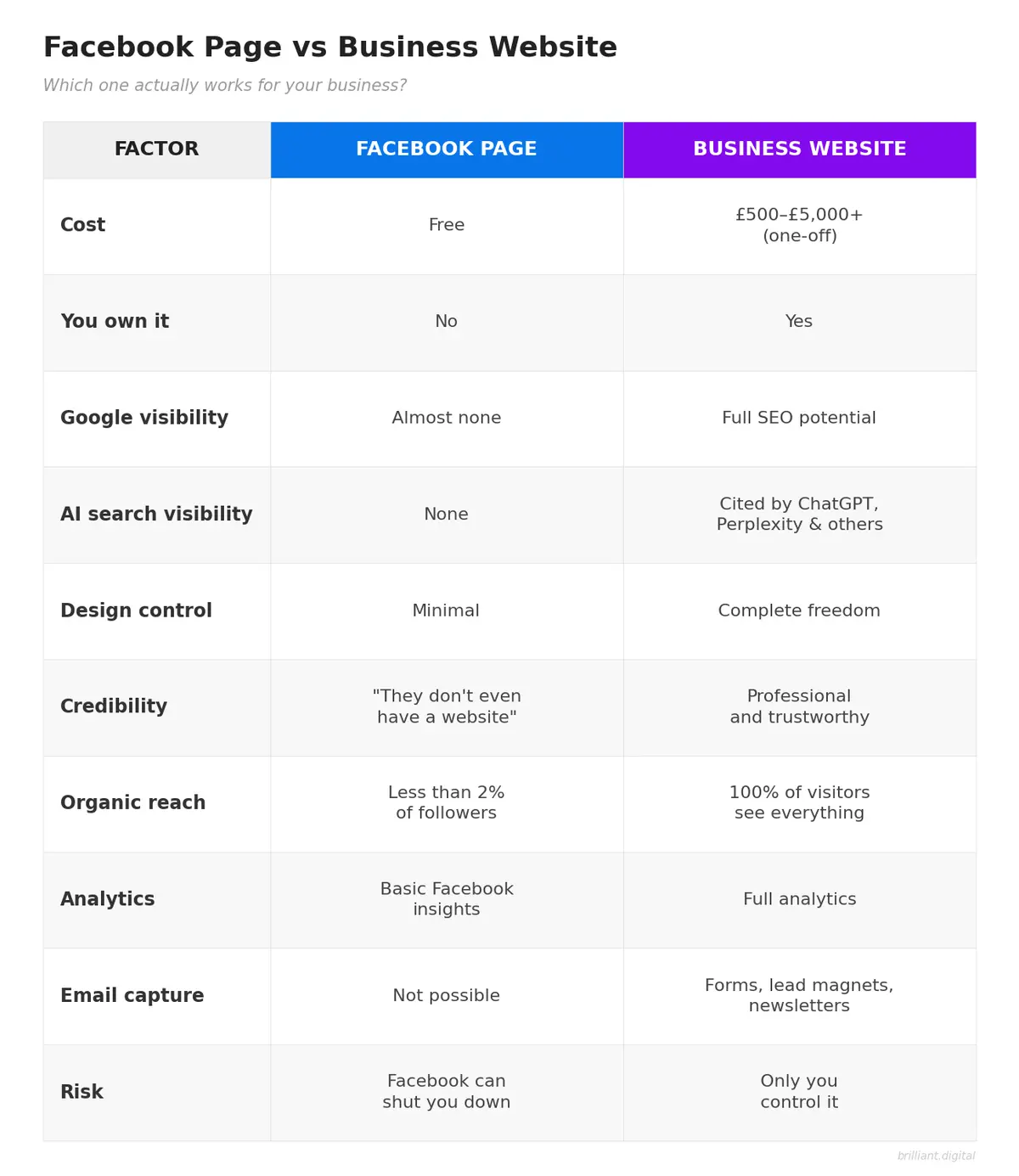
The pattern is clear. Facebook is free but limited in every dimension that actually drives business. A website costs something upfront, but gives you full ownership, full visibility, and full control.
"But All My Customers Are on Facebook"
This is the most common objection, and it deserves a straight answer.
Your customers might be on Facebook. But they do not find you there.
Think about your own behaviour. If someone recommends a tradesperson to you, what do you do next? You Google them. You look for a website. You check if there are reviews and photos of their work. You form a first impression before you pick up the phone. If there is nothing there, or if what you find looks unfinished, the doubt creeps in.
Facebook is a supplement, not a substitute. Use it for community, for sharing photos of completed jobs, for posting updates and getting recommendations. It is good at that. But your website is your professional home base. It is the place that converts someone who has heard of you into someone who makes contact.
The two work together. Facebook alone does not work.
What a Website Actually Costs in 2026
The biggest reason business owners avoid getting a website is that they think it will cost a fortune.
For a genuinely professional website built to last, UK prices typically sit between £1,500 and £5,000 for a small business. At the higher end, you are getting bespoke design, full CMS control, performance optimisation, and a website that will serve you for years. At the lower end, you are getting something that does the job without any frills.
For context: modern websites built using lightweight frameworks and smart hosting can cost as little as £0 per month to run once they are built. That is a fraction of what traditional hosting used to cost. And if the upfront cost feels like a stretch, companies like Brilliant Digital offer pay monthly packages that spread the investment over time, making a professional website genuinely accessible for businesses at any stage.
For a full breakdown of pricing and what you get at each level, see our guide: How Much Does Web Design Cost in the UK?
Frequently Asked Questions
Can I use a Facebook page instead of a website?
Technically, yes. But you lose Google visibility, AI search presence, professional credibility, and ownership of your own content. For a brand new business with zero budget, it is a starting point. For anyone who is serious about growing, it is not enough on its own.
Is a Facebook page better than a website for a small business?
No. Facebook is free and straightforward to set up, but limited in every way that matters for generating business. It cannot rank on Google, cannot be found via AI search, and gives you no control over who sees your content. A website does all of those things.
How much does a basic business website cost in the UK?
A professional small business website typically costs between £1,500 and £5,000 as a one-off build fee. Ongoing running costs are minimal with modern hosting, often less than £10 per month or nothing at all on platforms like Cloudflare. The right question is not "can I afford a website?" but "can I afford not to have one?"
Can people find my Facebook page on Google?
Rarely for commercial searches. Google prioritises websites with proper content and SEO. A Facebook page may appear if someone searches your exact business name, but it will not appear when potential clients search for your type of service in your area. That is the search traffic that actually generates business.
What to Do Next
Start with the domain name. Go to a registrar like 123-reg or Namecheap, search for your business name, and register it. It costs about £10-15 per year. That domain is yours. Nobody can take it away. You are claiming your corner of the internet, and you can build from there.
When you are ready to build a website that actually generates enquiries, Brilliant Digital has been doing exactly that since 2014. We have built over 150 websites and have 180+ five-star reviews from business owners across the UK. We are based in Bourne and work with clients nationwide.
No hard sell. Just a straight conversation about what is possible.