You paid for a website. It went live six weeks ago. You have searched for your own business, found nothing on the first page, and started to wonder whether you have been sold something that does not work.
Here is the short version. The first signs of life show up in weeks. Traffic worth having takes three to six months. Enquiries you can count on take six to twelve. A brand new website sits at the slow end of all three.
How long SEO takes to work also depends on something most articles skip. Ranking for a phrase almost nobody searches can happen in days. Ranking for the phrase that actually brings you customers takes far longer. Both things are normal, and confusing the two is why so many business owners believe their SEO has failed when it is running exactly on schedule.
This is what the timeline really looks like, what changes it, and how to tell the difference between slow progress and no progress.
Key Takeaways
- The first movement takes weeks, not days. Google's own documentation states that crawling, which simply means Google finding your page, "can take anywhere from a few days to a few weeks" (Google Search Central, 2026).
- Three to six months is when most websites see traffic worth measuring. Six to twelve months is when it becomes something you can rely on.
- A brand new website is slower at every stage, because Google has no history to judge it on.
- Local searches move faster than national ones. A complete Google Business Profile can change what you see within a week.
- Ranking quickly and ranking profitably are two different timelines. The easy keywords arrive first, and they are easy precisely because so few people search them.
How long does SEO take to work?
SEO usually takes three to six months to produce measurable results, and six to twelve months to produce results a business owner would call worthwhile. An established website with existing authority can move in 30 to 90 days. A brand new domain is often close to invisible for competitive searches during its first three to four months.
SEO, or search engine optimisation, is the work of making a website easier for search engines to find, understand and trust, so that it appears higher in the unpaid search results.
Those ranges are wide because narrowing them would mean making them up. It is worth knowing what Google itself is willing to commit to, because it is less than most agencies claim on its behalf.
Google's SEO Starter Guide says: "Every change you make will take some time to be reflected on Google's end. Some changes might take effect in a few hours, others could take several months." On judging your own work, the same guide says: "In general, you likely want to wait a few weeks to assess whether your work had beneficial effects in Google Search results."
That is the whole of it. Google publishes no headline figure. Plenty of articles on this subject cite Google as the source for one, and when we went looking for it in Google's current documentation in August 2026, we could not find it. What Google does commit to is a range from hours to months, and a recommendation to wait weeks before drawing conclusions.
How long it takes to rank on Google is not a single number, and anyone who gives you one without first asking about your website is guessing. Two things shape your timeline more than anything else: how old and how trusted your website already is, and how competitive the phrases you want are.
A five year old plumbing business adding a new service page is playing a completely different game from a business that launched its first website last month.
The SEO timeline, month by month
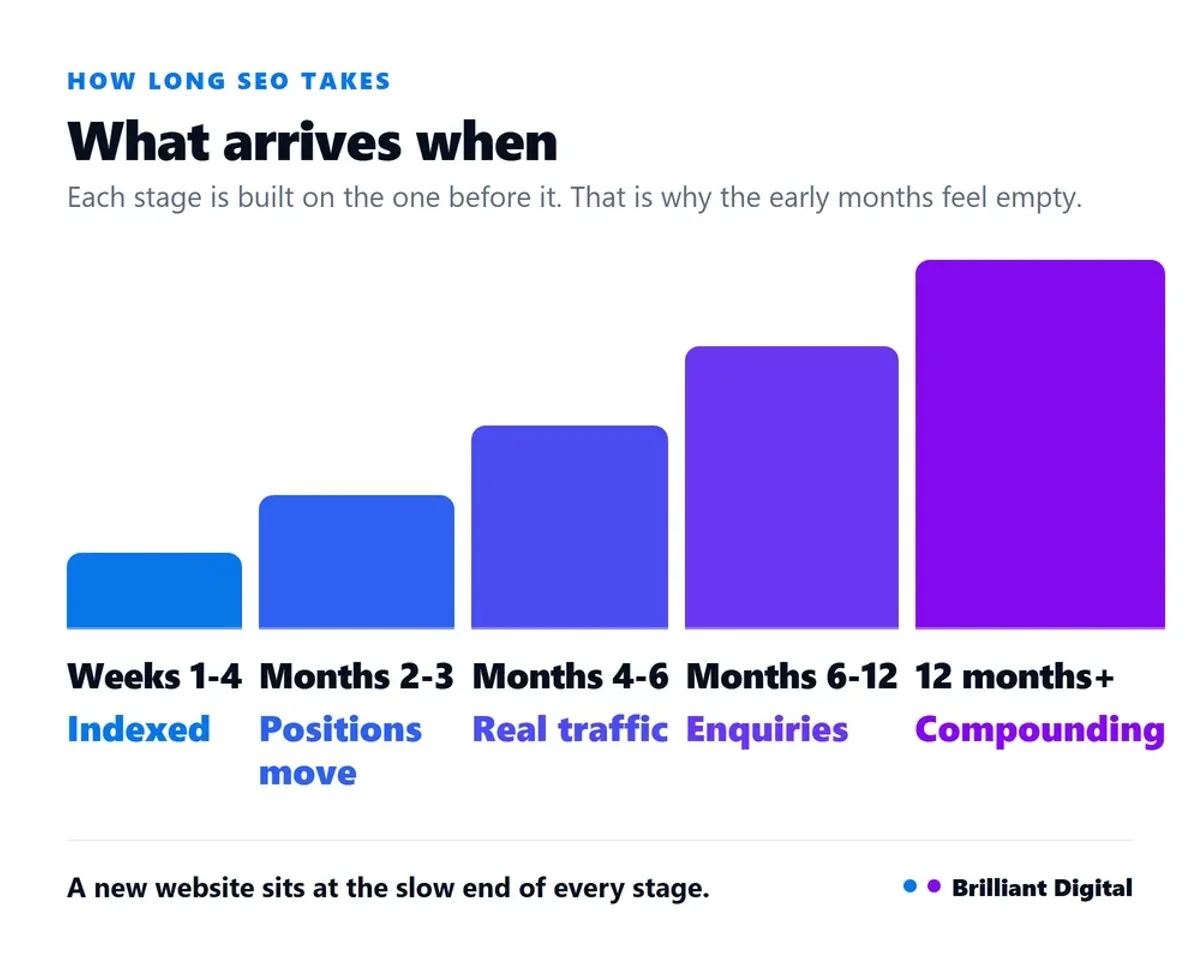
The honest month by month picture looks like this. Weeks one to four are technical groundwork and indexing. Months two and three bring early ranking movement on easier phrases. Months four to six produce the first meaningful traffic. Months six to twelve is when enquiries become consistent.
Here is what you should actually be able to see at each stage, and where to look for it.
- Weeks 1 to 4: indexing and groundwork. Your pages get crawled and added to Google's index. You set up Google Search Console. Technical problems get fixed. You will start to see impressions, which means your pages appeared in someone's results, even at position 60. You will see almost no clicks, and that is correct for this stage.
- Months 2 to 3: early movement. Rankings start to appear for long, specific phrases with little competition. Impressions climb steadily. Average position improves, often dramatically, because moving from position 80 to position 35 is much easier than moving from 12 to 5. Clicks are still thin. This is the stage where most people conclude it is not working.
- Months 4 to 6: the first real traffic. Local searches and long, specific queries start turning into visits. If you serve a particular town or county, this is usually the stage where you can trace an enquiry back to a page and know which one did the work.
- Months 6 to 12: enquiries become consistent. Competitive commercial phrases come into reach. Traffic stops being a line that wobbles and starts being a line that trends. You can predict roughly what next month looks like.
- 12 months and beyond: compounding. Pages that have been in the index for a year carry weight that new pages do not. New content ranks faster because the website around it is trusted. This is the point where SEO stops being a cost and starts behaving like an asset.
Why does SEO take so long?
SEO takes so long because nothing about it is instant, and each step waits for the one before it. Google has to find your page, decide it is worth storing, then decide it is a better answer than pages that have been earning trust for years. None of that happens on your schedule.
Broken into the parts that actually cost time:
- Crawling and indexing come first. Until Google has your page in its index, nothing else you do matters. Google's guidance on requesting a recrawl is blunt about this: "Requesting a crawl does not guarantee that inclusion in search results will happen instantly or even at all."
- You are queuing behind incumbents. The pages above you have often been there for years, collecting links and engagement the whole time. Google has no reason yet to believe you are the better answer.
- Links and reputation move on their own clock. You cannot make other websites link to you this month. That is the slowest signal there is, and it is largely outside your control.
- The compounding is the point. Each indexed, ranking page makes the next one slightly easier. That is genuinely powerful, and it is also the reason the first few months feel like nothing is happening.
Beyond the age of your domain, four things change how long your version of this takes:
- Competition. "Web design agency" and "emergency plumber in Bourne" are not the same difficulty, and never will be.
- Technical health. A slow website with indexing problems is not slow to rank because SEO is slow. It is slow because it is broken.
- Local versus national. Local is meaningfully faster, because you are competing against the businesses in your town rather than the whole country.
- How much you publish. One page a quarter compounds very slowly. There is no way round this.
Ranking fast and ranking for something that pays are two different timelines
You will rank quickly for phrases that bring you nothing, and slowly for the phrases that bring you customers. Both happen at once, which is why one website can look like a success and a failure depending on which number you look at. Almost every article skips this, and it is the most useful thing here.
Take a plumber in Peterborough. Two phrases, both perfectly reasonable to target:
- "emergency plumber Peterborough". Hundreds of searches a month, every plumber in the city competing for it, and the top results have been there for years. This is the phrase that pays. It is also the one that takes six to twelve months, if it comes at all.
- "why is my boiler making a banging noise". Almost nobody has written a decent answer for it locally. A good page can start ranking for this within weeks.
The second one can appear on page one remarkably fast. It is easy precisely because it is not contested, and it is not contested because relatively few people search it. That is not a coincidence, it is the whole mechanism. Low competition and low volume are usually the same fact described two ways.
This is why new websites so often produce a confusing first three months. Rankings genuinely appear. Search Console genuinely shows positions in the top twenty. The phone genuinely does not ring. Nothing has gone wrong: the fast wins have arrived and the valuable ones have not.
None of which makes the early wins pointless. They get pages indexed, they build the track record Google uses to judge everything you publish next, and they occasionally bring in someone with a very specific problem you happen to solve. They are the foundation. They are just not the return.
So when an agency tells you they got you to page one in three weeks, the only useful question is: page one for what, and how many people search it? Ask for the monthly search volume alongside the ranking. If they cannot give you it, or it turns out to be twenty searches a month, you have not been lied to exactly, but you have not been told the useful half either. A ranking without search volume behind it is a screenshot, not a result.
If you are not sure which category your own rankings fall into, send us the phrases you rank for and we will tell you straight whether they are worth anything. Get in touch. No proposal, no sales pressure.
How long until you show up in AI search?
AI search results follow ordinary SEO rather than bypassing it. Google's AI Overviews, ChatGPT and Perplexity assemble their answers from pages that are already indexed and already trusted, so being cited is downstream of the same work. Citations can appear faster than competitive rankings, but they are far less stable.
This matters more than it did a year ago. Search for "how long does SEO take to work" today and an AI Overview sits above every organic result, answering the question in full before you reach a single website.
What tends to get cited is reasonably consistent:
- Pages that commit to specific numbers rather than saying it depends
- Clear structure with labelled sections, so an answer can be lifted out cleanly
- Recent content, with dates attached to claims
- Pages that are already indexed and already ranking somewhere sensible
The caveat worth knowing is that citations are far more volatile than rankings. A page can be cited one month, absent the next, and back again after that, without anything on the page having changed. AI answers are regenerated rather than stored, so each one is a fresh decision.
The practical answer: if your pages are indexed and genuinely useful, you can appear in AI answers within weeks. Do not build a plan around staying there.
How do you tell if it's working?
Use Google Search Console, not Google Analytics. Search Console tells you how you performed in the search results themselves. Analytics tells you what people did after they arrived. Only one of them measures whether your SEO is working, and it is the one most business owners never open.
Search Console is free, and Google's own documentation covers setting it up. Once it is running, check these four things, in this order:
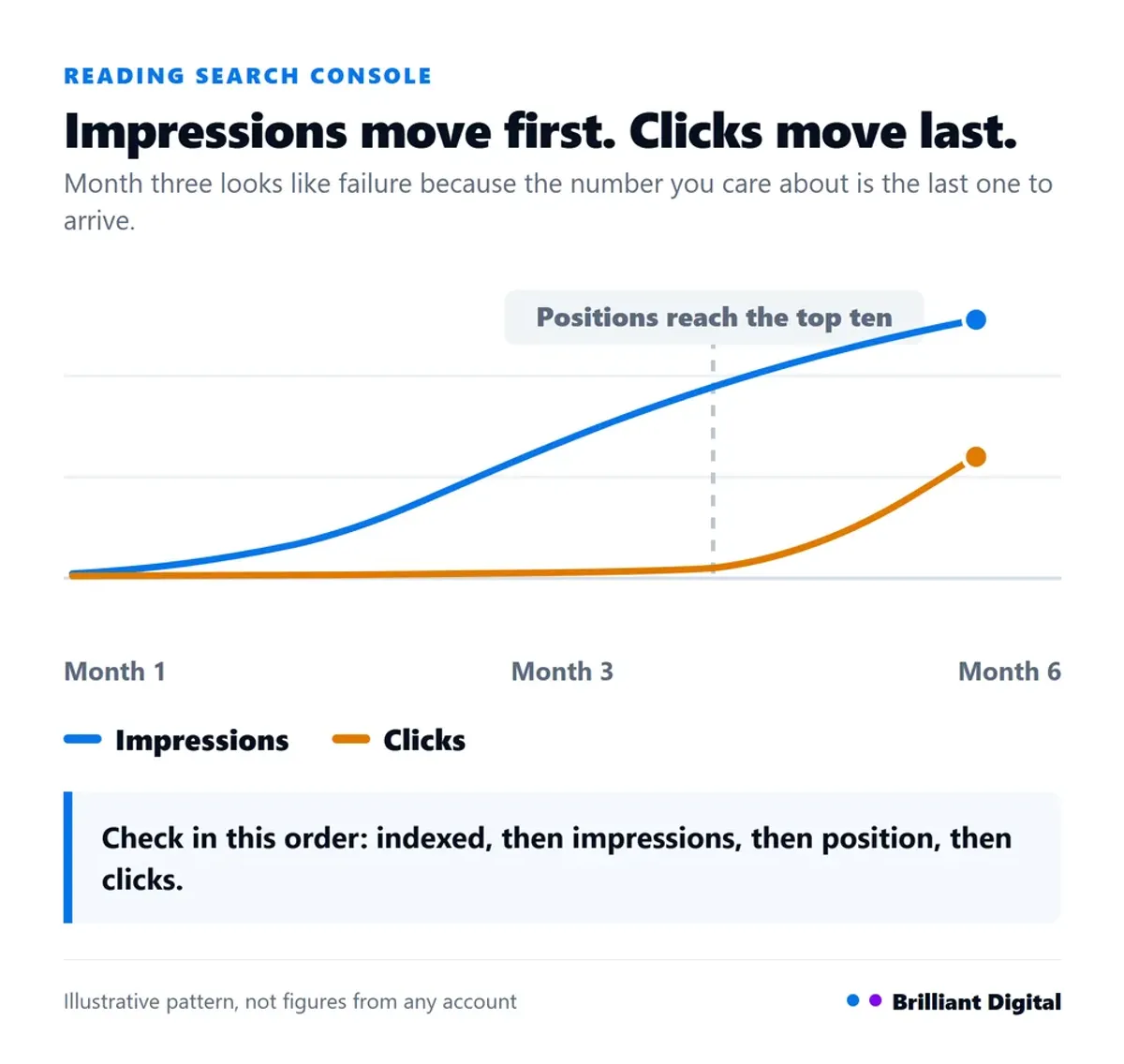
- Is the page indexed? If not, nothing else on this list applies. Fix that first.
- Impressions. Are you appearing at all, for anything? This moves first.
- Average position. Is it improving over months, not days?
- Clicks. This moves last, and only once positions cross into the top ten.
The order matters, because SEO results arrive in that sequence and not in the one you would expect. Impressions and position improve well before clicks do. Month three feels like failure for exactly this reason: the numbers that are moving are not yet the numbers you care about.
There is one more filter worth applying, and most people skip it. Filter your Search Console data to the United Kingdom before you read any of it. On a small UK website the unfiltered figures include a great deal of traffic that could never become a customer, and they routinely make your average position look worse than it is. Two minutes with the country filter will change what the data appears to be telling you.
Give any change four weeks before you judge it, which is also what Google's own guidance suggests. Checking weekly tells you about normal fluctuation in the results, not about your work.
If nothing at all has moved after three months, that is worth investigating. Usually it turns out to be an indexing problem rather than a content problem. Our guide on why your website might not be showing up on Google covers how to check.
How to get results faster
You cannot shortcut trust, but you can stop wasting the first three months. The fastest gains come from fixing what is broken, claiming what is free, and going after phrases you can realistically win instead of the one you wish you had.
In order of return for a typical UK small business:
- Fix indexing before anything else. A page Google has not indexed cannot rank no matter how good it is. Check it in Search Console.
- Complete your Google Business Profile properly. For a business serving a local area this is the fastest legitimate win there is, often visible within a week. Fill in every field, not the minimum: categories, every service, hours, service areas, photos. Google's own guidance sets out what counts, and we have covered the three ways to get your business showing on Google separately.
- Chase phrases you can actually win. Longer, more specific searches have less competition. Five specific pages that rank beat one broad page that does not.
- Improve pages sitting at positions 11 to 30 before writing new ones. Those pages have already convinced Google they are relevant. They just are not the best answer yet. This is almost always a better use of a day than a new article, and our guide to improving your Google rankings goes through the specific fixes.
- Publish consistently. Compounding cannot start until there is something to compound.
- And the honest one: if you need the phone to ring this month, SEO will not do it. Paid search will. We run Google Ads for clients as well as building their websites, and we will say plainly when paid is the better first move. We have written an honest comparison of PPC and SEO for anyone deciding where to start.
The pattern most small businesses do well with is straightforward: run ads for the months while SEO is warming up, then let SEO carry more of the load as it starts to compound. That is not a compromise. It is just what the two timelines look like side by side.
Frequently Asked Questions
Is SEO actually worth it?
For most local service businesses, yes, provided you can wait six to twelve months and the work is specific and measurable. It is poor value if you need enquiries this quarter, or if nobody searches for what you do. Check the search volume for your main phrases before committing to anything.
Can I do SEO myself?
Yes, and the highest value work is genuinely doable. Completing your Google Business Profile, fixing indexing problems, writing pages that answer real customer questions and setting up Search Console need no specialist tools. Technical fixes and competitive content are where outside help starts to pay for itself.
Is SEO dead now with AI?
No, but the payoff has shifted. AI Overviews answer more questions directly, so some informational searches produce fewer clicks than they did. AI answers are still assembled from indexed, trusted pages, so the underlying work is the same. Broad "how to" content has lost the most.
What is the 80/20 rule in SEO?
The idea that roughly 20% of the work produces 80% of the result. In practice that 20% is almost always: make sure your pages are indexed, complete your Google Business Profile, and improve pages already ranking on page two. Backlink campaigns and technical audits usually sit in the other 80%.
How much does SEO cost in the UK?
We do not sell SEO retainers, so treat this as an observation rather than a price list: quotes we see UK small businesses receive usually sit between £500 and £2,000 per month. Be wary of anything far cheaper, because the saving comes out of the hours spent. Ask which pages will change and what will be measured.
What to do next
If your website is new, the timeline above is your realistic expectation. The most useful thing you can do this month is make sure every page is indexed and your Google Business Profile is complete.
If your website is a year old and nothing has moved, the problem is usually specific and findable. Often it is not SEO at all, but a website that was never built to rank in the first place.
Still wondering whether SEO is worth it for a business your size? We have made that case separately in why SEO matters for a small business, including what happens to the businesses that ignore it.
We build websites that are technically capable of ranking, and we run Google Ads for the months while the SEO warms up. We have built over 150 websites since 2014, and we will not promise you page one in 30 days, because nobody can control Google's results and anyone claiming otherwise is selling you something.
Tell us about your business and where you are stuck, and we will come back to you honestly. Get in touch.