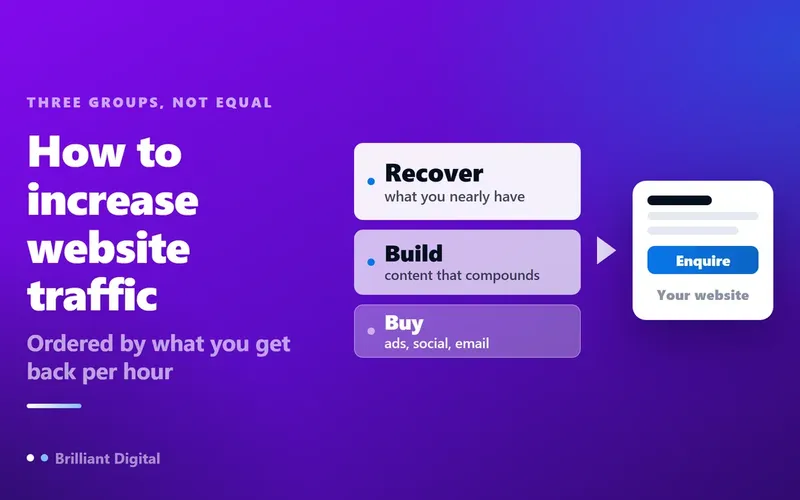
Search "what is paid advertising" and look at who wrote the results. Amazon. Adobe. Shopify. Meta.
All four of them make money when you spend money on ads. Not one of them is going to open with the sentence you most need to hear, which is that quite a lot of small businesses are not ready for this yet and should fix something else first.
Paid advertising is buying your way in front of people instead of waiting to be found. You bid in an auction, your ad appears alongside search results, and you pay when somebody clicks. It starts working the day you switch it on, which is the whole appeal and also the whole trap: it is the only marketing channel that will happily take your money while achieving nothing, quietly, for months.
We manage Google Ads for small businesses, so we have a stake here too. Ours is just the opposite one: a campaign that loses somebody money for six months costs us a client. So this guide covers which part of paid advertising to start with, what you genuinely need to spend, and the specific cases where the honest answer is not yet.
Key Takeaways
- Start with one campaign type, not four. Search first for almost every UK small business, because it captures demand that already exists rather than trying to create it.
- Your budget floor is arithmetic, not opinion. Cost per click multiplied by the clicks it takes to get an enquiry, multiplied by enough enquiries to learn anything. Below that you are buying a false conclusion.
- The ad is half the job. Sending traffic to a page that does not convert is an expensive way to discover your website is broken.
- Set up conversion tracking before you spend a penny. Without it, Google optimises towards the wrong thing and you have no idea which half is working.
- If your website does not convert the visitors it already gets, ads will not fix that. They will make it cost more.
What paid advertising actually is
Paid advertising is any online marketing where you pay a platform to place your message in front of a chosen audience. You set a budget, bid against other advertisers in an automated auction, and pay per click, per thousand impressions or per conversion. The platform decides who sees it based on your bid and your relevance.
That is the mechanical answer, and every glossary page gives it. Here is the distinction those pages tend to skip, and it is the one that decides where your money should go:
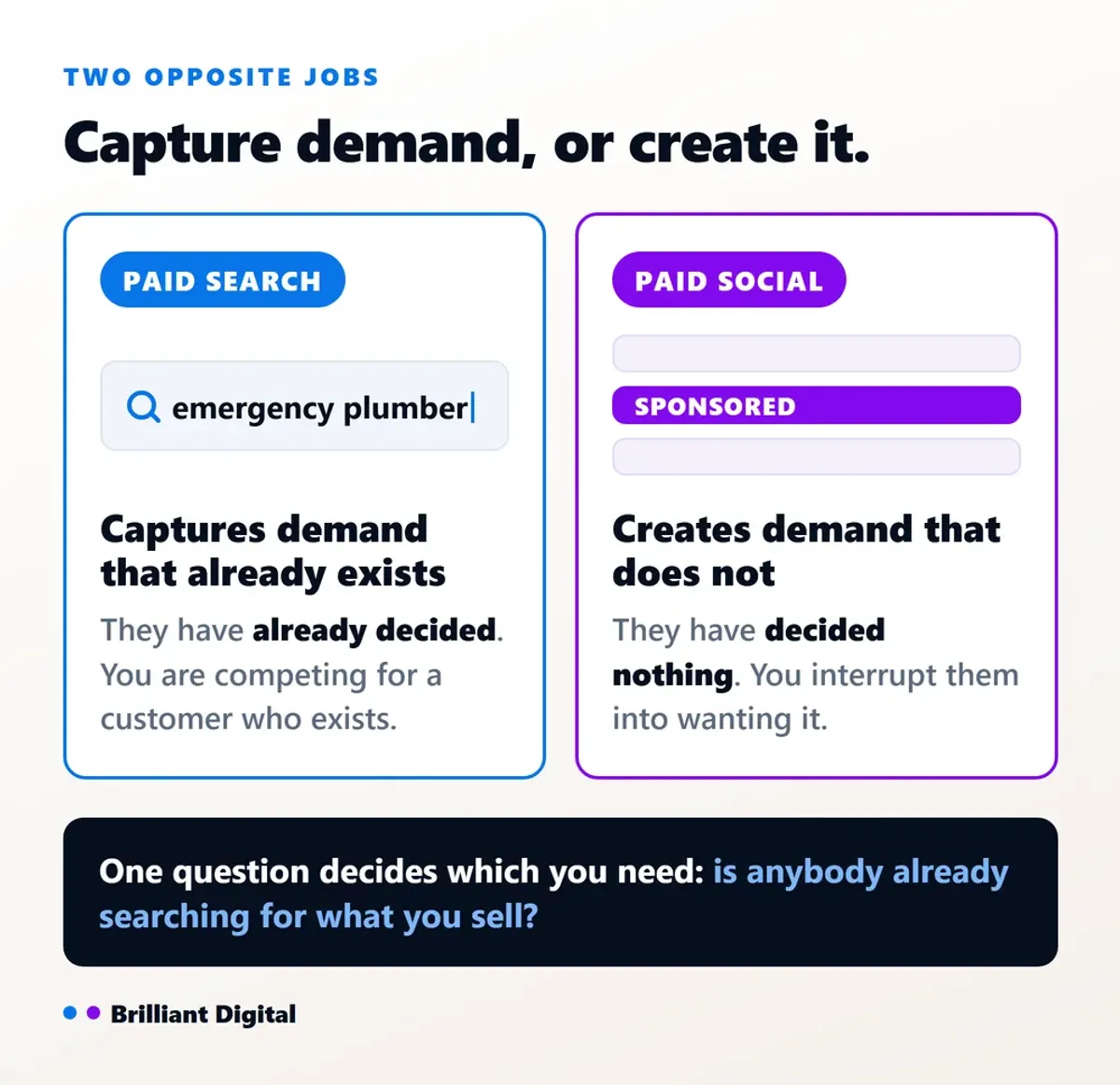
Paid search captures demand that already exists. Paid social creates demand that does not.
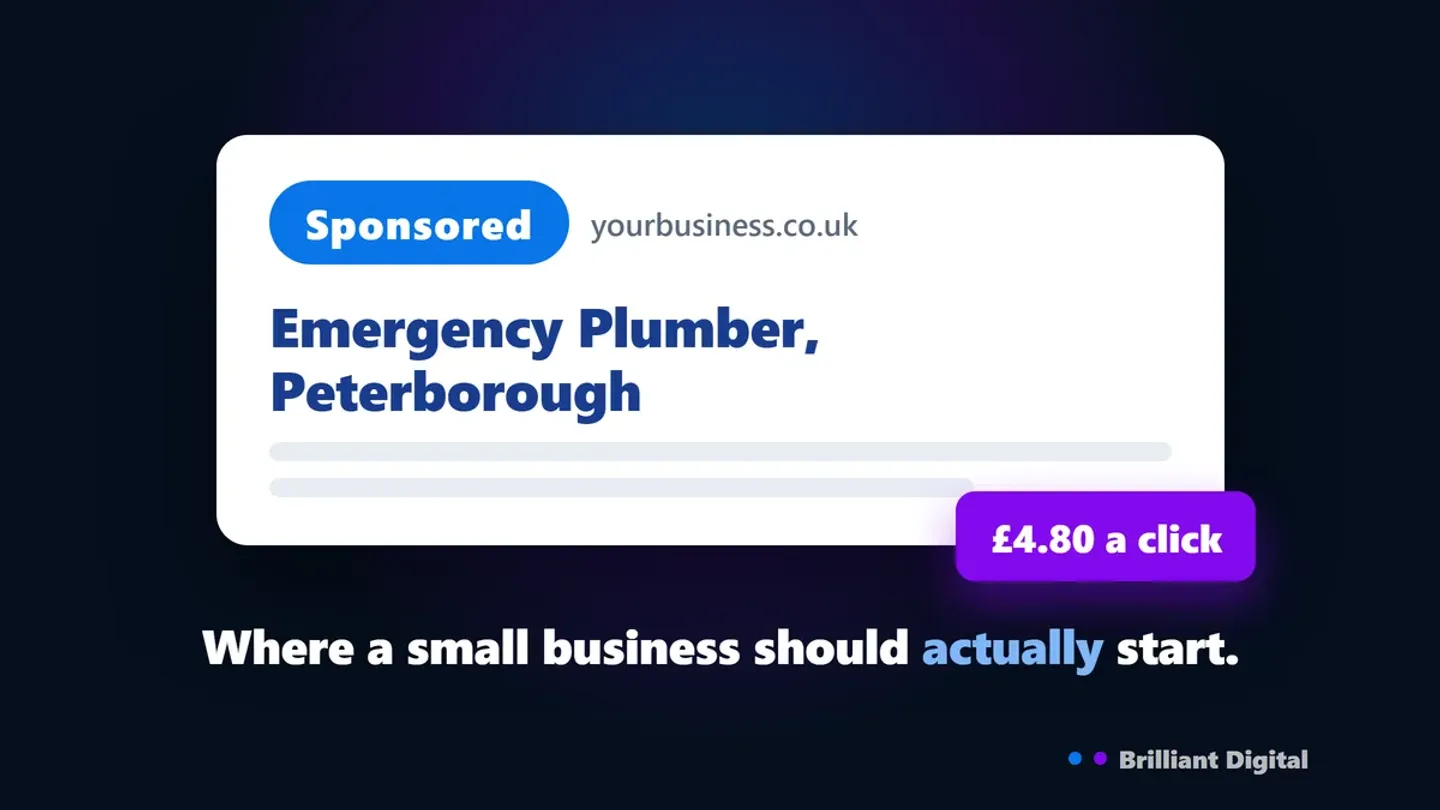
Somebody typing "emergency plumber Peterborough" into Google at eleven at night has already decided they need a plumber. You are competing for a customer who exists. Somebody scrolling a feed has not decided anything, and your job is to interrupt them convincingly enough to create a want they did not arrive with.
Those are two completely different jobs, with different costs, different timescales and different skills. Most guides list them side by side as though picking between them were a matter of taste. It is not. It is decided by whether anybody is searching for what you sell.
What paid advertising is actually good at
Paid advertising does four things that no other channel does as quickly, and it is worth being precise about them, because the generic benefit lists you will find elsewhere ignore what each one costs you. Every advantage here has a trade-off attached, and knowing both is the difference between a budget and a donation.
It works immediately. SEO takes months. A paid campaign can be live this afternoon and producing enquiries tomorrow. The trade: it stops the day you stop paying. You are renting attention, not building an asset, and month thirteen costs the same as month one.
It targets precisely. You can show ads only to people within twelve miles, only on weekday evenings, only when they search a specific phrase. Nothing else buys attention that narrowly. The trade: every filter shrinks your audience, and it is easy to target so tightly that you buy forty clicks a month and learn nothing.
It is measurable to the penny. You can know what each enquiry cost, which is uncomfortable but useful. Most marketing cannot tell you that. The trade: only if you set the measurement up. Without conversion tracking you get precise numbers about entirely the wrong things.
It tells you what people actually want. The search terms report shows the exact words people used before they contacted you. That is market research nobody had to fill in a survey for. The trade: none, really. This is the one benefit that keeps paying even if you stop advertising.
The honest summary: paid advertising is the fastest way to find out whether people want what you are selling at the price you are selling it. That is worth a lot, and it is not the same thing as a growth strategy.
The types of paid advertising
Most paid advertising a UK small business will ever need sits inside a single Google Ads account, as five different campaign types rather than five separate platforms to learn. That framing matters, because it is one login, one budget and one set of conversion tracking rather than five of everything.
Search ads
Text ads on the Google results page, marked "Sponsored", triggered by the words somebody types. This is the default starting point for almost every local or service business, and for most it is the only campaign type they will ever need.
You choose keywords, you write ads, and you pay when somebody clicks. The strength is intent: the person searching has told you what they want in their own words. The weakness is that everybody else knows this too, which is why the competitive terms cost what they cost.
The part beginners underestimate is match types. Broad match lets Google show your ad for anything it considers related, which on a small budget means paying for searches you would never have chosen. Phrase and exact match are narrower and more expensive per click, and almost always cheaper per enquiry when you are starting out. Start tight, then widen once you know what converts.
Shopping ads
Product listings with an image, a price and your shop name, shown across search and the Shopping tab. If you sell products online, these usually outperform text ads, because the customer sees the thing and the price before they click, which filters out people who were never going to buy at that price.
Shopping campaigns are driven by a product feed rather than keywords, which means the quality of your product titles and images does most of the work. Get the feed right and the campaign is straightforward. Get it wrong and no amount of bidding fixes it.
In practice that means writing product titles the way customers search rather than the way your supplier names things. "Brushed brass kitchen tap, single lever" will be found. A manufacturer's part number will not. It is unglamorous work on a spreadsheet, and it is the highest-return hour you will spend on a shopping campaign.
Retargeting
Ads shown to people who have already visited your website. The cheapest clicks you will buy and, for most small businesses, the best return in the account, because you are advertising to people who already know who you are.
It is also the campaign type people switch on last, usually a year after they should have. If you only ever run two campaign types, make them search and retargeting.
Display ads
Image and banner ads across the Google Display Network, which covers a very large share of the web plus Gmail and YouTube. Cheap per impression, cheap per click, and the place where small budgets most reliably disappear.
Display works for awareness and for retargeting. It does not work as a way of generating enquiries from cold audiences on a small budget, whatever the interface suggests when it offers to expand your campaign for you. Treat any automatic prompt to add Display to a search campaign with suspicion.
Video ads on YouTube
YouTube is a Google property and YouTube advertising runs through the same Google Ads account. Video suits businesses with something to demonstrate or explain, and businesses with a brand worth building.
It does not suit a plumber who needs the phone to ring on Thursday. Video is a considered-purchase and awareness format, and the production cost sits on top of the media cost. Worth knowing about, rarely worth starting with.
What about Facebook, Instagram, TikTok and LinkedIn?
Paid social is a genuine channel and some businesses should be using it. It works by interrupting people who were not looking for you, which means it needs creative rather than keywords, it takes longer to prove, and it suits businesses selling something nobody is searching for yet. A new homeware brand needs paid social. An emergency plumber does not.
We should be straight with you: we run Google Ads, not paid social, and this guide reflects that. We would rather say so than write a pretend-balanced comparison. If your business genuinely belongs on social rather than search, you want somebody who does that for a living, and it is not us.
Where should you start
One question decides it, and you can answer it in about a minute. Is anybody already searching for what you sell? Type it into Google the way a customer would. If there are ads at the top, there is demand and there are competitors paying for it. Start with Google search ads.
If nothing comes up, or only vaguely related things do, you are in the demand-creation business. That is a harder, slower job that runs on creative rather than keywords, and paid search will not rescue it.
Then, within Google, start with one campaign type:
- Search first, almost always.
- Retargeting second, once search is sending you enough traffic to retarget.
- Shopping alongside search if you sell products online.
- Display and video last, and only once the first two are paying for themselves.
Running four campaign types at once on a small budget is the most common and most expensive mistake we see. You split a budget that was already thin four ways, none of the four gathers enough data to optimise, and after two months you conclude that Google Ads does not work for your business. What did not work was running four experiments with enough money for one.
What you actually need to spend
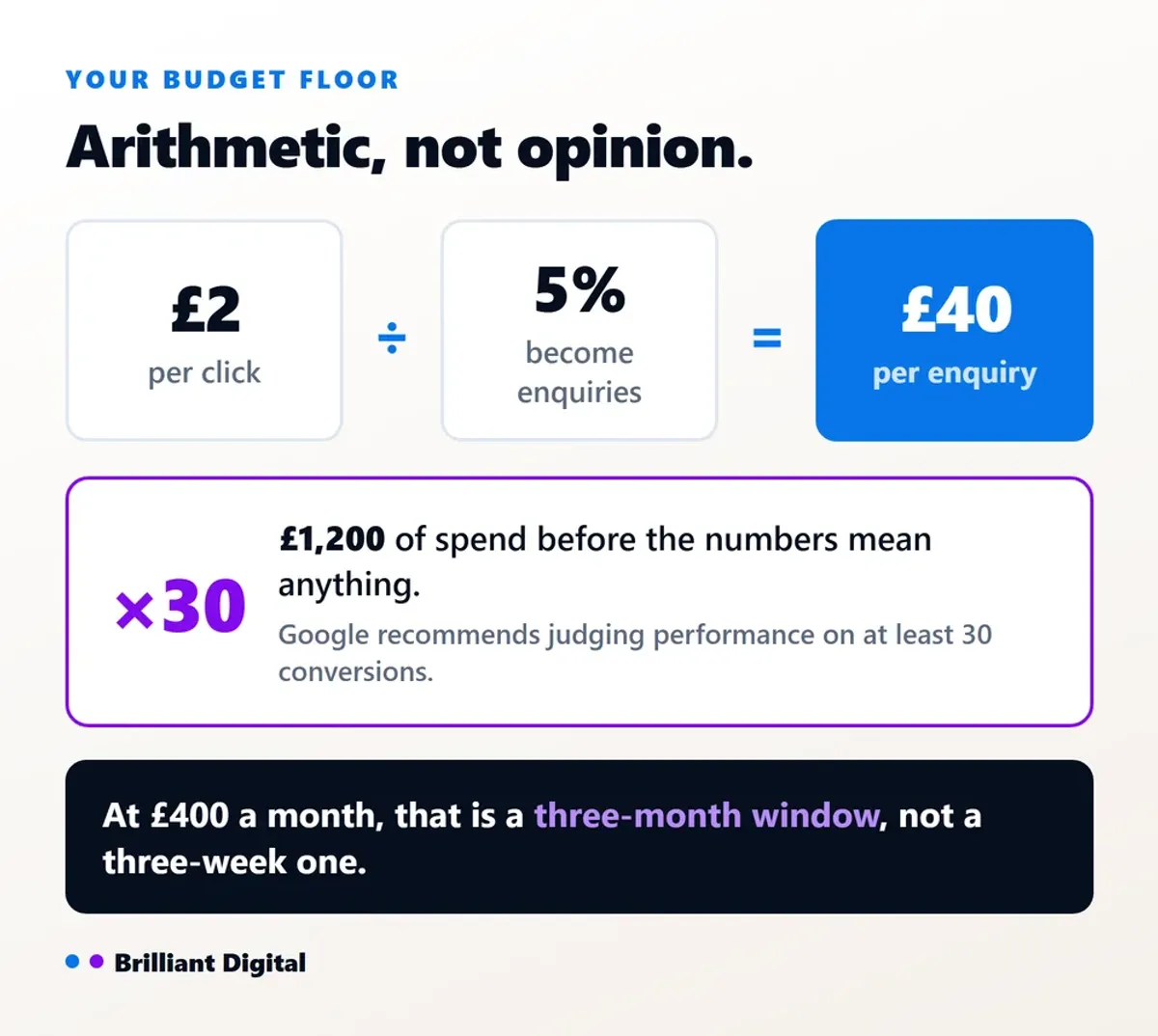
There is no universal minimum, and anybody quoting one without asking what you sell is guessing. Your budget floor is arithmetic rather than opinion, and you can work it out yourself in two minutes. Three figures decide it: your cost per click, your conversion rate, and what a customer is worth.
Start with your cost per click. Google's keyword planner will estimate it, and it varies enormously: a couple of pounds for a local trade, considerably more for competitive professional services. Then estimate what proportion of clicks turn into an enquiry. Five per cent is a reasonable starting assumption for a decent landing page.
At £2 a click and a five per cent conversion rate, one enquiry costs you £40. Ten enquiries a month costs £400. Whether that is expensive depends entirely on what an enquiry is worth to you, which is a number only you have: your average job value multiplied by the proportion of enquiries you win.
That last calculation is the one that matters, and it is the one most people skip. A £40 cost per enquiry is a disaster for a business with a £60 average job and a bargain for one with a £6,000 average job.
Below a certain point you are not running a campaign, you are buying a handful of clicks and a false conclusion. If your budget only buys forty clicks a month, you will get two enquiries in a good month and none in a bad one, and you will learn nothing from either.
You do not have to take our word for where that point sits, because Google publishes it. Its own guidance recommends judging performance over a period with at least 30 conversions, and 50 for target return on ad spend (Google Ads Help). Thirty enquiries is the number Google itself thinks you need before the data means anything.
For our plumber at £40 an enquiry, thirty conversions is £1,200. That does not mean you need £1,200 a month. It means that at £400 a month you are looking at a three-month window before the numbers are worth reading, and you should plan for that rather than panicking in week three.
Our guide to what web design costs in the UK covers the same honest-arithmetic approach for websites, and PPC versus SEO covers which channel deserves the money first if you cannot fund both.
Two worked examples
Abstract advice is easy to agree with and hard to use. Here are two UK businesses with the same £600 monthly budget and completely different correct answers, which is the point.
An emergency plumber in Lincolnshire
Demand exists and it is urgent. People search "emergency plumber near me" at the worst possible moment and they call the first credible result. Clicks are expensive, perhaps £4 to £6 on the emergency terms, because every plumber in the county wants them.

The right setup is narrow and boring. Search campaign only. A tight list of emergency and near-me terms, a heavy negative keyword list to keep out job seekers and DIY searches, ad scheduling weighted towards evenings and weekends, and location targeting set to a genuine travel radius rather than a hopeful one.
At £5 a click, £600 buys 120 clicks. At a ten per cent conversion rate, which is realistic for an urgent search landing on a page with a phone number at the top, that is twelve calls. If half become jobs at a few hundred pounds each, the maths works comfortably. Retargeting is pointless here because nobody browses for an emergency plumber and comes back on Thursday.
What month two looks like: pull the search terms report and add negatives for everything that was not a genuine emergency. Expect to find "plumbing courses", "plumber jobs", "how to bleed a radiator" and at least one search that has nothing to do with plumbing at all. Then check the hours. If nine out of ten calls came between six in the evening and midnight, the daytime budget is subsidising the evening and should be moved.
An independent kitchen showroom in Peterborough
Demand also exists, but nobody buys a kitchen the day they first search. The buying cycle is months, several people are involved, and the customer will visit six websites before they contact anybody.

The right setup is search plus retargeting. Search catches "kitchen showroom Peterborough" and "fitted kitchens near me". Retargeting keeps the showroom in front of everyone who visited and left, which is almost all of them, at a fraction of the search click cost.
The same £600 buys fewer, more expensive clicks, and the conversion rate looks terrible by the plumber's standards, because the visitor is not ready. The number that matters here is not enquiries this month, it is enquiries within ninety days. Judging this account on a thirty-day window would lead you to switch off something that was working.
What month two looks like: almost nothing conclusive, and that is the correct result. The useful signals this early are whether people are reaching the showroom pages at all, how long they stay, and whether anyone books a visit. Resist the urge to change bidding strategy because a month produced two enquiries. On a ninety-day cycle, month two is still month one of the data.
Same budget, same country, same platform. Opposite campaigns, opposite measurement windows, and opposite definitions of success. If you take one thing from this guide, take that: the right way to run paid advertising depends less on your industry than on how long your customer takes to decide.
What makes a Google ad actually work
A Google search ad is three headlines, two descriptions and a set of extensions, and Google mixes them automatically to find the combination that performs. That format is called a responsive search ad, and understanding how it assembles your text is most of the difference between an ad that earns its click and one that quietly drains the budget.
Write headlines that say different things, not the same thing five ways. Google needs genuine variety to test. If all your headlines are variations on "Quality Plumbing Services", it has nothing to work with. Give it the service, the location, the proof, the offer and the response time as separate angles.
Put the search term in at least one headline. Somebody who typed "emergency plumber Peterborough" and sees those words in your ad has had their question answered before they click. This is also the cheapest way to improve relevance, which lowers what you pay per click.
Use the extensions. Sitelinks, call buttons, location and callouts are free additions that make your ad physically bigger on the page and give people more ways in. An ad with extensions occupies more of the screen than one without, and screen space on a phone is most of the battle.
Say the awkward thing. Price ranges, minimum call-out fees, service areas, "no VAT" if that applies. Filtering out the wrong clicks before they happen is worth more than a higher click-through rate, because you pay for every one of those clicks either way.
The honest limitation: you are writing for a machine that will recombine your words, so tightly crafted sentences matter less here than a good spread of angles. That takes some getting used to if you are used to writing copy that stays in the order you wrote it.
The ad is half the job
A perfect ad sending traffic to a page that does not convert is an expensive way to find out your website is broken. Worse, Google charges you more for it. Ad Rank combines your bid with the quality of your ads and landing pages, so the page you send people to changes what you pay per click.
Google states it plainly: "even if your competition bids higher than you, you can still win a higher position, at a lower price, with high-quality ads and landing pages" (Google Ads Help).
Read that again, because it is the most commercially useful sentence Google publishes about its own auction. A better landing page is not just a better conversion rate. It is a discount on every click.
Three things decide what happens after the click:
- Message match. If the ad says "emergency plumber, 24 hours" the page must say that at the top. Sending ad traffic to your homepage and hoping people find their way is the single most common waste we see.
- One obvious next step. A phone number that is tappable on a phone, or a short form. Not both competing, and not four other things around them.
- Speed on mobile. Most paid clicks are mobile. A page that takes five seconds has lost a meaningful share of the people you just paid for before they saw anything.

If your website does not convert the visitors it already gets for free, paid traffic will not fix that. It will make the same problem cost money. Our guide to improving website speed covers the last of those three in detail, and it is the one most people can fix in an afternoon.
Not sure whether your site is ready for paid traffic? Open your own website on your phone, on mobile data rather than office wifi, and try to enquire the way a stranger would. Time it. If anything makes you hesitate, it will stop somebody who has no reason to persist. Tell us about your business and we will look at it honestly, including telling you if ads are the wrong next step.
How to tell whether it worked
If you cannot tell which clicks became enquiries, you are guessing, and worse, so is Google. Modern campaigns rely on automated bidding, and automated bidding optimises towards whatever you tell it counts as success. Tell it nothing and it optimises for clicks, which is how accounts end up with excellent traffic and a silent phone.
Set up conversion tracking before the first pound is spent. Form submissions, phone calls from the website, and calls from the ad itself. It is a setup job, not an ongoing one, and it is the difference between managing a campaign and watching one.
This is not optional in the way it used to be. Google's automated bidding, which is now the default on most campaign types, simply will not run without it: "To use Google Ads Smart Bidding, you need to have conversion tracking enabled" (Google Ads Help). Skip the setup and you are choosing manual bidding by accident.
Then watch the right number. Cost per enquiry is the number that matters. Clicks, impressions and click-through rate are diagnostics, not results. A campaign with a lower click-through rate and a lower cost per enquiry is the better campaign, every time.
Give it time, and be honest about how much. The first month is calibration: the account is learning, you are adding negative keywords, and the data is thin. Judging a campaign after nine days is how people conclude that something does not work before it has had a chance to.
How paid and organic work together
Paid and organic search are usually presented as a straight choice, and for a business that can only fund one of them it genuinely is. But they are not independent of each other, and running both changes what each one is worth. The most valuable thing paid gives you is not always the traffic.
Paid tells you, within weeks, exactly which search terms turn into enquiries. That is information your SEO work would otherwise take months to guess at. The search terms report from a paid campaign is the best keyword research a small business will ever get, because it is based on money rather than estimates.
It also runs the other way. If your site ranks organically for a term, you often do not need to pay for it as well, and the budget is better spent on terms where you are invisible. Working out which is which is the sort of decision that pays for itself.
PPC versus SEO covers the choice in more depth if you are deciding where a limited budget goes first.
Common mistakes that waste the budget
Most wasted ad spend does not come from bad luck or a difficult market. It comes from a small number of specific, avoidable mistakes, and the same ones turn up again and again in accounts that are underperforming. Here they are in rough order of how much money they cost:
- Running everything at once. Four campaign types on a budget that supports one. Covered above, and it remains the most expensive habit in this list.
- No negative keywords. Without them you pay for "plumber jobs", "plumber salary" and "how to fix a tap yourself". A search campaign without a negative keyword list leaks money from the first day. Our guide to negative keywords covers how to build one properly.
- Sending everything to the homepage. The ad promises something specific and the page delivers a general introduction to your business.
- Accepting the automatic recommendations. Google will offer to broaden your keywords, expand to Display, and raise your budget. Some of those suggestions are good. They are not neutral, and applying them automatically is how a tight search campaign quietly becomes something else.
- Bidding on terms you already rank first for organically. You can end up paying for clicks you were getting free.
- Judging too early. Nine days is not a test. Neither is a fortnight.
- Leaving it entirely alone. The opposite failure. An account with no negative keywords added in six months is not running itself, it is drifting.
When not to run paid ads
Sometimes the honest answer is not yet, and it is worth knowing which side of that line you are on before any money leaves your account. None of the following means paid advertising will never work for you. Each one means something else needs fixing first, and that fixing it is cheaper than advertising around it.
- No conversion tracking, and no plan to set it up. Fix this first. It takes an afternoon.
- A website that does not convert the traffic it already has. Paid traffic makes that problem more expensive, not smaller.
- A budget below your own floor, calculated the way described earlier. Save it and spend it in one concentrated month rather than dribbling it across six.
- Nobody is searching for what you sell and you have no creative to make them want it.
- Nobody can answer the phone. You pay for the click either way, and an unanswered call is the most expensive thing in this entire guide.
None of those is permanent. They are just reasons to do something else first.
Frequently Asked Questions
What is paid advertising?
Paid advertising is any online marketing where you pay a platform to show your message to a chosen audience. You bid in an auction against other advertisers and pay per click, per thousand impressions or per conversion. Search, shopping, display, video and social ads are all forms of it.
Which paid ads are the best?
For most UK small businesses, Google search ads, because they reach people who are already looking for what you sell. Shopping ads suit online retailers, and retargeting gives the best return per pound once you have traffic. The best format is the one matching how your customers actually buy.
How much should a small business spend on paid advertising?
Work it out rather than copying a figure. Multiply your cost per click by the clicks needed for one enquiry, then by the number of enquiries you need monthly to judge results. At £2 a click and a five per cent conversion rate, ten enquiries costs around £400 a month.
Do companies pay you to advertise for them?
That is a different thing from what this guide covers. Affiliate schemes and sponsorships pay you for promoting somebody else's product. Paid advertising means you are the one buying placement to promote your own business, which is what almost everybody searching this term needs.
How long before paid advertising works?
Expect the first month to be calibration rather than results, while the account gathers conversion data and you refine keywords and negatives. Meaningful judgement needs roughly ninety days for considered purchases, less for urgent services where somebody buys the same day they search.
What to do next
Three things, in order, before you spend anything. Search for what you sell the way a customer would and see whether ads appear, because that tells you whether search is your channel. Do the budget arithmetic with your own cost per click and average job value. Set up conversion tracking.
Then start with one campaign type and give it ninety days.
If you would rather that was handled by somebody who does it daily, that is what our Google Ads management service is for. Tell us about your business and what you are hoping paid advertising will do, and we will come back honestly, including telling you if the answer is not yet. No lengthy proposal, no hard sell.