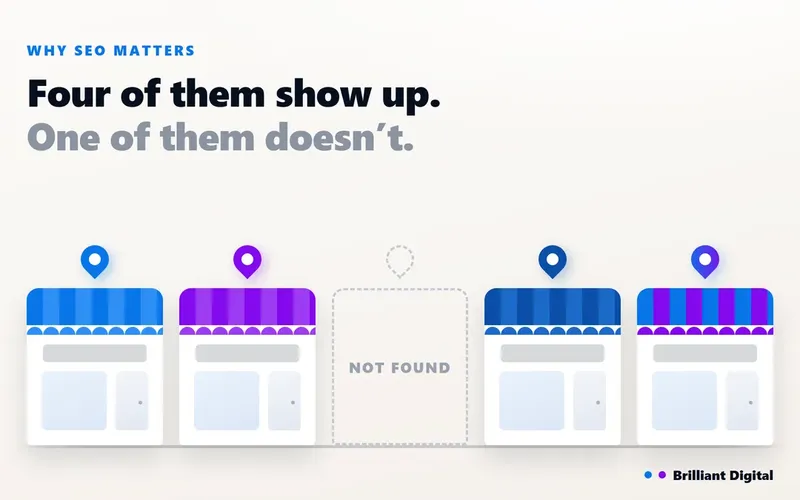
Your new website goes live. You post it once on Facebook. Then nothing happens.
That is how most launches go, and it is rarely because the website is bad. It is because nobody decided who was doing what, in what order, once the build was finished.
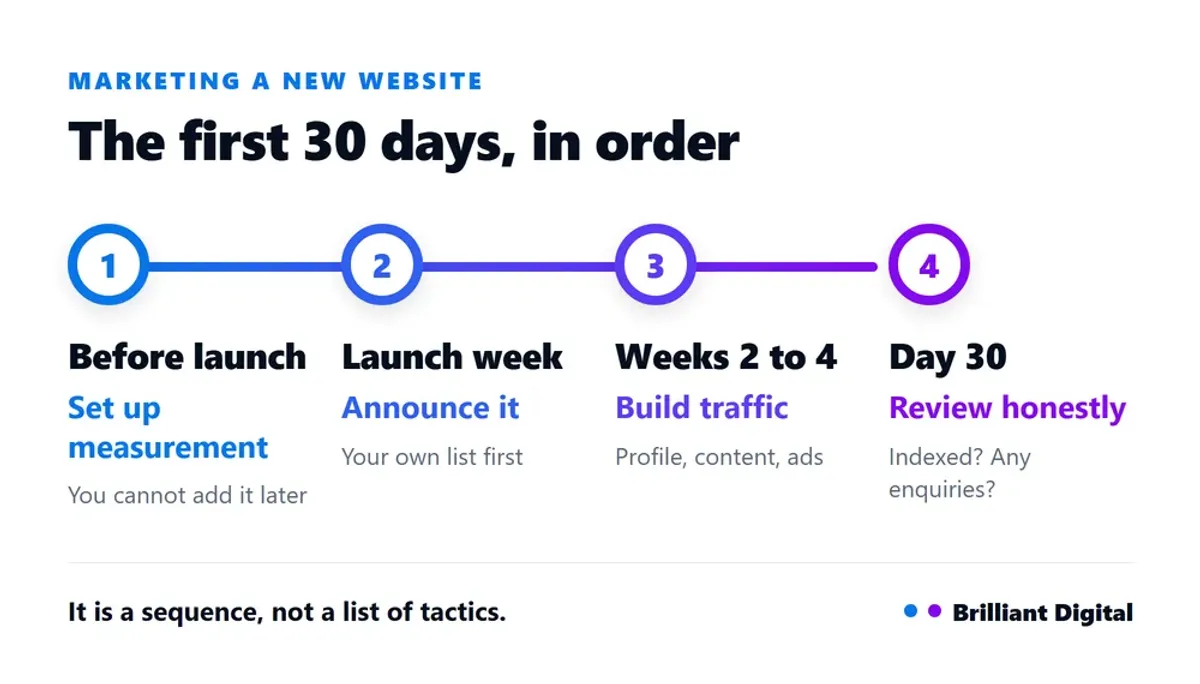
A marketing strategy for a new website is a sequence, not a list of tactics. Get your measurement in place before you launch. Announce properly in launch week. Then spend weeks two to four building traffic that keeps arriving. Do those three things in that order and the site has a fair chance. Skip the first one and you will never know which of the others worked.
We have built more than 150 websites since 2014. The difference between a launch that produces enquiries and one that goes quiet almost never comes down to the design. It comes down to what happens in the 30 days either side of go-live.
Here is that sequence, in order, with the jobs that actually matter at each stage.
Key Takeaways
- Marketing a new website is a sequence, not a list of tactics. Before launch, launch week, weeks 2 to 4, then a 30-day review.
- Set up analytics and Google Search Console before you go live. Month one is unmeasurable if you add tracking afterwards, and you cannot go back and fix it.
- The announcement is the step almost everyone skips. Email your existing list first, because it is the only audience you already own.
- Google will not send you traffic in week one. "It can take a few weeks for Google to notice a new site" (Google Search Central, 2026).
- Paid ads are the bridge. SEO does not deliver in month one. Ads do, and they tell you which messages work while the organic side builds.
Why your new website needs a marketing strategy from day one
A new site has nothing to trade on. It starts with no history, no rankings and no audience. In month one, the only traffic it gets is traffic you send it. That is the whole reason order matters: the work that generates visitors has to be planned before launch, not improvised after it.
Launch day is not the finish line. Most business owners assume it is. It is closer to the starting gun. The site is the tool, and a tool that nobody has been told about does nothing.
Measurement cannot be backfilled. That is the other reason to sequence it. If analytics goes on in week three, you have permanently lost the data for weeks one and two. You will never be able to answer the only question that matters at the end of the month, which is what actually brought people in.
Momentum is short. There is a real cost to drifting. The interest around a launch is genuine but it does not last. You have a few weeks where "we have just launched our new website" is a reason to contact people, appear in someone's inbox, or ask for a share. Six weeks later it is old news and you have spent the goodwill without using it.
Handover is where launches fall over. The agency's job ends and yours begins. We handle the technical side of a launch for our clients, but nobody outside your business can email your customers or ask your suppliers to share the news. Agree who owns each job before go-live and the handover stops being a cliff edge.
Before you launch: five things to sort while the site is still in build
Five marketing jobs need doing before go-live, not after. Analytics and Search Console. A redirect plan. Your Google Business Profile URL. A written definition of what counts as a conversion. A drafted announcement. All five are cheap to do early and expensive or impossible to fix later.
1. Get analytics and Search Console live on day one.
Whatever you use, it needs to be recording from the first visitor. We install Plausible on client sites because it is privacy-focused, GDPR-compliant and simple enough that owners actually look at it. Google Analytics is free and more powerful, and also far more work to read.
Alongside it, verify the site in Google Search Console. It is free. It is the only place you see the searches your site appears for, and the only tool that tells you whether Google has indexed you at all.
2. Know where your old URLs are going.
If you already had a website, every page that changes address needs to point at its replacement. Get this wrong and you lose rankings you have already earned, which is the single most expensive mistake at launch. Google's own guidance is to use permanent redirects when URLs change and to keep the old and new content matched page for page (Google Search Central).
This is a technical job, and it is one your web designer should be handling. Your job is to ask the question before launch day rather than after it. The checks themselves are a separate list, and we have written that up in full: the technical launch checklist.
3. Update your Google Business Profile to the new URL.
Quietly forgotten on most launches. If your profile still points at an old address, every click from local search lands somewhere wrong. It takes two minutes and it protects the traffic source that matters most to local businesses.
4. Decide what counts as a conversion.
Write it down. Is it a contact form submission, a phone call, a booking, a newsletter signup? Without that decision, you have no way of judging month one beyond "it feels quiet". With it, you have a number to compare everything against.
Pick one primary action and no more than two secondary ones. A plumber might count phone calls as primary and form submissions as secondary. A shop might count online orders as primary and newsletter signups as secondary.
The point is not precision. It is agreeing the target before the results come in, because once they do it is very easy to move the goalposts.
5. Write the announcement before launch day.
Launch day is busy, and the announcement is the thing that gets pushed to "later" and then never happens. Draft the email and the social posts while the site is still in build, when you have time to think about what you are actually saying.
Launch week: how to announce a new website
Announce a new website by telling the people who already know you, in this order. Email your existing list. Post on your social channels with a reason to care. Contact customers and suppliers directly. Then update every profile that carries your web address. The whole sequence takes an afternoon and it is the highest-return week you will have.
Email your existing list first. It is the only audience you own outright, and it is the one that converts. Keep it short. What changed, why it is better for them, and one link. If you have never emailed your list, a website launch is a genuinely good reason to start.
Three paragraphs is plenty. Open with what is new, spend the middle on the one thing that makes their life easier, and finish with a single clear link. Resist the urge to link to six pages. One destination, one decision.
Then post it properly. "Check out our new website!" gets ignored, because it asks the reader to care about your project rather than their problem. What works is posting the thing the website now does for them:
- The problem it solves, with the page that solves it
- A before and after, if the old site was genuinely dated
- One specific improvement: online booking, clearer pricing, a proper mobile experience
- A short behind-the-scenes post about why you rebuilt it
Space the posts out. One on launch day, one two or three days later, one the following week. Most of your audience will not be looking on the day you press publish, and a launch is one of the few times repeating yourself is justified.
Tell customers and suppliers directly. A one-line message to twenty people who already trust you beats a post that reaches two hundred who do not. Suppliers and local partners are worth a mention too, since a fair number of them keep a links page and will happily add you.
Update every profile that carries your URL. Social bios, Google Business Profile, online listings, your email signature, invoices, quotes, and anywhere your address is printed. This is dull and it takes an hour, and skipping it means part of your audience keeps landing on an old page.
One thing worth saying plainly: do not wait until everything is perfect. There will be a page you want to rewrite and a photo you want to replace. Announce anyway. A site nobody knows about is worth less than a site with a paragraph you are not thrilled with.

Launching soon and the marketing side is still a blank page? That is usually the part we end up helping with. Tell us what you are launching and we will give you an honest view of what we would do first.
Weeks 2 to 4: the marketing that actually brings people in
Once the announcement is done, five activities do the real work in weeks two to four. Your Google Business Profile. Local listings. Publishing content. Paid ads. And capturing the visitors you have paid to attract. Not all five are equal. If you only have time for two, do the Google Business Profile work and the paid ads.
Google Business Profile posts and reviews
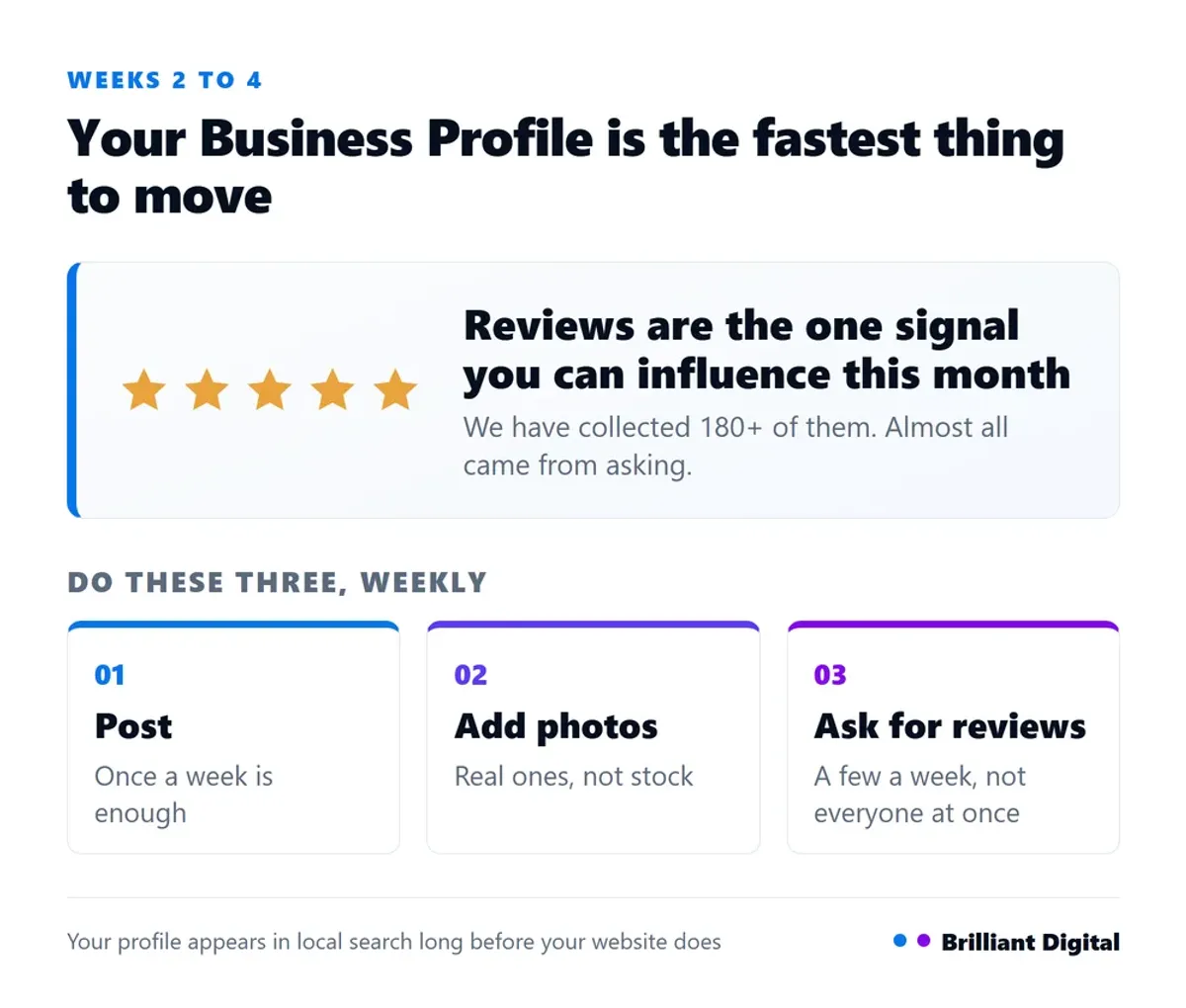
For a local business, this is the single most valuable thing you can do in month one. Your profile appears in local search and Maps long before your website does, and it costs nothing.
Post to it weekly. Add photos. Most importantly, ask recent customers for reviews, because reviews are the one signal you can genuinely influence in your first month. We have collected more than 180 five-star reviews ourselves, and almost all of them came from asking.
Ask in person or by message while the work is still fresh. Send the review link directly rather than explaining where to find it. Ask a few people a week instead of everyone at once. There is more detail in our guide to getting the most from your Google Business Profile.
Local listings and citations
Getting your business listed consistently across the places people look is worth doing once, properly. Name, address, phone number and web address need to match everywhere.
Be realistic about the return. This is housekeeping that supports local search, not a traffic strategy. An hour spent on the listings that matter in your area beats submitting to a hundred directories nobody visits. Our guide to promoting a small business locally covers where that hour is best spent.
Start publishing
Content is the long game and it should start now, even though it pays out later. One useful article a month, answering a question customers actually ask you, gives Google something to rank and gives you something to send people.
Do not expect it to move anything in month one. Expect the first meaningful organic movement somewhere between three and six months, and treat anything earlier as a bonus. We have written about why blogging works for small businesses if you want the longer case.
Paid ads for traffic now
Here is the honest position: SEO will not deliver in month one, and paid ads will. If you need enquiries while the organic side builds, Google Ads is the bridge.
It does two jobs. It puts you in front of people already searching for what you sell, and it tells you within a fortnight which messages and which services people respond to. That information then shapes everything else you write. Start small, target the searches closest to buying, and judge it on enquiries rather than clicks.
Be honest with yourself about the numbers before you start. If a campaign costs £400 a month and one new customer is worth £1,200 to you, it only needs to work occasionally. If a customer is worth £60, the maths is much harder and the money is probably better spent elsewhere.
Capture the visitors you paid for
If someone lands on your site, does not enquire, and leaves with no way for you to contact them again, that visit is spent. A newsletter signup, a downloadable guide, or a well-built landing page turns a percentage of that traffic into something you can follow up.
This matters most if you are running ads. Paying for traffic and capturing none of it is the most expensive habit in small business marketing.
What to check after 30 days
At day 30, check five things. Is the site indexed by Google? Do you appear when someone searches your business name? Are impressions showing in Search Console? How many enquiries have you received, and where did they come from? That is the whole review. It takes twenty minutes.
Is it indexed? Type site:yourdomain.co.uk into Google, using your own address. If pages come back, you are in the index. If nothing does, that is the problem to fix before anything else, and our guide on why a website is not showing up on Google walks through the causes.
Do you rank for your own name? You should, within a few weeks. If you do not, something is wrong.
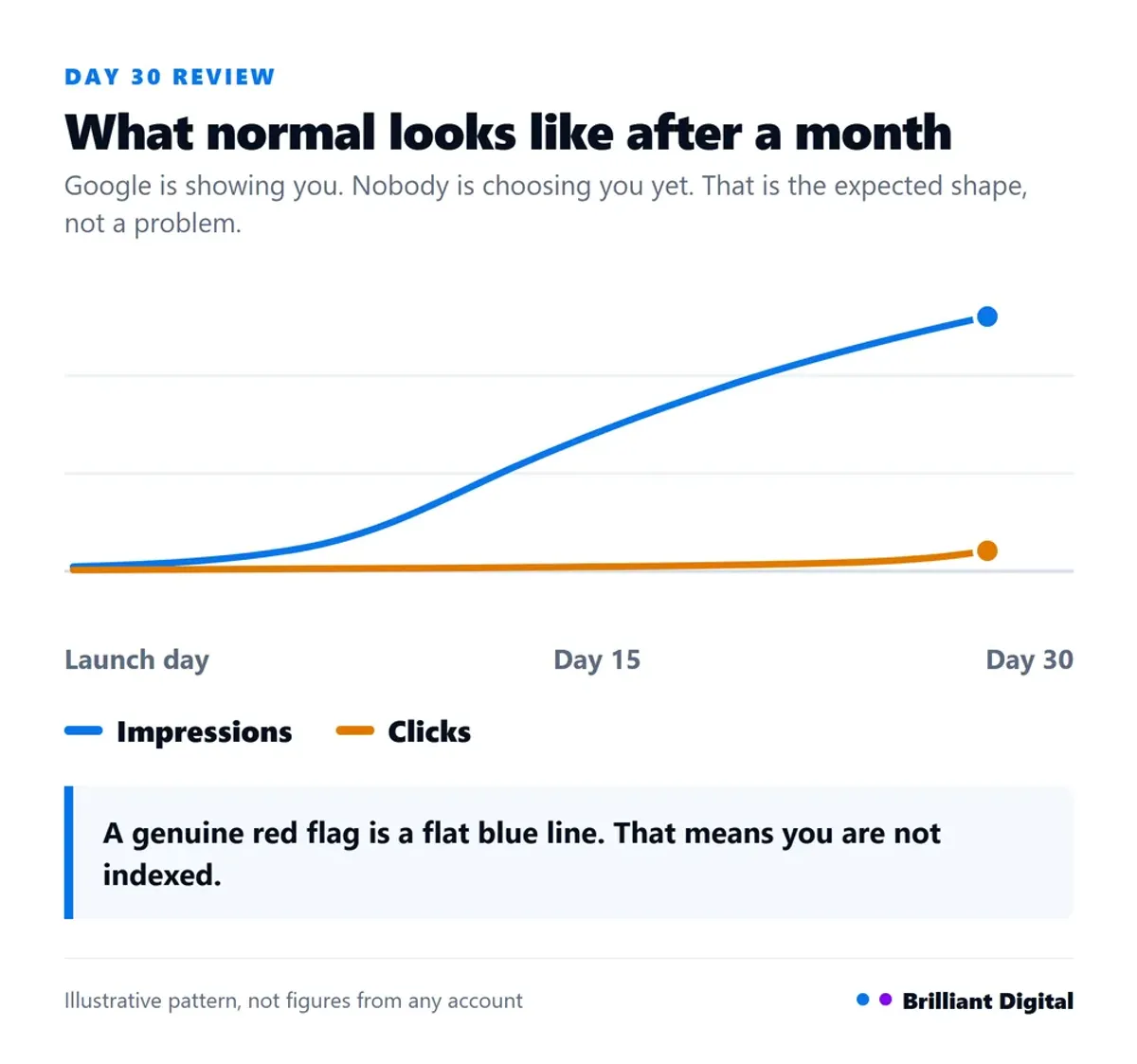
What does Search Console show? Impressions before clicks is normal and healthy at this stage. It means Google is showing you and nobody is choosing you yet.
How many enquiries? Against the definition you wrote before launch.
What is normal at day 30: indexed, ranking for your business name, a handful of impressions on real search terms, and any enquiries coming from ads, email or direct contact rather than organic search. What is a genuine red flag: not indexed at all, no analytics data, or nobody in your existing audience knowing the site exists.
The mistakes that waste a launch
Four mistakes account for most quiet launches. Announcing once and then stopping. Expecting organic traffic immediately. Launching with no tracking in place. Rebuilding the site three months later instead of marketing the one you already have. None of them are about design, and all four are avoidable in an afternoon.
Announcing once and stopping. One post is not an announcement, it is a notification that reached whoever happened to be scrolling. Spread it across a fortnight, in different formats, on different channels.
Expecting Google traffic immediately. Google is explicit that "it can take a few weeks for Google to notice a new site, or any changes in your existing site" (Google Search Central, 2026). Noticing is not the same as ranking. Plan for months, not days.
No tracking, so no idea what worked. Without analytics you are guessing. After a quiet month the guess is usually "the website does not work", when the truth is "nobody was told about it".
Rebuilding instead of marketing. This is the expensive one. Three months in, with the site quiet, the instinct is to redesign. In most cases the site was never the problem, and the second build goes just as quiet as the first because the same 30 days get skipped again.
If you take one thing from this article, take that. Before you spend money on another website, spend a fortnight properly marketing the one you already have. It costs almost nothing and it answers the question a rebuild only postpones.
Frequently Asked Questions
How do you announce a new website launch?
Email your existing customer list first, then post on your social channels explaining what the site now does for them rather than that it exists. Contact key customers and suppliers directly, and update every profile, listing and email signature that carries your web address.
How do I launch a new website?
Set up analytics and Google Search Console before go-live, map any old URLs to their replacements, update your Google Business Profile, and decide what counts as a conversion. Then go live, announce it in the same week, and review performance at day 30.
How do you promote the launch of a new website?
Start with the audience you already have: email, social, and direct contact with customers. Then build ongoing traffic through your Google Business Profile, consistent content, and paid ads if you need enquiries quickly. Capture email addresses from the visitors who do not enquire.
How long does it take to launch a new website?
A small business website typically takes four to eight weeks to design and build, depending on how much content is needed and how quickly feedback comes back. The marketing preparation should run alongside that build rather than starting after it, so analytics, redirects and the announcement are ready on day one.
How long before a new website shows up on Google?
Google states it "can take a few weeks" to notice a new site (Google Search Central, 2026). In practice, expect to be indexed within a few days to a few weeks, ranking for your business name within a month, and competing for commercial search terms after three to six months.
What to do next
If you are launching soon, the highest-value thing you can do this week is the pre-launch list: analytics on, Search Console verified, redirects agreed with whoever built the site, and the announcement written. Everything after that is easier if those four are done.
Already launched and it has gone quiet. Do not rebuild. Work out whether the site is indexed, whether anyone was told about it, and whether anything is being measured. That usually explains it.
You need enquiries now, not in six months. That is what paid search is for. We manage Google Ads for small businesses across the UK, and we are happy to say plainly when it is not the right spend. Tell us about your business and what you are hoping the website will do, and we will come back to you honestly. There are more ideas in our list of 15 small business marketing ideas if you want somewhere else to start.