You went to the breakfast meeting. You handed out cards, you had three decent conversations, and someone said they knew a person who needed exactly what you do.
Then nothing happened.
That gap, between a good conversation and an actual customer, is where most small business networking quietly falls apart. The benefits of business networking are real and well documented. What almost nobody talks about is the step that sits between the handshake and the enquiry.
Business networking is the practice of building working relationships with other business owners and professionals, so that opportunities, referrals and advice flow between you over time. It is not computer networking, and it is not network marketing. It is people who know what you do recommending you to people who need it.
Here is what it genuinely gets you, and the one thing you need to have in place before any of it pays off.
Key Takeaways
- Referrals are the main return. Every major guide on this topic puts referrals and new business first, and so does Google's own summary of the topic.
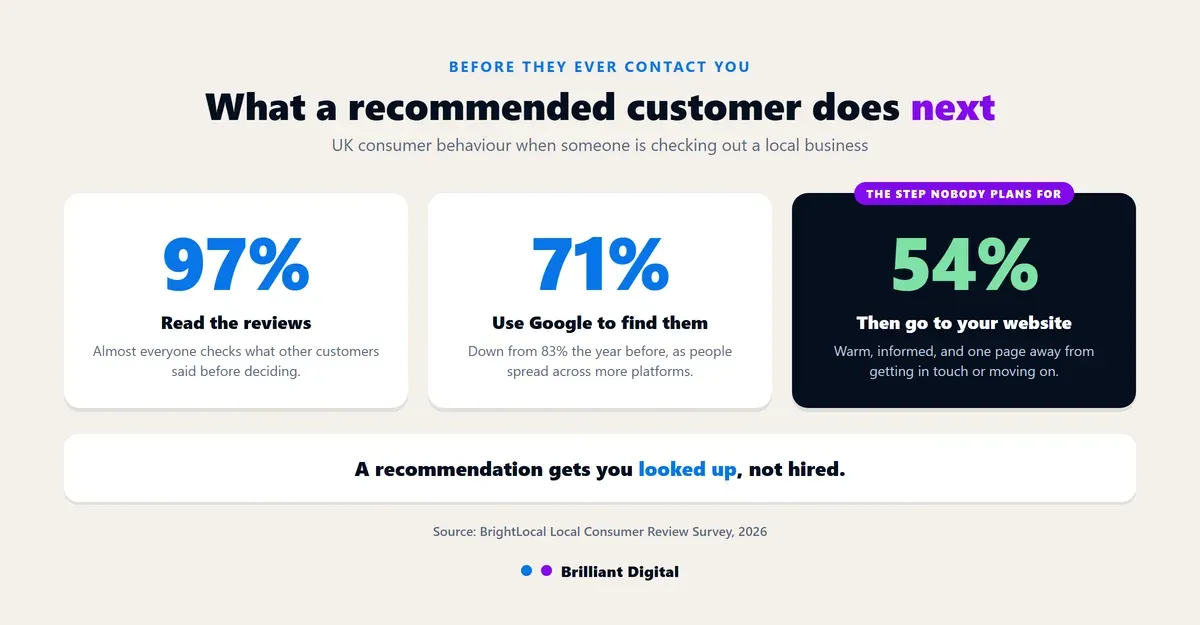
- The referral checks you online before they contact you. 97% of consumers read reviews for local businesses, and 54% then go on to check the business's website (BrightLocal, 2026). A recommendation gets you looked up, not hired.
- Your website is the conversion point. The person arriving from a referral is warm, informed, and about to decide. What they find decides whether you get the enquiry.
- The real cost is time, not membership fees. Most networking groups cost less than the hours you will put into them.
- It is not for every business. If your customers are not local and your average sale is small, your time is usually better spent elsewhere.
1. Referrals and new business
Referrals are the single biggest return from business networking. A recommendation from someone who has met you carries trust that no advert can buy, and referred prospects tend to arrive further along in their decision, already partly convinced and less likely to be shopping around on price.
This is why most owners join a network in the first place, and it is the benefit that keeps them there. More than half of our own clients arrive this way, which is why referrals sit near the top of every honest list of ways to promote a small business locally.
The mechanism is simple. You spend enough time around a group of business owners that they understand what you do and who you do it for. When someone in their world describes a problem you solve, your name comes up. You are not selling. Somebody else is vouching for you.
The quality difference matters more than the volume. Ten referrals from people who genuinely understand your business will beat a hundred cold enquiries, because the trust has already been transferred before the first conversation.
2. Opportunities beyond direct sales
Networking produces opportunities that are not customers: joint ventures, supplier relationships, subcontracting, referral partnerships with businesses that serve the same clients you do. These often turn out to be worth more than any single sale, because one good partnership can send work your way for years.
The useful pattern is finding businesses that sit next to yours rather than against you.
An accountant and a solicitor. A builder and an architect. A web designer and a copywriter. None of you compete, all of you talk to the same customers at different points, and each of you can pass work in both directions.
The caution: be selective. Not every opportunity is worth pursuing, and saying yes to everything is how people lose a year to projects that went nowhere.
3. Advice you cannot easily buy
Networking gives you access to business owners who have already solved the problem you are currently stuck on. That is genuinely difficult to buy. Consultants charge for it, and business books generalise it. A person in your local group who dealt with the same issue eighteen months ago will just tell you what happened.
Business networks are also a recognised source of formal business advice. Among UK SME employers that sought external information or advice, 22% used business networks or trade associations, up three percentage points on the previous year (UK Government Longitudinal Small Business Survey, 2024).
Worth reading that figure properly. It is 22% of the businesses that went looking for advice, not 22% of all small businesses. Networks are a common source of advice for owners who actively seek it, which is a smaller and more deliberate group than the raw number suggests.
4. Visibility and credibility
Turning up consistently makes you the person people think of first. Visibility in a business network compounds: the tenth time someone sees you is worth far more than the first, because familiarity is what turns a name into a recommendation.
Credibility follows the same pattern, and it is built by being useful rather than by pitching.
The owners who get the most out of networking are usually the ones answering other people's questions, making introductions that benefit somebody else, and generally being helpful without keeping score. That reputation is what people are really passing on when they refer you.
5. Confidence and getting better at explaining what you do
Regular networking forces you to explain your business clearly, out loud, to people who have no context. Most owners are surprisingly bad at this at first. Doing it weekly fixes it faster than any amount of rewriting your website copy at midnight.
The knock-on effect is the valuable part. Once you can explain what you do in a sentence that makes sense to a stranger, your sales conversations improve, your marketing gets sharper, and your website copy gets easier to write.
6. Early sight of what is changing
Business owners talk to each other about what is actually happening before it reaches the trade press: which suppliers have become unreliable, which regulations are starting to bite, what customers have started asking for. A short conversation often gives you a clearer read on your sector than a stack of reports.
This is particularly useful in trades and services, where the shifts are local and never get written up anywhere.
7. Finding people to work with
Networks are a reliable route to contractors, freelancers and staff who come with a personal recommendation attached. For a small business making its first hire, that matters. A recommendation from someone whose judgement you already trust removes a lot of the risk from a decision you cannot easily undo.
The same applies to the suppliers and subcontractors you rely on. Most small businesses find their best ones through someone they know, not through a search.
Networking will get you recommended. Your website decides what happens next. If you are not sure what a referral finds when they look you up, tell us about your business and we will give you an honest view.
The referral looked you up. What did they find?
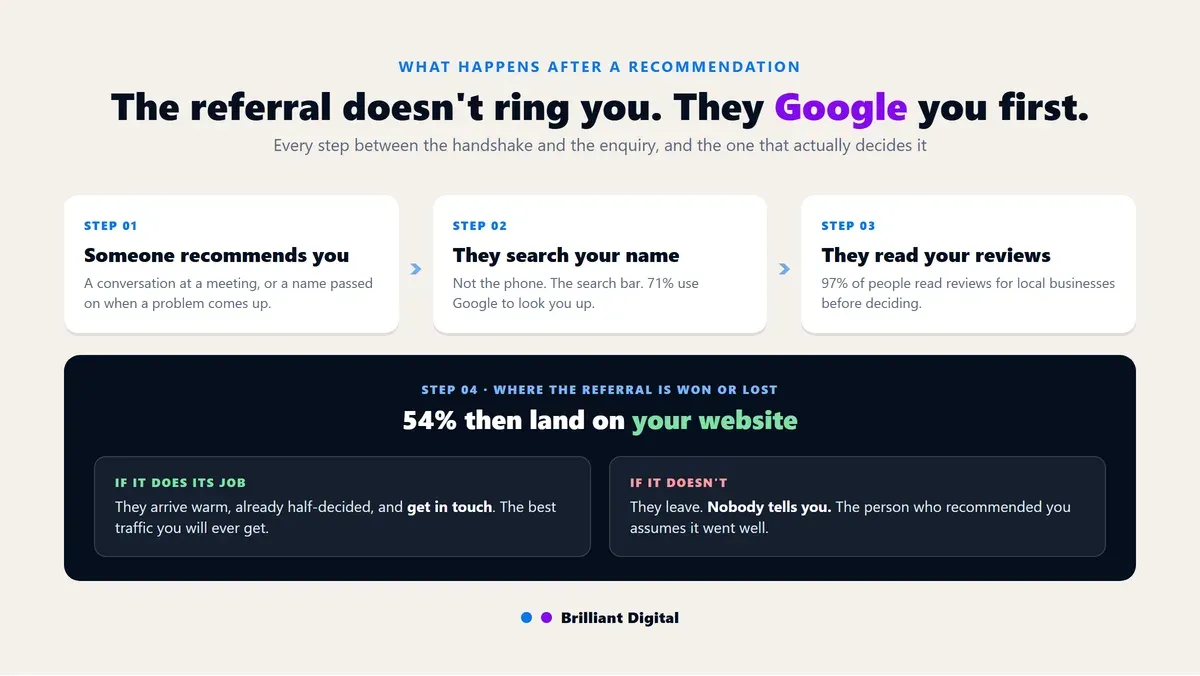
Here is the step almost every article on this topic skips. When somebody recommends you, the person receiving that recommendation does not usually pick up the phone. They search for your business first. That search, not the conversation at the event, is where the referral is won or lost.
The data on this is clear. 97% of consumers read reviews for local businesses, and 54% of those who read positive reviews then go on to check the business's website (BrightLocal Local Consumer Review Survey, 2026). Google remains the main place they look, used by 71% of consumers to find reviews, though that is down from 83% the year before as people spread across more platforms.
So the chain runs like this. Someone recommends you. The prospect searches your business name. They read a few reviews. Then they land on your website, already warm, already half-decided, and looking for a reason to either get in touch or move on.
That visitor is the most valuable traffic you will ever get. They arrived pre-sold by a person they trust. And they are met by whatever your website happens to be.
If that website is slow, out of date, really just a Facebook page, unclear about what you do, or missing the proof that backs up what your contact just told them, the referral quietly dies there. Nobody tells you it happened. The person who recommended you assumes it went well. You conclude that networking does not work for your business.
What that visitor needs to find is narrow and specific:
- Immediate confirmation they are in the right place. What you do and who you do it for, visible without scrolling.
- Proof that matches the recommendation. Real reviews, real work, real names. This is where testimonials and reviews do the heavy lifting.
- A straightforward way to get in touch. Not a maze. One obvious next step.
- A site that loads quickly on a phone. They are probably checking you between other things.
None of this is exotic. It is just the difference between a website that converts and a website that exists. Networking is one of several channels that all end at the same place: somebody arrives at your website and decides. The same is true of local search, SEO, and most of the other marketing you might be doing.
Networking without a website that can close is like buying tickets to a match you have no intention of attending.
What business networking actually costs
The membership fee is the smallest part of the cost. UK networking generally falls into three tiers: free or low-cost local meetups, membership organisations with an annual subscription, and structured referral groups with a joining fee, an annual membership and a weekly or fortnightly meeting charge on top.
Prices vary by group and by region, so check directly with whichever you are considering rather than trusting a figure in an article.
The cost that actually decides whether networking works for you is time. A structured weekly group typically means:
- A meeting of 60 to 90 minutes, often early morning
- Travel either side of it
- One-to-one coffees with other members between meetings
- Following up on the referrals you receive, and finding referrals to give
Add that up honestly. It is frequently half a day a week once travel and follow-up are counted, every week, for at least six months before the relationships mature enough to produce much.
That is the real price. If half a day a week is worth more to your business spent elsewhere, no membership fee makes networking a bargain.

When networking is a waste of your time
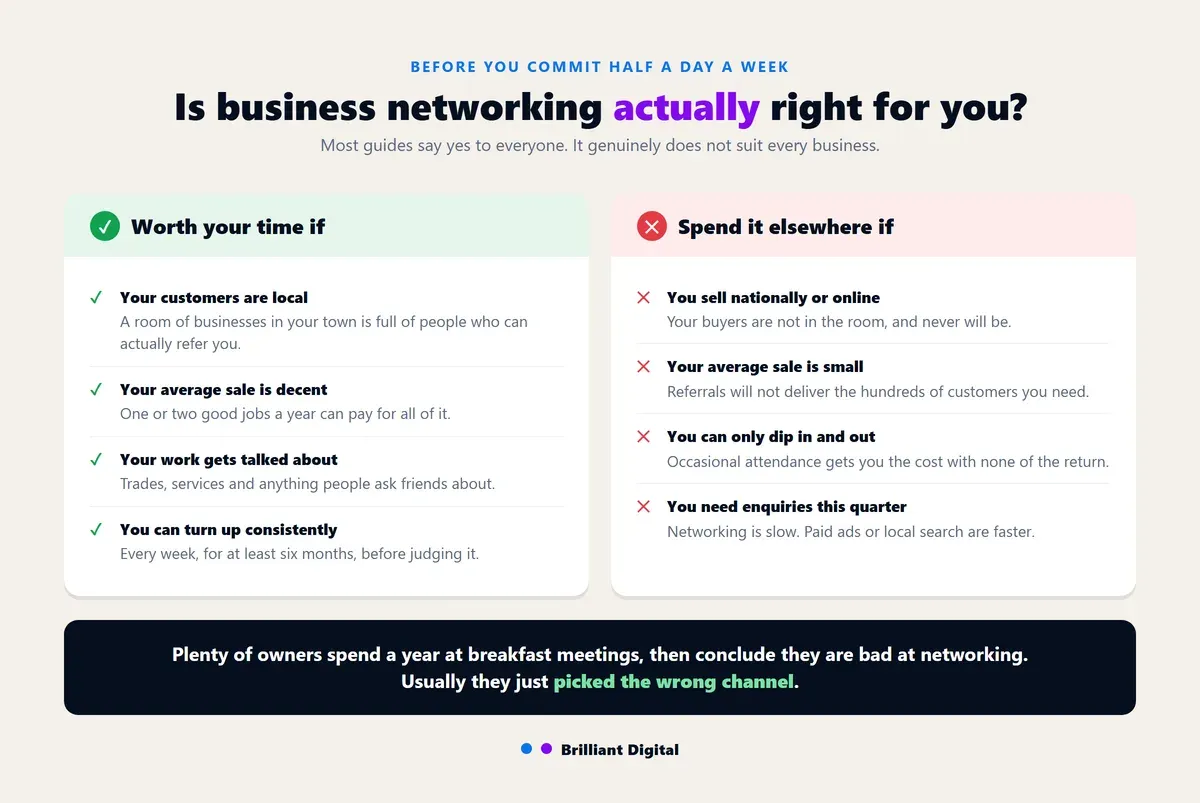
Business networking is not right for every business, and the guides that present it as universally worthwhile are not being straight with you. It works best when your customers are local, your average sale is large enough to justify the time, and your work is the sort people naturally recommend.
It tends not to work when:
- Your customers are not local. A room of businesses in your town is not useful if you sell nationally or online to a niche audience.
- Your average sale is small. If you need hundreds of customers a month, referrals will not move the needle fast enough to justify half a day a week.
- You cannot commit consistently. Turning up occasionally is worse than not going. Networking pays out on consistency, and dipping in and out gets you the cost with none of the return.
- You need results this quarter. Networking is slow. If you need enquiries next month, paid advertising or local search will get you there faster.
Being honest about this matters, because plenty of owners spend a year at breakfast meetings that were never going to suit their business, and conclude they are bad at networking. Usually they just picked the wrong channel.
Frequently Asked Questions
What are the main benefits of business networking?
The main benefits are referrals and new business, partnership opportunities, access to practical advice from other owners, greater visibility and credibility in your area, better confidence explaining what you do, early sight of industry changes, and personal recommendations for staff and suppliers.
Is business networking worth it for a small business?
It depends on your business. Networking works well if your customers are local, your average sale is reasonably large, and you can commit consistently for at least six months. It works poorly for national, online-only or very low-value transactional businesses.
How long does business networking take to produce results?
Usually six months or more. Referrals depend on other members genuinely understanding what you do and trusting you enough to put their own reputation behind a recommendation, and that takes repeated contact. Expect very little in the first three months.
What is the difference between business networking and network marketing?
They are unrelated. Business networking is building professional relationships so that referrals and opportunities flow between independent businesses. Network marketing, sometimes called MLM, is a sales model where individuals recruit others into a distribution structure and earn from their sales.
Do I need a website to benefit from networking?
Effectively, yes. 54% of consumers check a business's website after reading positive reviews (BrightLocal, 2026), so most referrals will look you up before contacting you. Without a website that answers their questions, you lose introductions you never find out about.
Where to go from here
If you already network and the referrals are not converting, the problem is rarely the networking. It is usually what happens in the ninety seconds after someone searches your business name.
We have built over 150 websites since 2014, and the ones that work hardest are almost always the ones built around a specific visitor arriving with a specific question. A referral checking you out is exactly that visitor.
If you want an honest view of what yours is doing with the traffic your networking sends it, get in touch. No lengthy proposal, no hard sell, just a straight opinion on whether it is doing its job.