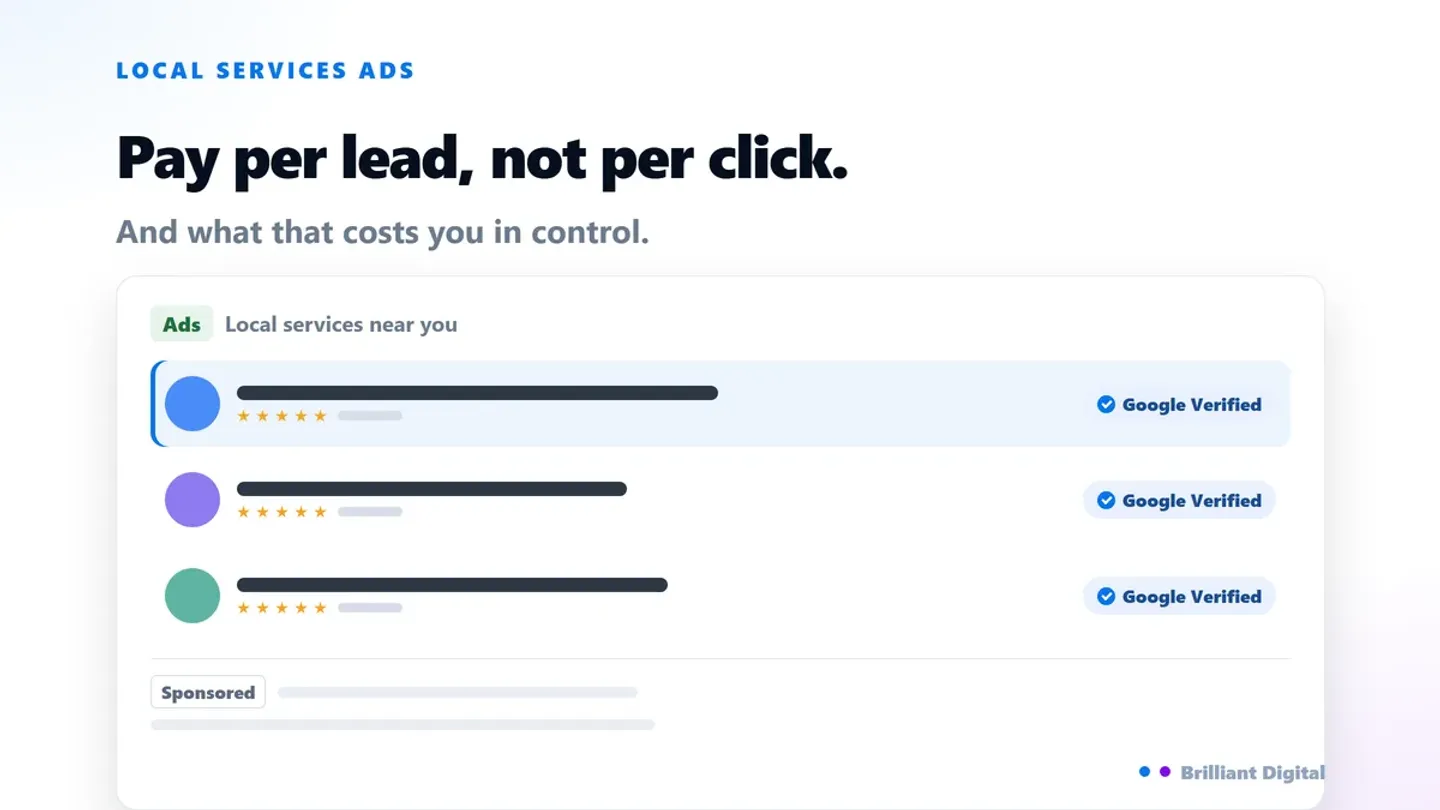
Local Services Ads are Google's pay-per-lead ads for local service businesses. They sit at the very top of the search results, above the normal Google Ads, and you pay when someone contacts you rather than when someone clicks.
That is the short version. The longer version matters more right now, because the product is in the middle of the biggest change since it launched: Google is folding Local Services Ads into Google Ads. For UK businesses that happens in 2027.
So if you are weighing this up, you are really answering two questions. Is it worth running, and does it still make sense to treat it as a separate thing from your Google Ads?
This article covers both, including the cases where the honest answer is that Local Services Ads are not for you.
Key Takeaways
- You pay per lead, not per click. A lead is a phone call or a message, not a website visit.
- They appear above standard Google Ads, with a verification badge on your profile.
- In the UK the badge is Google Verified, not the American "Google Guaranteed".
- They are moving into Google Ads. Migration started in the US in August 2026. Non-US accounts, including the UK, transition in 2027.
- You control far less than you do in a normal Google Ads campaign. For most local businesses they work alongside Google Ads, not instead of it.
What Are Local Services Ads?
Local Services Ads are a Google advertising product built specifically for local service businesses. Your profile appears at the top of Google Search and Google Maps when someone nearby searches for what you do, and Google charges you when that person calls you or sends you a message.
There are no keywords. You choose your service categories and the areas you cover, and Google matches you to searches from there.
Whether you can use them depends on your trade and your area, and Google keeps the current list and an eligibility check on its own UK Local Services Ads page. That is worth two minutes before you read any further, because the list changes and any list published in an article is out of date the moment a category moves.
A note on the name. In the UK the badge on your profile is Google Verified. "Google Guaranteed" is the American version, and the difference is not cosmetic: the American badge carries a money-back guarantee to the customer, funded by Google, and the UK badge does not. A lot of UK pages still use the American name out of habit. Worth knowing, so you are not expecting a guarantee you cannot offer.
Google also notes that the Verified badge is currently unavailable in the automotive, beauty and dining categories.

How Are They Different From Google Ads?
The difference is billing and control. Google Ads charges per click and gives you keywords, negative keywords, match types, schedules, devices and landing pages to work with. Local Services Ads charge per lead and give you a category, an area and a budget.
That is close to the entire lever set.
- Billing: pay per lead versus pay per click.
- Position: the Local Services unit sits above standard search ads.
- Targeting: keywordless. You pick categories and areas, Google decides the rest.
- Where the lead lands: a separate Local Services inbox, not your website and not your normal Google Ads reporting.
- What you can fix: far less, because there is far less to configure.
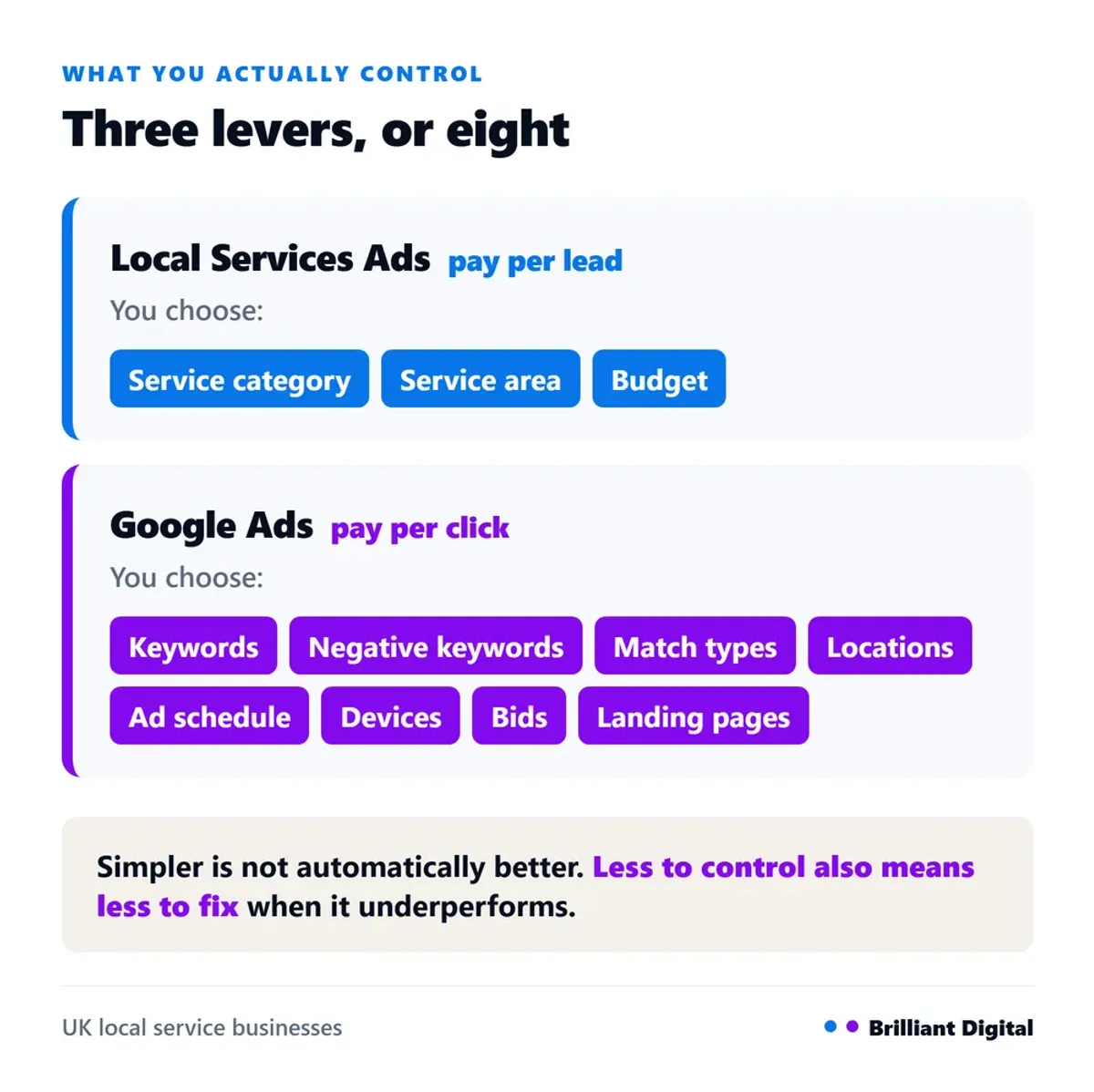
Here is the part most guides skip. Simplicity sounds like a benefit, and often it is. But less to control also means less to fix when it underperforms. If a Google Ads campaign is bringing the wrong enquiries, you can look at the search terms and add negatives. If Local Services Ads bring the wrong enquiries, your options are narrower: adjust your categories, adjust your area, or turn it off.
Local Services Ads Are Moving Into Google Ads
In August 2026 Google began moving Local Services Ads into Google Ads, where they become a Performance Max campaign with a pay-per-lead goal. The pay-per-lead model stays. The separate dashboard does not.
The rollout is phased, and the timing is the part UK businesses need:
- August 2026: the first phase, covering selected home and shop-front service advertisers in the United States.
- Late 2026: broader groups, including service-area businesses without a shop front.
- 2027: non-US accounts, which includes the UK, along with the remaining categories.
So if you are reading American coverage saying this is happening now, it is not happening to you yet. Google's own transition documentation sets out the schedule.
What Google says stays the same: the pay-per-lead billing, the ad positions on Search and Maps, and the keywordless targeting. What changes is where you manage it, how you bid, and what happens to your history.
Three of those changes are worth knowing well before your turn comes.
Your performance reports do not come with you. Google states plainly that Local Services Ads performance reports will not transition to Google Ads. If you want your history, download or screenshot it before your migration date. Once the dashboard redirects, it is gone.
Manual bidding goes away. Setting a maximum cost per lead is no longer supported, and vertical-level target CPA is deprecated. If you run several trades under one campaign, they will be unified under a single target unless you split them into separate campaigns.
Your weekly budget becomes a daily one. Google divides your historical weekly average by seven. Monthly spend is capped at that daily figure multiplied by 30.4, so the total should not change, but daily spend will move around more than you are used to.
Your Google Verified badge carries over automatically, and Google says insurance and licence reverification are not required.
None of this is a reason to wait. Nothing about how Local Services Ads work for you changes before your account migrates, and when it does, Google moves your settings across for you. If it is worth running now, run it now. The migration is something to prepare for, not something to sit out.
Are Local Services Ads Worth It?
For an eligible business that can respond quickly, usually yes. It is often the most sensible first paid channel a small local business can turn on.
The case for it is genuinely good. You are not paying to be seen or paying for clicks from people who were browsing; you pay when somebody rings you or messages you. You sit above the paid results. You do not need a website to run it. And there is no campaign to manage, no keywords to research and no landing page to build, which matters when nobody in the business has time to do any of that.
They suit you if your categories and area are covered, you have reviews, and someone answers the phone promptly.
They suit you less if you need volume or control, your service area is wider than the categories allow, or you are in one of the categories where the badge is unavailable.
Two honest caveats.
It is a capped channel. It produces a modest flow of leads and then stops, because that is what the budget and the category structure are designed to do. Fine when you know it going in, disappointing if you expected something you could scale.
In the UK you have less protection against poor leads than in the US. Google screens leads at the point of contact and does not charge for ones it judges invalid. But the automatic credit system, where a charged lead gets refunded later if Google's models decide it was low quality, is only available in the United States and Canada. Google's own documentation states that lead credits are not available to advertisers in EMEA, which includes the UK. You can still submit feedback on a bad lead. You should not assume it will be credited back.
And one group should genuinely not bother: anyone who cannot answer the phone reliably. Google is explicit that if you regularly fail to answer calls or respond to messages, your ad ranking may be affected. You pay for the lead either way. Slow responses cost you twice.
If your categories are not covered, that is not a dead end. Skip to the section below on choosing between the two.
What Actually Goes Wrong
We manage Google Ads for local service businesses, and we regularly see Local Services Ads running alongside the accounts we look after. The problems are rarely the ones people expect, and they are almost never about the ads themselves.
Verification quietly throttles you. Onboarding involves uploading licence or insurance documents. If one of those checks does not pass, the account still looks live and the budget still looks set, but delivery drops to a fraction of what you asked for. There is no alarm. You simply notice, eventually, that it went quiet.
The leads land where nobody is looking. They arrive in the Local Services inbox, which is not your email, not your website enquiry form and not your Google Ads reporting. A business that checks those three places every day can still have enquiries sitting unopened for weeks. After the migration these move into Google Ads under Goals, then Conversions, then Leads, which is at least one fewer place to forget.
Reviews do more work than you think. Your profile is the ad. There is no headline to write and no landing page to improve, so reviews and response speed are most of what separates you from the business listed next to you.
None of these are difficult to fix. They are just invisible until someone looks.
Not sure whether Local Services Ads or a standard campaign suits your business? Tell us what you do and where and we will give you a straight answer.
So Which Should You Use?
For most local businesses, a standard local Google Ads campaign is the workhorse. You decide which searches you appear for, what you pay, when you show and where people land. When something is not working, there is something to change.
Local Services Ads are a narrower, capped supplement. Where they are available and the response is quick, they are a good source of cheap, high-intent enquiries with very little management.
The sensible answer for an eligible business is usually both, with Google Ads doing the heavy lifting.
If you are not eligible, nothing is lost. Local Google Ads works for any local business, in any trade, in any area. It is the broader product and always has been, which is part of why Google is bringing the two together. Our guide to how paid advertising works covers where to start, and whether Google Ads are worth it for a small business is the honest version of that question.

Frequently Asked Questions
Are Local Services Ads the same as Google Ads?
Not yet, but they are becoming the same thing. Local Services Ads are a separate pay-per-lead product with its own dashboard. Google began moving them into Google Ads in August 2026 as a Performance Max campaign with a pay-per-lead goal, reaching UK accounts in 2027.
How much do Local Services Ads cost?
You pay per lead, not per click. Google says the price of a lead varies with your location, the job type, the type of lead and your bidding mode, so a roofing enquiry in a competitive area costs more than a window clean in a quiet one. You set the budget, and every charged lead counts against it.
Are Local Services Ads free?
No. They are free to appear in the sense that you are not charged for impressions or clicks, but you pay for each valid lead. If nobody contacts you, you are not charged. If ten people call, you pay for ten leads, up to your budget.
Where do Local Services Ads appear?
They show at the top of Google Search and Google Maps, above standard search ads, for people searching in the areas you cover. Google confirms that ad placements stay exactly the same after the move into Google Ads, so the position you are paying for does not change.
What is the Google Verified badge?
It is the badge shown on your Local Services profile once your business passes Google's screening checks. In the UK it is called Google Verified. The American equivalent, Google Guaranteed, includes a customer money-back guarantee that is not part of the UK product.
How do I turn Local Services Ads off?
You can pause at any time without cancelling. In the current dashboard you pause the ad; after migration you set the campaign status to Paused in Google Ads. Pausing stops new leads immediately and you keep your profile and verification.
What to Do Next
Two quick things. Check whether your trade and area are covered using Google's eligibility checker. Then, if you are already running Local Services Ads, download your performance reports so you still have your history when the migration reaches UK accounts in 2027.
After that, the useful question is not really which product to use. It is what you want from local advertising: a steady trickle you barely touch, or a channel you can control and grow.
If it is the second, that is what we do. Tell us your trade and your patch and we will tell you honestly whether paid search is worth it for you, including when it is not.